Chapter 9
心营
Heart's Cultivation
517
of 659
English Translation
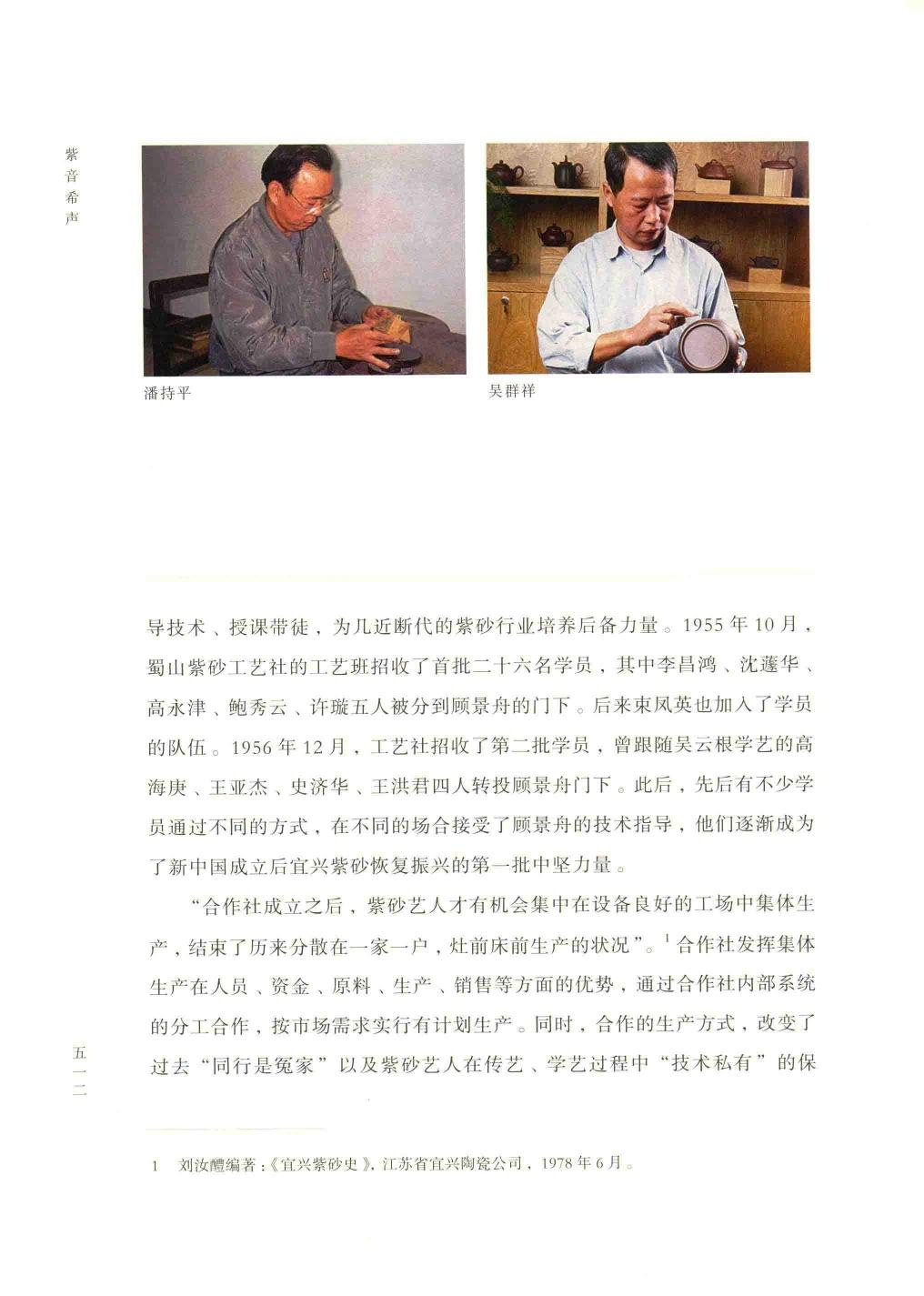
Pan Chiping
...leading technical instruction and teaching apprentices, cultivating reserve forces for the nearly discontinued purple clay industry. In October 1955, the craft class of the Mingshan Purple Clay Craft Cooperative recruited its first batch of twenty-six students. Among them, Li Changhong, Shen Yinghua, Gao Yongjin, Bao Xiuyun, and Xu Xuan were assigned to study under Gu Jingzhou—later Shu Fengying also joined the group of students. In December 1956, the cooperative recruited a second batch of students. Gao Haigeng, Wang Yajie, Shi Jihua, and Wang Hongjun, who had previously studied under Wu Yungen, transferred to study under Gu Jingzhou. Thereafter, many students successively received technical guidance from Gu Jingzhou through different means and on different occasions. They gradually became the first core force in the restoration and revitalization of Yixing purple clay pottery after the founding of New China.
"After the establishment of the cooperative, purple clay artisans finally had the opportunity to concentrate in well-equipped workshops for collective production, ending the long-standing situation of scattered production in individual households, working in front of stoves and beds."[1] The cooperative leveraged the advantages of collective production in terms of personnel, capital, raw materials, production, and sales. Through systematic division of labor and cooperation within the cooperative, they implemented planned production according to market demand. At the same time, the cooperative mode of production changed the past situation of "peers as rivals" and the "private ownership of techniques" among purple clay artisans during the process of teaching and learning crafts.
---
[1] Liu Rulin, ed., *History of Yixing Purple Clay Pottery* (Jiangsu Province Yixing Ceramics Company, June 1978).
Chapter 9
心营
Heart's Cultivation
Pages 506-525
View Chapter →
English Translation
Pan Chiping
...leading technical instruction and teaching apprentices, cultivating reserve forces for the nearly discontinued purple clay industry. In October 1955, the craft class of the Mingshan Purple Clay Craft Cooperative recruited its first batch of twenty-six students. Among them, Li Changhong, Shen Yinghua, Gao Yongjin, Bao Xiuyun, and Xu Xuan were assigned to study under Gu Jingzhou—later Shu Fengying also joined the group of students. In December 1956, the cooperative recruited a second batch of students. Gao Haigeng, Wang Yajie, Shi Jihua, and Wang Hongjun, who had previously studied under Wu Yungen, transferred to study under Gu Jingzhou. Thereafter, many students successively received technical guidance from Gu Jingzhou through different means and on different occasions. They gradually became the first core force in the restoration and revitalization of Yixing purple clay pottery after the founding of New China.
"After the establishment of the cooperative, purple clay artisans finally had the opportunity to concentrate in well-equipped workshops for collective production, ending the long-standing situation of scattered production in individual households, working in front of stoves and beds."[1] The cooperative leveraged the advantages of collective production in terms of personnel, capital, raw materials, production, and sales. Through systematic division of labor and cooperation within the cooperative, they implemented planned production according to market demand. At the same time, the cooperative mode of production changed the past situation of "peers as rivals" and the "private ownership of techniques" among purple clay artisans during the process of teaching and learning crafts.
---
[1] Liu Rulin, ed., *History of Yixing Purple Clay Pottery* (Jiangsu Province Yixing Ceramics Company, June 1978).
章节导航 Chapter Navigation
Chapter 1
序文
Pages 6-6
Chapter 2
引言
Pages 28-31
Chapter 3
达变
Pages 32-133
Chapter 3
开宗立派
Pages 46-66
Chapter 3
传道授业
Pages 67-98
Chapter 3
大师淳友
Pages 99-120
Chapter 3
学艺谋生
Pages 121-133
Chapter 4
化神
Pages 134-141
Chapter 5
独妙
Pages 142-405
Chapter 5
匠心独运 不苟丝毫
Pages 142-179
Chapter 5
器利善事 物尽其用
Pages 180-199
Chapter 5
紫泥春华 研精究微
Pages 200-405
Chapter 6
驾简
Pages 406-427
Chapter 6
精雕细刻 文质合一
Pages 406-410
Chapter 6
师法自然 妙趣横生
Pages 411-415
Chapter 6
丝来线去 曲尽其妙
Pages 416-427
Chapter 7
明志
Pages 463-485
Chapter 7
高山仰止 淡泊明志
Pages 463-472
Chapter 7
啜墨看茶 气定神闲
Pages 473-478
Chapter 7
齿少心锐 怡志抒情
Pages 479-485
Chapter 8
存真
Pages 428-462
Chapter 8
规圆矩方 弃伪存真
Pages 428-436
Chapter 8
有物有则 钻尖仰高
Pages 437-462
Chapter 9
心营
Pages 506-525
Chapter 9
坚守传统 艺立潮头
Pages 506-513
Chapter 9
新型师承 桃李满园
Pages 514-525
Chapter 10
附录
Pages 526-651
Chapter 10
顾景舟紫艺论文
Pages 526-535
Chapter 10
技术课备课笔记
Pages 536-543
Chapter 10
顾景舟艺术年表
Pages 544-651
Chapter 11
参考文献
Pages 652-657
Chapter 12
鸣谢
Pages 658-659