Chapter 10
附录
Appendix
552
of 659
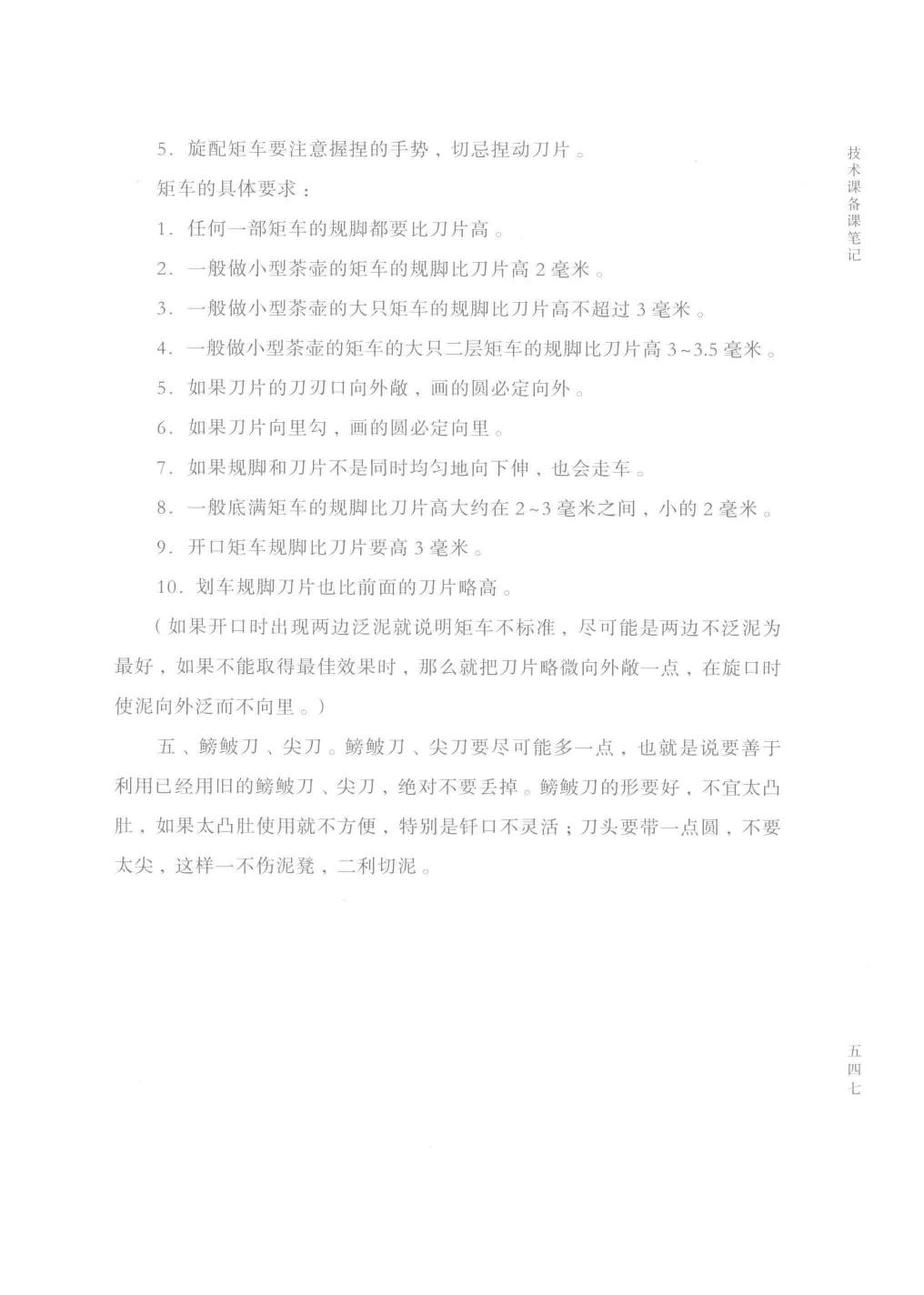
English Translation
Specific Requirements for the Compass Tool:
1. The compass foot of any compass tool must be higher than the blade.
2. For compass tools used in making small teacups, the compass foot should be 2 millimeters higher than the blade.
3. For compass tools used in making the bodies of small teapots, the compass foot should be no more than 3 millimeters higher than the blade.
4. For two-tier compass tools used in making the bodies of small teapots, the compass foot should be 3-3.5 millimeters higher than the blade.
5. If the blade's cutting edge angles outward, the circle drawn will inevitably curve outward.
6. If the blade hooks inward, the circle drawn will inevitably curve inward.
7. If the compass foot and blade do not extend downward evenly and simultaneously, the tool will veer off course.
8. For compass tools used on full bottoms, the compass foot should generally be approximately 2-3 millimeters higher than the blade, with 2 millimeters for smaller pieces.
9. For small compass tools, the compass foot should be 3 millimeters higher than the blade.
10. The blade of the trimming compass foot should also be slightly higher than the preceding blade.
> (If clay spreads on both sides when opening, this indicates the compass tool is not properly calibrated. Ideally, clay should not spread on either side. If optimal results cannot be achieved, then angle the blade slightly outward so that when turning the rim, the clay spreads outward rather than inward.)
## 5. Tools
Wire tools, pointed knives, loach knives—have as many pointed knives as possible. This means making good use of wire tools and pointed knives that have already been used, and absolutely never discarding them. The loach knife should have a good shape and should not be too convex in the belly; if too convex, it becomes inconvenient to use, particularly making rim work inflexible. The knife head should be slightly rounded, not too pointed—this way it won't damage the clay surface and will cut the clay more effectively.
Chapter 10
附录
Appendix
Pages 526-651
View Chapter →
English Translation
Specific Requirements for the Compass Tool:
1. The compass foot of any compass tool must be higher than the blade.
2. For compass tools used in making small teacups, the compass foot should be 2 millimeters higher than the blade.
3. For compass tools used in making the bodies of small teapots, the compass foot should be no more than 3 millimeters higher than the blade.
4. For two-tier compass tools used in making the bodies of small teapots, the compass foot should be 3-3.5 millimeters higher than the blade.
5. If the blade's cutting edge angles outward, the circle drawn will inevitably curve outward.
6. If the blade hooks inward, the circle drawn will inevitably curve inward.
7. If the compass foot and blade do not extend downward evenly and simultaneously, the tool will veer off course.
8. For compass tools used on full bottoms, the compass foot should generally be approximately 2-3 millimeters higher than the blade, with 2 millimeters for smaller pieces.
9. For small compass tools, the compass foot should be 3 millimeters higher than the blade.
10. The blade of the trimming compass foot should also be slightly higher than the preceding blade.
> (If clay spreads on both sides when opening, this indicates the compass tool is not properly calibrated. Ideally, clay should not spread on either side. If optimal results cannot be achieved, then angle the blade slightly outward so that when turning the rim, the clay spreads outward rather than inward.)
## 5. Tools
Wire tools, pointed knives, loach knives—have as many pointed knives as possible. This means making good use of wire tools and pointed knives that have already been used, and absolutely never discarding them. The loach knife should have a good shape and should not be too convex in the belly; if too convex, it becomes inconvenient to use, particularly making rim work inflexible. The knife head should be slightly rounded, not too pointed—this way it won't damage the clay surface and will cut the clay more effectively.
章节导航 Chapter Navigation
Chapter 1
序文
Pages 6-6
Chapter 2
引言
Pages 28-31
Chapter 3
达变
Pages 32-133
Chapter 3
开宗立派
Pages 46-66
Chapter 3
传道授业
Pages 67-98
Chapter 3
大师淳友
Pages 99-120
Chapter 3
学艺谋生
Pages 121-133
Chapter 4
化神
Pages 134-141
Chapter 5
独妙
Pages 142-405
Chapter 5
匠心独运 不苟丝毫
Pages 142-179
Chapter 5
器利善事 物尽其用
Pages 180-199
Chapter 5
紫泥春华 研精究微
Pages 200-405
Chapter 6
驾简
Pages 406-427
Chapter 6
精雕细刻 文质合一
Pages 406-410
Chapter 6
师法自然 妙趣横生
Pages 411-415
Chapter 6
丝来线去 曲尽其妙
Pages 416-427
Chapter 7
明志
Pages 463-485
Chapter 7
高山仰止 淡泊明志
Pages 463-472
Chapter 7
啜墨看茶 气定神闲
Pages 473-478
Chapter 7
齿少心锐 怡志抒情
Pages 479-485
Chapter 8
存真
Pages 428-462
Chapter 8
规圆矩方 弃伪存真
Pages 428-436
Chapter 8
有物有则 钻尖仰高
Pages 437-462
Chapter 9
心营
Pages 506-525
Chapter 9
坚守传统 艺立潮头
Pages 506-513
Chapter 9
新型师承 桃李满园
Pages 514-525
Chapter 10
附录
Pages 526-651
Chapter 10
顾景舟紫艺论文
Pages 526-535
Chapter 10
技术课备课笔记
Pages 536-543
Chapter 10
顾景舟艺术年表
Pages 544-651
Chapter 11
参考文献
Pages 652-657
Chapter 12
鸣谢
Pages 658-659