Chapter 10
附录
Appendix
553
of 659
English Translation
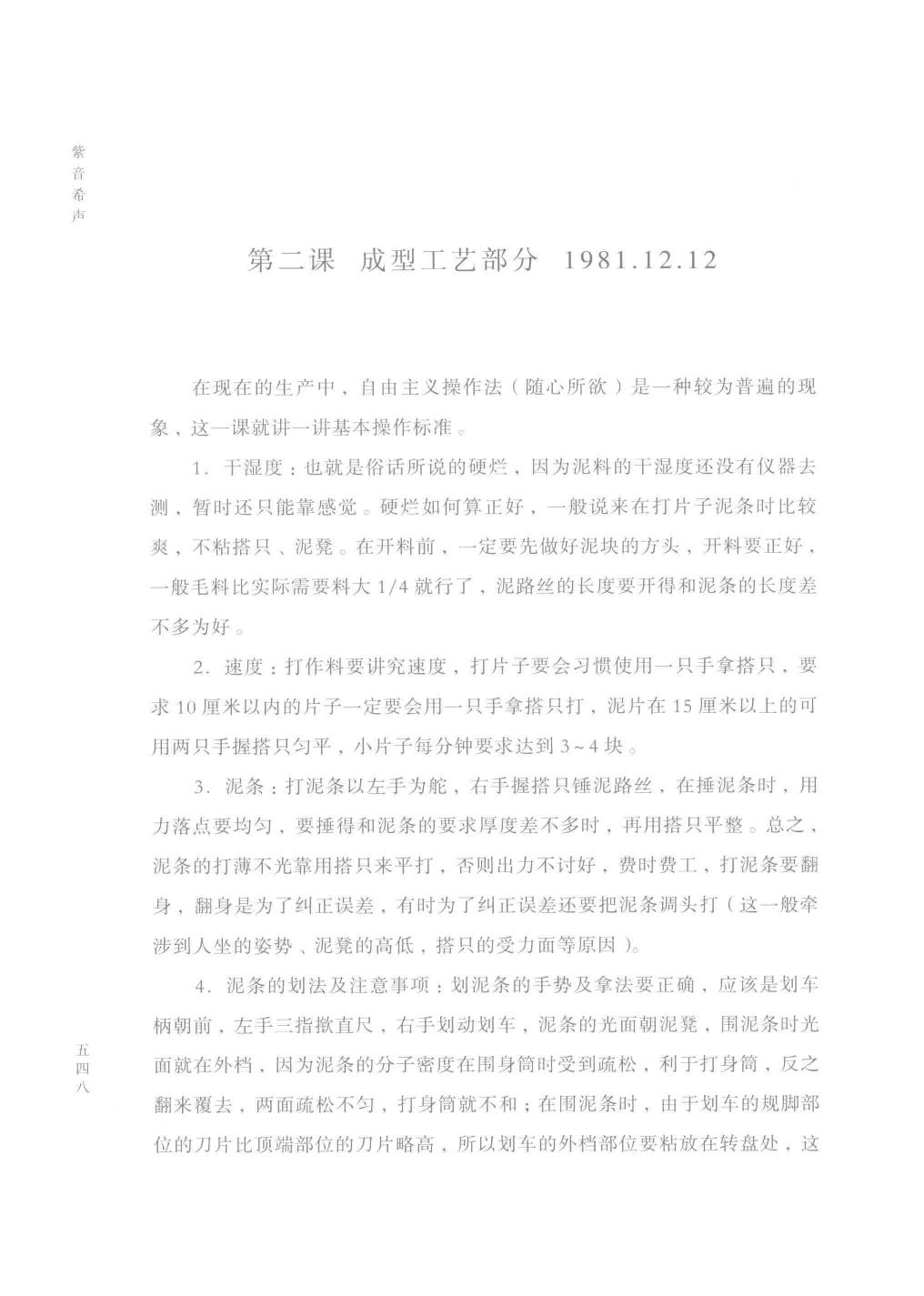
## Lesson Two: Forming Process Section (December 12, 1981)
In current production, the practice of free-form operation (following one's whims) is a relatively common phenomenon. This lesson will cover the basic operational standards.
1. **Moisture content**: This refers to what is colloquially called "hardness and softness." Since there are no instruments yet to measure the moisture level of clay, we must rely on feel for the time being. How to determine the proper hardness and softness? Generally speaking, when beating clay slabs and coils, it should feel crisp, not sticking to the paddle or clay board. Before opening the clay, one must first prepare the square edges of the clay block. The opening should be just right—generally, the rough material should be about 1/4 larger than what is actually needed. The length of the clay strips should be cut approximately the same as the length of the clay coils.
2. **Speed**: Working the clay requires attention to speed. When beating slabs, one should develop the habit of using one hand to hold the paddle. For slabs within 10 centimeters, one must be able to beat them holding the paddle with one hand. For clay slabs over 15 centimeters, both hands may be used to grip the paddle and flatten evenly. For small slabs, the requirement is to achieve 3-4 pieces per minute.
3. **Clay coils**: When beating clay coils, the left hand should be capable, with the right hand gripping the paddle to beat the clay strips. When beating clay coils, the force should land evenly. Beat until it approaches the required thickness of the coil, then use the paddle to smooth it. In short, thinning clay coils does not rely solely on flat beating with the paddle—otherwise, the effort yields poor results, wasting time and labor. Clay coils must be turned over; turning is done to correct errors. Sometimes, to correct errors, the coil must be reversed end-to-end for beating (this generally relates to factors such as one's sitting posture, the height of the clay board, and the bearing surface of the paddle).
4. **Method of cutting clay coils and precautions**: The hand position and grip for cutting clay coils must be correct. The cutting tool handle should face forward, with the left hand's three fingers holding the straight ruler, and the right hand moving the cutting tool. The smooth side of the clay coil should face the clay board; when wrapping the coil, the smooth side will be on the outside. This is because the molecular density of the clay coil becomes loosened when forming the cylinder body, which facilitates beating the cylinder. Conversely, if turned back and forth with uneven loosening on both sides, the cylinder beating will not be harmonious. When wrapping the clay coil, since the blade at the base of the cutting tool's gauge is slightly higher than the blade at the top, the outer gauge portion of the cutting tool should be placed against the turntable.
Chapter 10
附录
Appendix
Pages 526-651
View Chapter →
English Translation
## Lesson Two: Forming Process Section (December 12, 1981)
In current production, the practice of free-form operation (following one's whims) is a relatively common phenomenon. This lesson will cover the basic operational standards.
1. **Moisture content**: This refers to what is colloquially called "hardness and softness." Since there are no instruments yet to measure the moisture level of clay, we must rely on feel for the time being. How to determine the proper hardness and softness? Generally speaking, when beating clay slabs and coils, it should feel crisp, not sticking to the paddle or clay board. Before opening the clay, one must first prepare the square edges of the clay block. The opening should be just right—generally, the rough material should be about 1/4 larger than what is actually needed. The length of the clay strips should be cut approximately the same as the length of the clay coils.
2. **Speed**: Working the clay requires attention to speed. When beating slabs, one should develop the habit of using one hand to hold the paddle. For slabs within 10 centimeters, one must be able to beat them holding the paddle with one hand. For clay slabs over 15 centimeters, both hands may be used to grip the paddle and flatten evenly. For small slabs, the requirement is to achieve 3-4 pieces per minute.
3. **Clay coils**: When beating clay coils, the left hand should be capable, with the right hand gripping the paddle to beat the clay strips. When beating clay coils, the force should land evenly. Beat until it approaches the required thickness of the coil, then use the paddle to smooth it. In short, thinning clay coils does not rely solely on flat beating with the paddle—otherwise, the effort yields poor results, wasting time and labor. Clay coils must be turned over; turning is done to correct errors. Sometimes, to correct errors, the coil must be reversed end-to-end for beating (this generally relates to factors such as one's sitting posture, the height of the clay board, and the bearing surface of the paddle).
4. **Method of cutting clay coils and precautions**: The hand position and grip for cutting clay coils must be correct. The cutting tool handle should face forward, with the left hand's three fingers holding the straight ruler, and the right hand moving the cutting tool. The smooth side of the clay coil should face the clay board; when wrapping the coil, the smooth side will be on the outside. This is because the molecular density of the clay coil becomes loosened when forming the cylinder body, which facilitates beating the cylinder. Conversely, if turned back and forth with uneven loosening on both sides, the cylinder beating will not be harmonious. When wrapping the clay coil, since the blade at the base of the cutting tool's gauge is slightly higher than the blade at the top, the outer gauge portion of the cutting tool should be placed against the turntable.
章节导航 Chapter Navigation
Chapter 1
序文
Pages 6-6
Chapter 2
引言
Pages 28-31
Chapter 3
达变
Pages 32-133
Chapter 3
开宗立派
Pages 46-66
Chapter 3
传道授业
Pages 67-98
Chapter 3
大师淳友
Pages 99-120
Chapter 3
学艺谋生
Pages 121-133
Chapter 4
化神
Pages 134-141
Chapter 5
独妙
Pages 142-405
Chapter 5
匠心独运 不苟丝毫
Pages 142-179
Chapter 5
器利善事 物尽其用
Pages 180-199
Chapter 5
紫泥春华 研精究微
Pages 200-405
Chapter 6
驾简
Pages 406-427
Chapter 6
精雕细刻 文质合一
Pages 406-410
Chapter 6
师法自然 妙趣横生
Pages 411-415
Chapter 6
丝来线去 曲尽其妙
Pages 416-427
Chapter 7
明志
Pages 463-485
Chapter 7
高山仰止 淡泊明志
Pages 463-472
Chapter 7
啜墨看茶 气定神闲
Pages 473-478
Chapter 7
齿少心锐 怡志抒情
Pages 479-485
Chapter 8
存真
Pages 428-462
Chapter 8
规圆矩方 弃伪存真
Pages 428-436
Chapter 8
有物有则 钻尖仰高
Pages 437-462
Chapter 9
心营
Pages 506-525
Chapter 9
坚守传统 艺立潮头
Pages 506-513
Chapter 9
新型师承 桃李满园
Pages 514-525
Chapter 10
附录
Pages 526-651
Chapter 10
顾景舟紫艺论文
Pages 526-535
Chapter 10
技术课备课笔记
Pages 536-543
Chapter 10
顾景舟艺术年表
Pages 544-651
Chapter 11
参考文献
Pages 652-657
Chapter 12
鸣谢
Pages 658-659