Chapter 10
附录
Appendix
554
of 659
English Translation
It is essential to develop proper habits and absolutely avoid putting the cart before the horse.
## 5. Beating the Body Cylinder
Beating the body cylinder (*da shen tong*) is one of the most difficult fundamental techniques in Yixing clay forming. When beating the body cylinder, both hands must work in close coordination, but they should not deliberately assist in rotation. The force applied must be even and consistent—absolutely not heavy one moment and light the next. The speed should neither be too fast nor too slow, but maintained at a moderate pace. Relatively speaking, small body cylinders can be worked faster, while large body cylinders should be worked more slowly. The paddle should not intentionally lift upward or press downward. After the body cylinder is properly beaten, the bottom coil should be attached. Generally, the bottom coil of a body cylinder should be attached to the inside of the clay strip. Take care that the boundary between the bottom coil and clay strip remains distinct—they must not become muddled together and entangled. When wheel-throwing the bottom coil, pay attention to placing the smooth surface (that is, the side smoothed with the clay rib) against the wheel. After throwing, flip it over to attach, so that the smooth surface faces outward (or in other words, the small eye of the foot rim faces up and the large eye faces down), achieving the effect of tight on the inside and loose on the outside.
Nowadays, fully handmade forming has become less common. Generally, plaster molds are used for pressing or squeezing the clay. Even when using plaster molds to squeeze the form, attention must be paid to beating the body cylinder. When placing it into the plaster mold, one must have a good sense of the difficult shape, so that when expanding the form, only slight adjustments are needed—merely adequate and nothing more. Currently, there is a widespread reaction that the mold quality is poor. The qualification of molds must be verified by ourselves, and any incorrect areas must be corrected by ourselves. When inspecting and repairing molds, it is better for the mold to be slightly concave rather than protruding, as this facilitates trimming. After demolding, one should develop the habit of immediately trimming the mold seam lines.
Because our Yixing pottery products have countless variations in form, the technical methods employed in production change accordingly with the craft requirements.
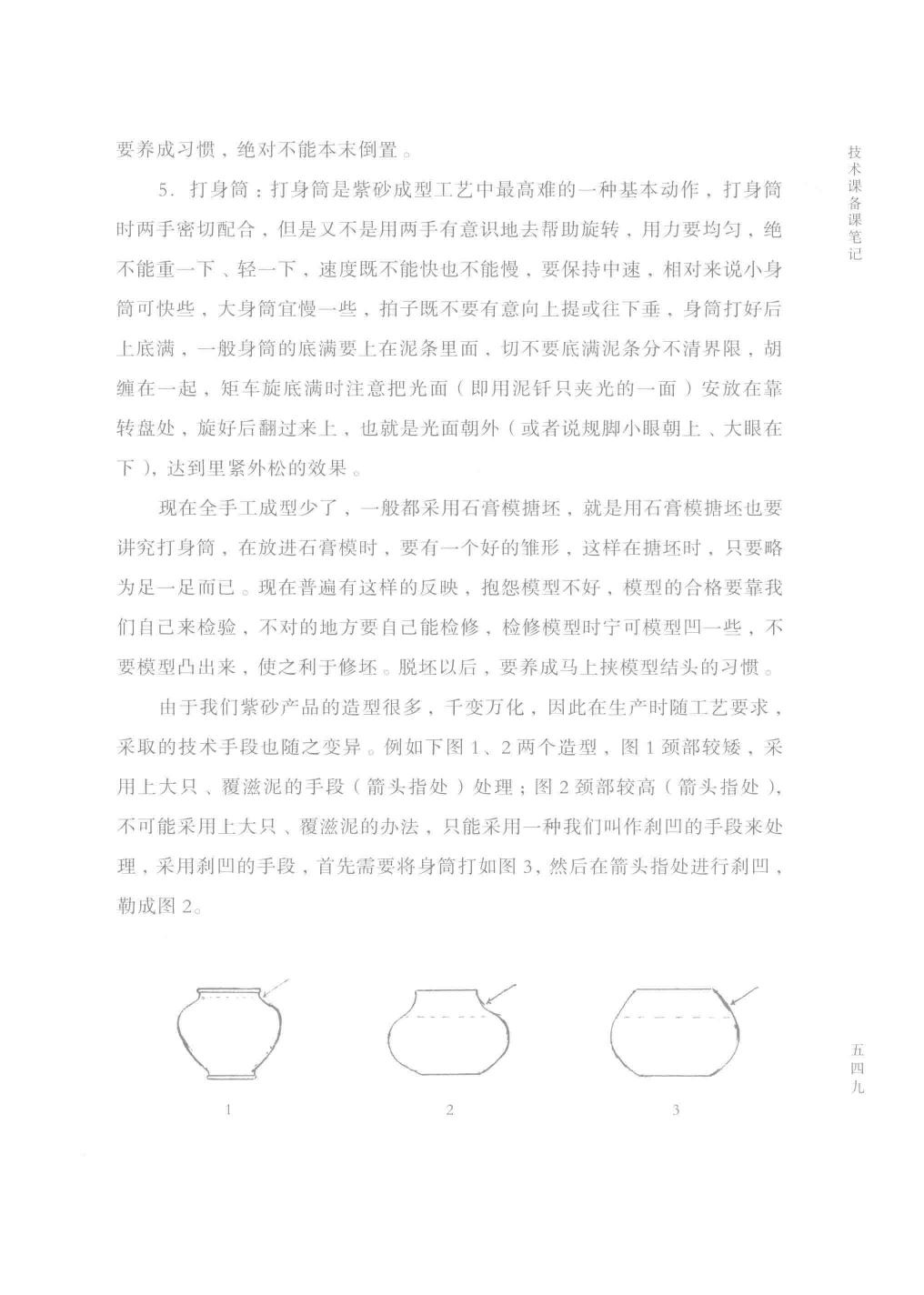
For example, consider the two forms shown in Figures 1 and 2 below:
Figure 1 has a relatively short neck, which is handled by applying a large rib and adding slip (indicated by the arrow). Figure 2 has a relatively tall neck (indicated by the arrow), where it is impossible to use the method of applying a large rib and adding slip. Instead, one must employ a technique we call "collaring inward" (*sha ao*) to handle it. To use the collaring technique, one must first beat the body cylinder as shown in Figure 3, then perform the collaring at the location indicated by the arrow, shaping it into Figure 2.
[Figures 2 and 3 referenced in text]
---
*Page 59*
Chapter 10
附录
Appendix
Pages 526-651
View Chapter →
English Translation
It is essential to develop proper habits and absolutely avoid putting the cart before the horse.
## 5. Beating the Body Cylinder
Beating the body cylinder (*da shen tong*) is one of the most difficult fundamental techniques in Yixing clay forming. When beating the body cylinder, both hands must work in close coordination, but they should not deliberately assist in rotation. The force applied must be even and consistent—absolutely not heavy one moment and light the next. The speed should neither be too fast nor too slow, but maintained at a moderate pace. Relatively speaking, small body cylinders can be worked faster, while large body cylinders should be worked more slowly. The paddle should not intentionally lift upward or press downward. After the body cylinder is properly beaten, the bottom coil should be attached. Generally, the bottom coil of a body cylinder should be attached to the inside of the clay strip. Take care that the boundary between the bottom coil and clay strip remains distinct—they must not become muddled together and entangled. When wheel-throwing the bottom coil, pay attention to placing the smooth surface (that is, the side smoothed with the clay rib) against the wheel. After throwing, flip it over to attach, so that the smooth surface faces outward (or in other words, the small eye of the foot rim faces up and the large eye faces down), achieving the effect of tight on the inside and loose on the outside.
Nowadays, fully handmade forming has become less common. Generally, plaster molds are used for pressing or squeezing the clay. Even when using plaster molds to squeeze the form, attention must be paid to beating the body cylinder. When placing it into the plaster mold, one must have a good sense of the difficult shape, so that when expanding the form, only slight adjustments are needed—merely adequate and nothing more. Currently, there is a widespread reaction that the mold quality is poor. The qualification of molds must be verified by ourselves, and any incorrect areas must be corrected by ourselves. When inspecting and repairing molds, it is better for the mold to be slightly concave rather than protruding, as this facilitates trimming. After demolding, one should develop the habit of immediately trimming the mold seam lines.
Because our Yixing pottery products have countless variations in form, the technical methods employed in production change accordingly with the craft requirements.
For example, consider the two forms shown in Figures 1 and 2 below:
Figure 1 has a relatively short neck, which is handled by applying a large rib and adding slip (indicated by the arrow). Figure 2 has a relatively tall neck (indicated by the arrow), where it is impossible to use the method of applying a large rib and adding slip. Instead, one must employ a technique we call "collaring inward" (*sha ao*) to handle it. To use the collaring technique, one must first beat the body cylinder as shown in Figure 3, then perform the collaring at the location indicated by the arrow, shaping it into Figure 2.
[Figures 2 and 3 referenced in text]
---
*Page 59*
章节导航 Chapter Navigation
Chapter 1
序文
Pages 6-6
Chapter 2
引言
Pages 28-31
Chapter 3
达变
Pages 32-133
Chapter 3
开宗立派
Pages 46-66
Chapter 3
传道授业
Pages 67-98
Chapter 3
大师淳友
Pages 99-120
Chapter 3
学艺谋生
Pages 121-133
Chapter 4
化神
Pages 134-141
Chapter 5
独妙
Pages 142-405
Chapter 5
匠心独运 不苟丝毫
Pages 142-179
Chapter 5
器利善事 物尽其用
Pages 180-199
Chapter 5
紫泥春华 研精究微
Pages 200-405
Chapter 6
驾简
Pages 406-427
Chapter 6
精雕细刻 文质合一
Pages 406-410
Chapter 6
师法自然 妙趣横生
Pages 411-415
Chapter 6
丝来线去 曲尽其妙
Pages 416-427
Chapter 7
明志
Pages 463-485
Chapter 7
高山仰止 淡泊明志
Pages 463-472
Chapter 7
啜墨看茶 气定神闲
Pages 473-478
Chapter 7
齿少心锐 怡志抒情
Pages 479-485
Chapter 8
存真
Pages 428-462
Chapter 8
规圆矩方 弃伪存真
Pages 428-436
Chapter 8
有物有则 钻尖仰高
Pages 437-462
Chapter 9
心营
Pages 506-525
Chapter 9
坚守传统 艺立潮头
Pages 506-513
Chapter 9
新型师承 桃李满园
Pages 514-525
Chapter 10
附录
Pages 526-651
Chapter 10
顾景舟紫艺论文
Pages 526-535
Chapter 10
技术课备课笔记
Pages 536-543
Chapter 10
顾景舟艺术年表
Pages 544-651
Chapter 11
参考文献
Pages 652-657
Chapter 12
鸣谢
Pages 658-659