Chapter 10
附录
Appendix
555
of 659
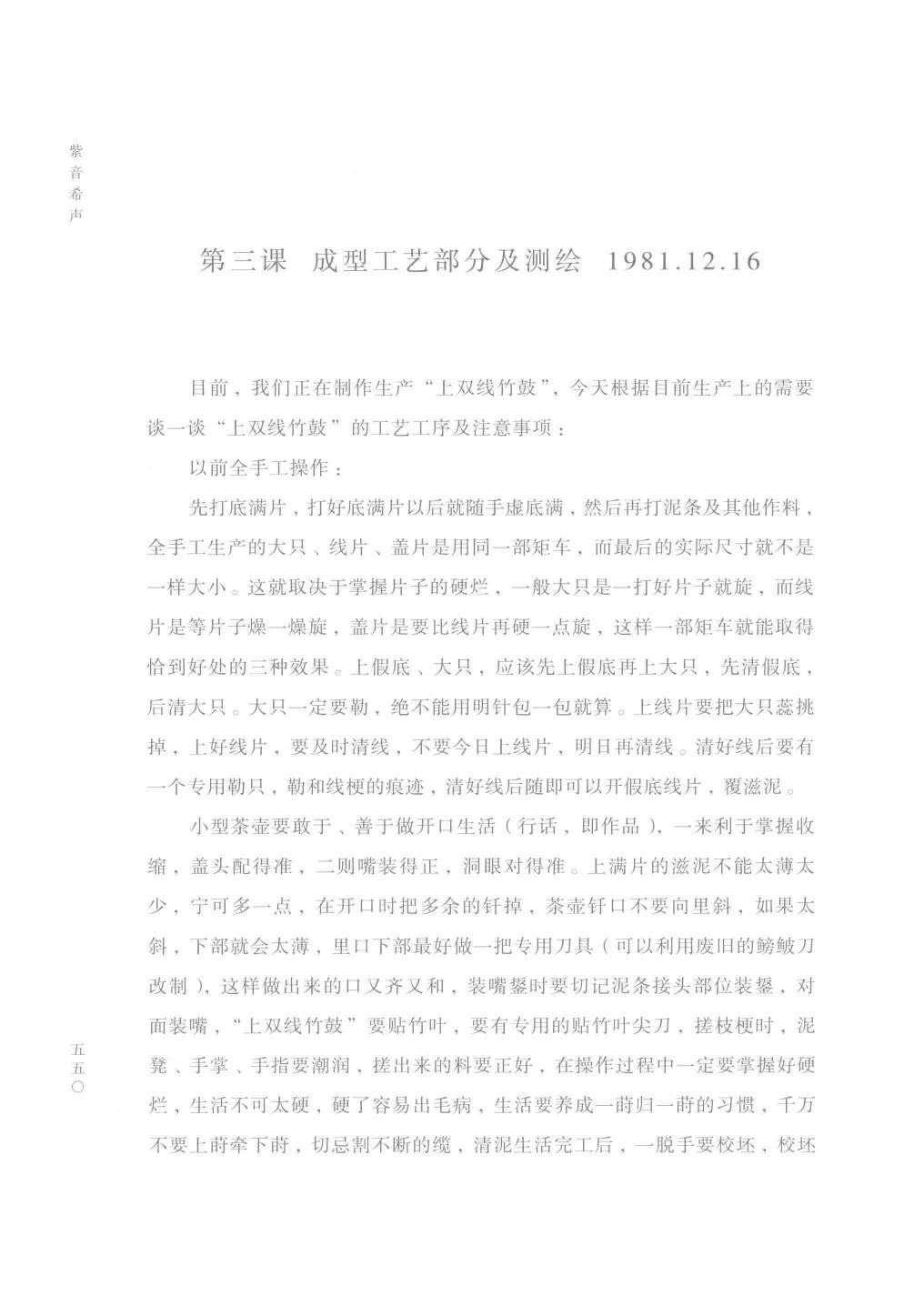
English Translation
## Lesson Three: Forming Techniques and Measurement (December 16, 1981)
Currently, we are producing the "Double-Line Bamboo Drum" teapot. Today, based on current production needs, I will discuss the technical procedures and precautions for making the "Double-Line Bamboo Drum":
**Traditional fully handmade process:**
First, beat out the bottom slab. After completing the bottom slab, immediately attach it loosely to the base, then beat out the clay coils and other components. In fully handmade production, the body, rim ring, and lid are all thrown on the same wheel, yet the final actual dimensions are not identical. This depends on mastering the clay's firmness—generally, the body is thrown immediately after beating the slab, the rim ring is thrown after letting the slab dry somewhat, and the lid is thrown when even firmer than the rim ring. This way, one wheel can achieve three perfectly calibrated results. When attaching the false bottom and body, the false bottom should be attached first, then the body. Clean the false bottom first, then clean the body. The body must be compressed with the *le* tool[1]—simply smoothing with a rib is absolutely insufficient. When attaching the rim ring, remove the clay slip from the body. After attaching the rim ring, clean it promptly—don't attach the rim ring today and clean it tomorrow. After cleaning the rim, use a specialized *le* tool to smooth away traces of the *le* tool and rim marks. Immediately after cleaning the rim, you can cut open the false bottom of the rim ring and apply slip.
For small teapots, one must dare to and be skilled at working with the piece open (trade terminology, meaning the work-in-progress). First, this facilitates controlling shrinkage and achieving precise lid fit; second, it allows the spout to be attached straight and the holes to align accurately. The slip applied to the rim cannot be too thin or too little—better to have a bit extra and trim the excess when opening. The teapot's mouth opening should not slant inward; if it's too slanted, the lower section will be too thin. For the lower interior of the mouth, it's best to make a specialized cutting tool (废旧的鱼鳞刀 can be repurposed and modified). This produces a mouth that is both even and harmonious. When attaching the spout, remember to position the handle at the clay coil's seam, with the spout opposite. The "Double-Line Bamboo Drum" requires bamboo leaf appliqué—you need a specialized pointed knife for applying bamboo leaves. When rolling the handle, the clay, palm, and fingers should be moist, and the rolled component should be just right. Throughout the process, you must master the proper firmness—the work cannot be too hard, as hardness easily causes problems. Develop the habit of completing each piece in one session. Never leave work half-finished, dragging on endlessly. After completing the clay work, immediately check the piece upon release, checking for defects.
---
[1] *Le* (勒): A specialized compression tool used in Yixing pottery making
Chapter 10
附录
Appendix
Pages 526-651
View Chapter →
English Translation
## Lesson Three: Forming Techniques and Measurement (December 16, 1981)
Currently, we are producing the "Double-Line Bamboo Drum" teapot. Today, based on current production needs, I will discuss the technical procedures and precautions for making the "Double-Line Bamboo Drum":
**Traditional fully handmade process:**
First, beat out the bottom slab. After completing the bottom slab, immediately attach it loosely to the base, then beat out the clay coils and other components. In fully handmade production, the body, rim ring, and lid are all thrown on the same wheel, yet the final actual dimensions are not identical. This depends on mastering the clay's firmness—generally, the body is thrown immediately after beating the slab, the rim ring is thrown after letting the slab dry somewhat, and the lid is thrown when even firmer than the rim ring. This way, one wheel can achieve three perfectly calibrated results. When attaching the false bottom and body, the false bottom should be attached first, then the body. Clean the false bottom first, then clean the body. The body must be compressed with the *le* tool[1]—simply smoothing with a rib is absolutely insufficient. When attaching the rim ring, remove the clay slip from the body. After attaching the rim ring, clean it promptly—don't attach the rim ring today and clean it tomorrow. After cleaning the rim, use a specialized *le* tool to smooth away traces of the *le* tool and rim marks. Immediately after cleaning the rim, you can cut open the false bottom of the rim ring and apply slip.
For small teapots, one must dare to and be skilled at working with the piece open (trade terminology, meaning the work-in-progress). First, this facilitates controlling shrinkage and achieving precise lid fit; second, it allows the spout to be attached straight and the holes to align accurately. The slip applied to the rim cannot be too thin or too little—better to have a bit extra and trim the excess when opening. The teapot's mouth opening should not slant inward; if it's too slanted, the lower section will be too thin. For the lower interior of the mouth, it's best to make a specialized cutting tool (废旧的鱼鳞刀 can be repurposed and modified). This produces a mouth that is both even and harmonious. When attaching the spout, remember to position the handle at the clay coil's seam, with the spout opposite. The "Double-Line Bamboo Drum" requires bamboo leaf appliqué—you need a specialized pointed knife for applying bamboo leaves. When rolling the handle, the clay, palm, and fingers should be moist, and the rolled component should be just right. Throughout the process, you must master the proper firmness—the work cannot be too hard, as hardness easily causes problems. Develop the habit of completing each piece in one session. Never leave work half-finished, dragging on endlessly. After completing the clay work, immediately check the piece upon release, checking for defects.
---
[1] *Le* (勒): A specialized compression tool used in Yixing pottery making
章节导航 Chapter Navigation
Chapter 1
序文
Pages 6-6
Chapter 2
引言
Pages 28-31
Chapter 3
达变
Pages 32-133
Chapter 3
开宗立派
Pages 46-66
Chapter 3
传道授业
Pages 67-98
Chapter 3
大师淳友
Pages 99-120
Chapter 3
学艺谋生
Pages 121-133
Chapter 4
化神
Pages 134-141
Chapter 5
独妙
Pages 142-405
Chapter 5
匠心独运 不苟丝毫
Pages 142-179
Chapter 5
器利善事 物尽其用
Pages 180-199
Chapter 5
紫泥春华 研精究微
Pages 200-405
Chapter 6
驾简
Pages 406-427
Chapter 6
精雕细刻 文质合一
Pages 406-410
Chapter 6
师法自然 妙趣横生
Pages 411-415
Chapter 6
丝来线去 曲尽其妙
Pages 416-427
Chapter 7
明志
Pages 463-485
Chapter 7
高山仰止 淡泊明志
Pages 463-472
Chapter 7
啜墨看茶 气定神闲
Pages 473-478
Chapter 7
齿少心锐 怡志抒情
Pages 479-485
Chapter 8
存真
Pages 428-462
Chapter 8
规圆矩方 弃伪存真
Pages 428-436
Chapter 8
有物有则 钻尖仰高
Pages 437-462
Chapter 9
心营
Pages 506-525
Chapter 9
坚守传统 艺立潮头
Pages 506-513
Chapter 9
新型师承 桃李满园
Pages 514-525
Chapter 10
附录
Pages 526-651
Chapter 10
顾景舟紫艺论文
Pages 526-535
Chapter 10
技术课备课笔记
Pages 536-543
Chapter 10
顾景舟艺术年表
Pages 544-651
Chapter 11
参考文献
Pages 652-657
Chapter 12
鸣谢
Pages 658-659