Chapter 10
附录
Appendix
563
of 659
English Translation
The previous lesson covered the lid; this lesson covers the base.
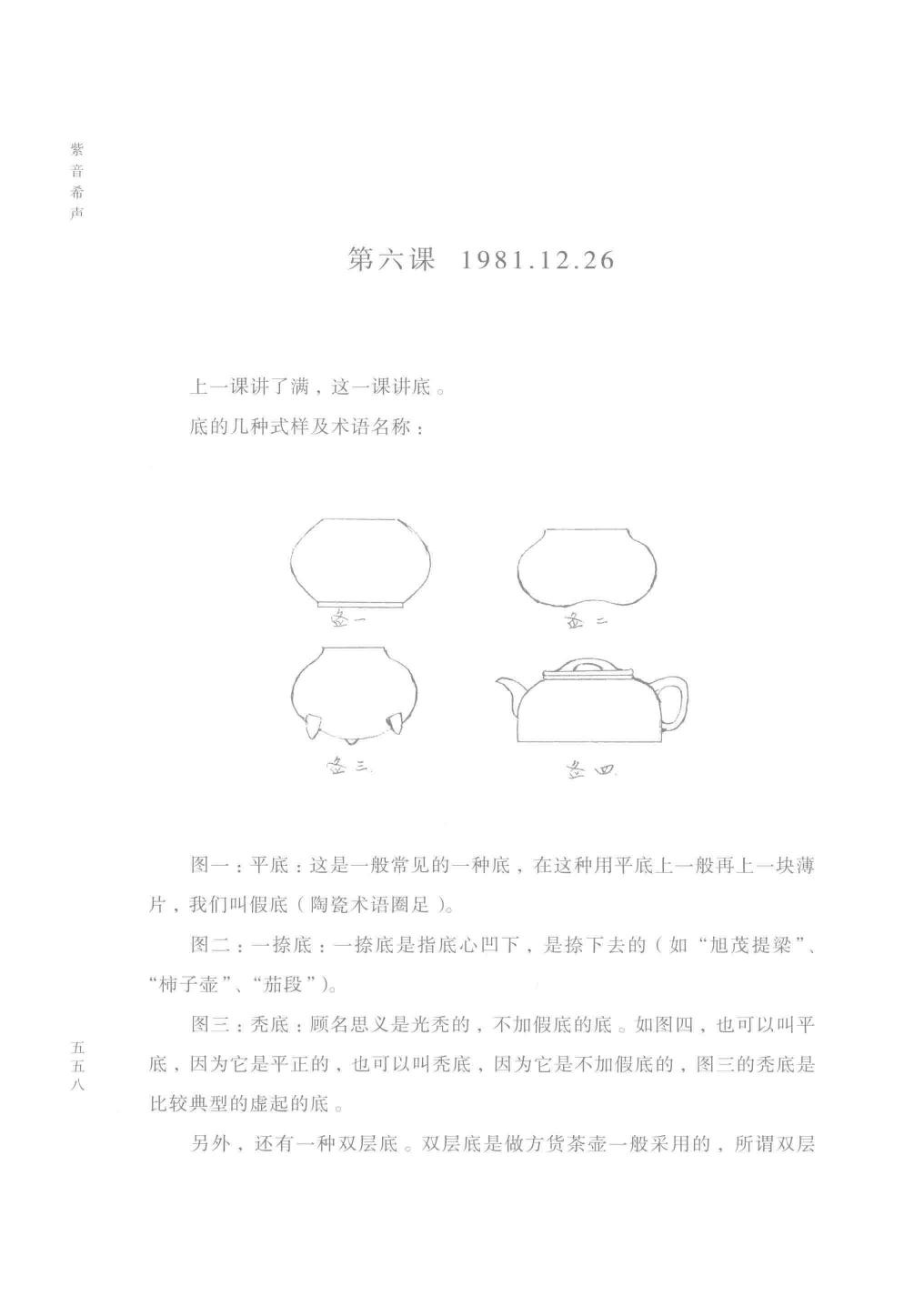
Several types of bases and their technical terminology:
**Figure 1: Flat Base** - This is the most commonly seen type of base. On this flat base, a thin clay slab is typically added on top, which we call a false bottom (ceramic terminology: added bottom).
**Figure 2: Recessed Base** - A recessed base refers to a base where the center is sunken inward (as in the "Xu Zang Tiliang," "Persimmon," and "Eggplant Segment" styles).
**Figure 3: Bare Base** - As the name suggests, this is a bare base without an added false bottom. As shown in Figure 4, it can also be called a flat base because it is level and flat, or it can be called a bare base because no false bottom is added. The bare base in Figure 3 is a relatively typical raised base.
Additionally, there is another type called the double-layer base. The double-layer base is generally used when making square-shaped teapots. The so-called double...
[Note: The text appears to be incomplete at the end]
Chapter 10
附录
Appendix
Pages 526-651
View Chapter →
English Translation
The previous lesson covered the lid; this lesson covers the base.
Several types of bases and their technical terminology:
**Figure 1: Flat Base** - This is the most commonly seen type of base. On this flat base, a thin clay slab is typically added on top, which we call a false bottom (ceramic terminology: added bottom).
**Figure 2: Recessed Base** - A recessed base refers to a base where the center is sunken inward (as in the "Xu Zang Tiliang," "Persimmon," and "Eggplant Segment" styles).
**Figure 3: Bare Base** - As the name suggests, this is a bare base without an added false bottom. As shown in Figure 4, it can also be called a flat base because it is level and flat, or it can be called a bare base because no false bottom is added. The bare base in Figure 3 is a relatively typical raised base.
Additionally, there is another type called the double-layer base. The double-layer base is generally used when making square-shaped teapots. The so-called double...
[Note: The text appears to be incomplete at the end]
章节导航 Chapter Navigation
Chapter 1
序文
Pages 6-6
Chapter 2
引言
Pages 28-31
Chapter 3
达变
Pages 32-133
Chapter 3
开宗立派
Pages 46-66
Chapter 3
传道授业
Pages 67-98
Chapter 3
大师淳友
Pages 99-120
Chapter 3
学艺谋生
Pages 121-133
Chapter 4
化神
Pages 134-141
Chapter 5
独妙
Pages 142-405
Chapter 5
匠心独运 不苟丝毫
Pages 142-179
Chapter 5
器利善事 物尽其用
Pages 180-199
Chapter 5
紫泥春华 研精究微
Pages 200-405
Chapter 6
驾简
Pages 406-427
Chapter 6
精雕细刻 文质合一
Pages 406-410
Chapter 6
师法自然 妙趣横生
Pages 411-415
Chapter 6
丝来线去 曲尽其妙
Pages 416-427
Chapter 7
明志
Pages 463-485
Chapter 7
高山仰止 淡泊明志
Pages 463-472
Chapter 7
啜墨看茶 气定神闲
Pages 473-478
Chapter 7
齿少心锐 怡志抒情
Pages 479-485
Chapter 8
存真
Pages 428-462
Chapter 8
规圆矩方 弃伪存真
Pages 428-436
Chapter 8
有物有则 钻尖仰高
Pages 437-462
Chapter 9
心营
Pages 506-525
Chapter 9
坚守传统 艺立潮头
Pages 506-513
Chapter 9
新型师承 桃李满园
Pages 514-525
Chapter 10
附录
Pages 526-651
Chapter 10
顾景舟紫艺论文
Pages 526-535
Chapter 10
技术课备课笔记
Pages 536-543
Chapter 10
顾景舟艺术年表
Pages 544-651
Chapter 11
参考文献
Pages 652-657
Chapter 12
鸣谢
Pages 658-659