Chapter 10
附录
Appendix
564
of 659
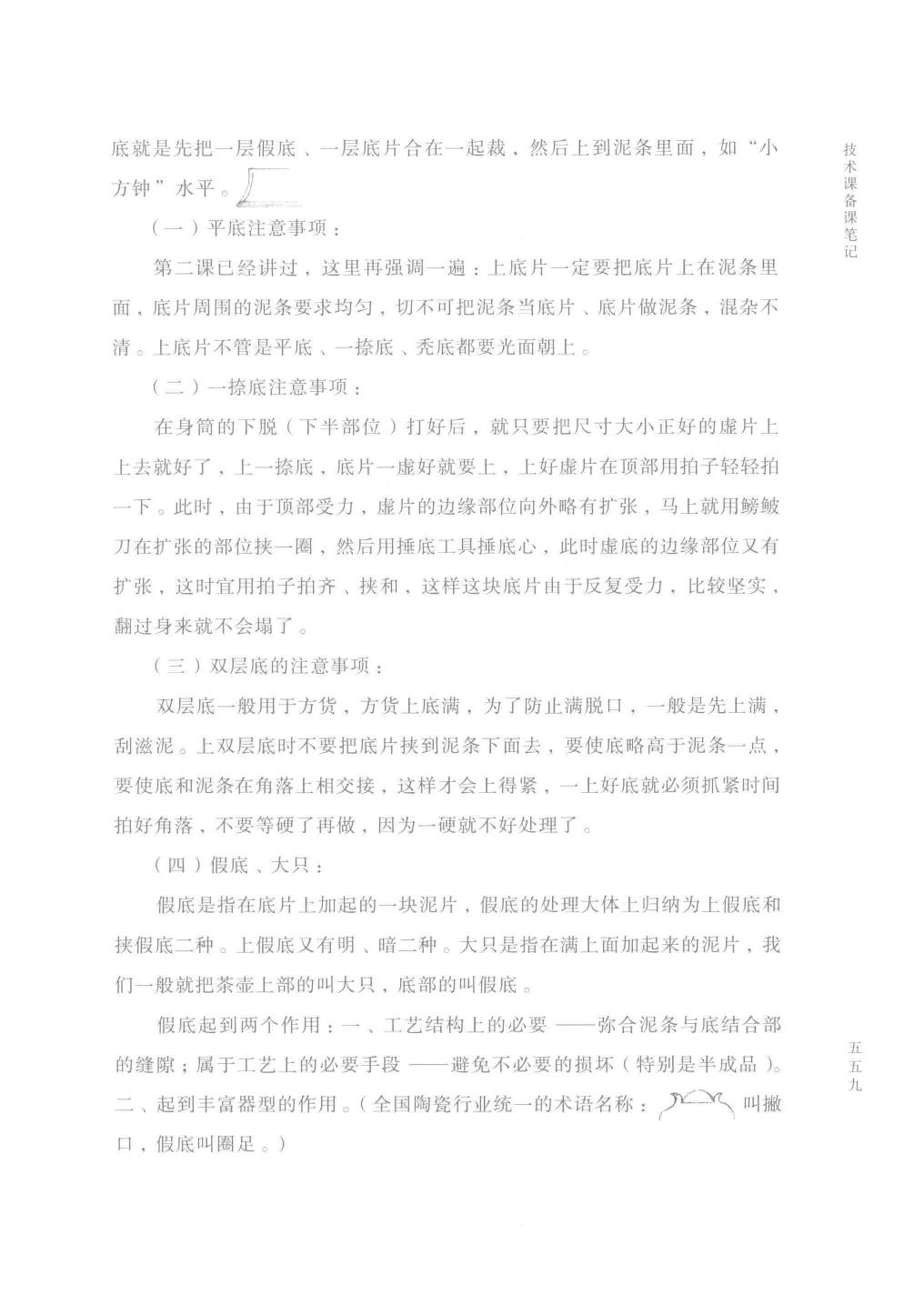
English Translation
The bottom is made by first cutting a false bottom and a bottom piece together, then attaching them inside the clay coil, maintaining the "small square bell" level.
As already explained in the second lesson, I emphasize again: when attaching the bottom piece, you must place it inside the clay coil. The clay coil around the bottom piece must be uniform. Never confuse the clay coil with the bottom piece or use the bottom piece as a clay coil—keep them clearly distinguished. When attaching the bottom piece, whether it's a flat bottom, single-layer bottom, or bare bottom, the smooth side must face upward.
## (II) Precautions for Single-Layer Bottom:
After the lower section (lower half) of the body cylinder is completed, you simply need to attach a bottom piece of the correct size. When attaching a single-layer bottom, the bottom piece should be attached as soon as it's ready. After attaching the bottom piece, gently tap the top with a paddle. At this point, due to the force applied at the top, the edge of the bottom piece will expand slightly outward. Immediately use a fish-tail knife to trim around the expanded area, then use the hand-bottom tool to work the bottom center. At this time, the edge of the bottom will expand again. Use the paddle to tap it flat and trim it. Through this repeated application of force, the bottom piece becomes quite solid and won't collapse when turned over.
## (III) Precautions for Double-Layer Bottom:
Double-layer bottoms are generally used for square-shaped wares. When attaching the bottom to square wares, to prevent the rim from detaching, the general practice is to attach the rim first and scrape away excess clay. When attaching a double-layer bottom, don't press the bottom piece under the clay coil—the bottom should be slightly higher than the clay coil and should meet the clay coil at the corners. This ensures a tight attachment. As soon as the bottom is attached, you must work quickly to tap the corners properly. Don't wait until it hardens, because once it hardens, it becomes difficult to work with.
## (IV) False Bottom and Top Section:
A false bottom refers to a clay piece added onto the bottom piece. The treatment of false bottoms can be broadly categorized into two types: attaching the false bottom and trimming the false bottom. Attaching false bottoms can be further divided into visible and concealed types. The top section refers to the clay piece added on top of the rim. We generally call the upper part of a teapot the "top section" and the lower part the "false bottom."
The false bottom serves two purposes: First, it's a structural necessity in the craftsmanship—it bridges the gap between the clay coil and the bottom joint; it's an essential technical measure to avoid unnecessary damage (especially to semi-finished products). Second, it enriches the form of the vessel. (According to the unified terminology of the national ceramics industry: the top section is called the "flared rim," and the false bottom is called the "foot ring.")
---
[Note: The final line appears to be a header or title fragment that may be part of a larger document structure]
Chapter 10
附录
Appendix
Pages 526-651
View Chapter →
English Translation
The bottom is made by first cutting a false bottom and a bottom piece together, then attaching them inside the clay coil, maintaining the "small square bell" level.
As already explained in the second lesson, I emphasize again: when attaching the bottom piece, you must place it inside the clay coil. The clay coil around the bottom piece must be uniform. Never confuse the clay coil with the bottom piece or use the bottom piece as a clay coil—keep them clearly distinguished. When attaching the bottom piece, whether it's a flat bottom, single-layer bottom, or bare bottom, the smooth side must face upward.
## (II) Precautions for Single-Layer Bottom:
After the lower section (lower half) of the body cylinder is completed, you simply need to attach a bottom piece of the correct size. When attaching a single-layer bottom, the bottom piece should be attached as soon as it's ready. After attaching the bottom piece, gently tap the top with a paddle. At this point, due to the force applied at the top, the edge of the bottom piece will expand slightly outward. Immediately use a fish-tail knife to trim around the expanded area, then use the hand-bottom tool to work the bottom center. At this time, the edge of the bottom will expand again. Use the paddle to tap it flat and trim it. Through this repeated application of force, the bottom piece becomes quite solid and won't collapse when turned over.
## (III) Precautions for Double-Layer Bottom:
Double-layer bottoms are generally used for square-shaped wares. When attaching the bottom to square wares, to prevent the rim from detaching, the general practice is to attach the rim first and scrape away excess clay. When attaching a double-layer bottom, don't press the bottom piece under the clay coil—the bottom should be slightly higher than the clay coil and should meet the clay coil at the corners. This ensures a tight attachment. As soon as the bottom is attached, you must work quickly to tap the corners properly. Don't wait until it hardens, because once it hardens, it becomes difficult to work with.
## (IV) False Bottom and Top Section:
A false bottom refers to a clay piece added onto the bottom piece. The treatment of false bottoms can be broadly categorized into two types: attaching the false bottom and trimming the false bottom. Attaching false bottoms can be further divided into visible and concealed types. The top section refers to the clay piece added on top of the rim. We generally call the upper part of a teapot the "top section" and the lower part the "false bottom."
The false bottom serves two purposes: First, it's a structural necessity in the craftsmanship—it bridges the gap between the clay coil and the bottom joint; it's an essential technical measure to avoid unnecessary damage (especially to semi-finished products). Second, it enriches the form of the vessel. (According to the unified terminology of the national ceramics industry: the top section is called the "flared rim," and the false bottom is called the "foot ring.")
---
[Note: The final line appears to be a header or title fragment that may be part of a larger document structure]
章节导航 Chapter Navigation
Chapter 1
序文
Pages 6-6
Chapter 2
引言
Pages 28-31
Chapter 3
达变
Pages 32-133
Chapter 3
开宗立派
Pages 46-66
Chapter 3
传道授业
Pages 67-98
Chapter 3
大师淳友
Pages 99-120
Chapter 3
学艺谋生
Pages 121-133
Chapter 4
化神
Pages 134-141
Chapter 5
独妙
Pages 142-405
Chapter 5
匠心独运 不苟丝毫
Pages 142-179
Chapter 5
器利善事 物尽其用
Pages 180-199
Chapter 5
紫泥春华 研精究微
Pages 200-405
Chapter 6
驾简
Pages 406-427
Chapter 6
精雕细刻 文质合一
Pages 406-410
Chapter 6
师法自然 妙趣横生
Pages 411-415
Chapter 6
丝来线去 曲尽其妙
Pages 416-427
Chapter 7
明志
Pages 463-485
Chapter 7
高山仰止 淡泊明志
Pages 463-472
Chapter 7
啜墨看茶 气定神闲
Pages 473-478
Chapter 7
齿少心锐 怡志抒情
Pages 479-485
Chapter 8
存真
Pages 428-462
Chapter 8
规圆矩方 弃伪存真
Pages 428-436
Chapter 8
有物有则 钻尖仰高
Pages 437-462
Chapter 9
心营
Pages 506-525
Chapter 9
坚守传统 艺立潮头
Pages 506-513
Chapter 9
新型师承 桃李满园
Pages 514-525
Chapter 10
附录
Pages 526-651
Chapter 10
顾景舟紫艺论文
Pages 526-535
Chapter 10
技术课备课笔记
Pages 536-543
Chapter 10
顾景舟艺术年表
Pages 544-651
Chapter 11
参考文献
Pages 652-657
Chapter 12
鸣谢
Pages 658-659