Chapter 10
附录
Appendix
594
of 659
English Translation
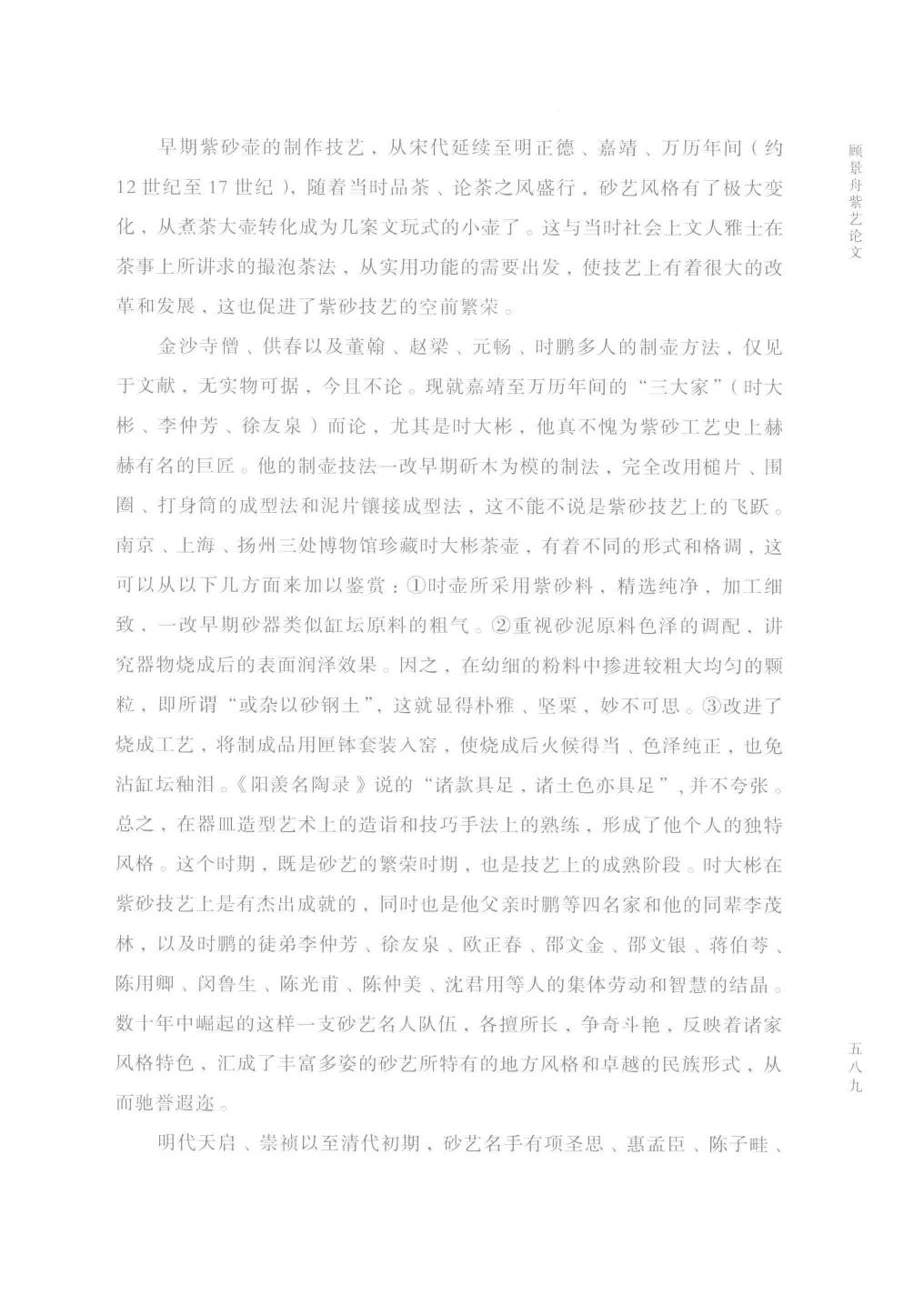
The craft of Yixing pottery continued from the Song Dynasty through the Zhengde, Jiajing, and Wanli reigns of the Ming Dynasty (approximately 12th to 17th centuries). As the customs of tea tasting and tea discussion flourished during this period, the style of Yixing pottery underwent tremendous changes, transforming from large tea storage vessels into small teapots suitable as scholar's desk ornaments. This evolution was driven by the literati's pursuit of the gongfu tea brewing method, which, based on practical functional needs, brought about significant reforms and developments in craftsmanship. This also promoted an unprecedented flourishing of Yixing pottery techniques.
Regarding the production methods of Gong Chun, as well as Dong De, Zhao Liang, Yuan Chang, Shi Peng, and others, these are only documented in historical texts with no surviving physical objects, so we shall not discuss them here. Focusing instead on the "Three Great Masters" of the Jiajing to Wanli period (Shi Dabin, Shi Pengshi, and Li Zhongfang, Xu Youquan), particularly Shi Dabin—he truly deserves to be called a renowned master in the history of Yixing pottery craft. His teapot-making techniques completely abandoned the early method of carving wood molds, instead fully adopting the methods of clay slab construction, wheel throwing, and clay slab joining. This was nothing short of a leap forward in Yixing pottery technique. The Shi Dabin teapots treasured in museums in Nanjing and Shanghai display different forms and styles, which can be appreciated from the following aspects:
First, the Yixing clay selected by Shi Dabin was refined and pure, with fine processing that eliminated the coarse quality resembling jar materials from earlier pottery. He placed great emphasis on blending the colors of clay materials and pursued the lustrous surface effect after firing. Therefore, he mixed relatively coarse, uniform particles into the fine powder, the so-called "mixing with sandy grog soil," which created an elegant, firm, and wonderfully subtle effect.
Second, he improved the firing process by placing finished pieces in saggars before loading them into the kiln, ensuring proper firing temperature and pure coloration while avoiding glaze drips from other pottery. The statement in *Yangxian Ming Tao Lu* that "all styles are complete, all clay colors are complete" is not an exaggeration.
In summary, in terms of vessel form and modeling artistry, as well as technical proficiency, he formed his own unique style. This period was both a prosperous era for Yixing pottery and a mature stage in its craftsmanship. Shi Dabin made outstanding achievements in Yixing pottery technique, which were also the crystallization of the collective labor and wisdom of his father Shi Peng and other famous masters, his contemporaries Li Maolin and Shi Penghang, as well as his disciples Li Zhongfang, Xu Youquan, Ou Zhengchun, Shao Wenjin, Shao Wenyin, Jiang Boji, Chen Yongze, Min Lusheng, Chen Guangfu, Chen Zhongmei, Shen Junyong, and others. This team of renowned Yixing pottery artists, each excelling in their specialties and competing in innovation, reflected the distinctive characteristics of various schools and converged into the rich and varied local style unique to Yixing pottery and its outstanding national form, thus gaining fame far and wide.
From the Tianqi and Chongzhen reigns of the Ming Dynasty through the early Qing Dynasty, famous Yixing pottery craftsmen included Xiang Shengsi, Hui Mengchen, Chen Ziqi, and others.
Chapter 10
附录
Appendix
Pages 526-651
View Chapter →
English Translation
The craft of Yixing pottery continued from the Song Dynasty through the Zhengde, Jiajing, and Wanli reigns of the Ming Dynasty (approximately 12th to 17th centuries). As the customs of tea tasting and tea discussion flourished during this period, the style of Yixing pottery underwent tremendous changes, transforming from large tea storage vessels into small teapots suitable as scholar's desk ornaments. This evolution was driven by the literati's pursuit of the gongfu tea brewing method, which, based on practical functional needs, brought about significant reforms and developments in craftsmanship. This also promoted an unprecedented flourishing of Yixing pottery techniques.
Regarding the production methods of Gong Chun, as well as Dong De, Zhao Liang, Yuan Chang, Shi Peng, and others, these are only documented in historical texts with no surviving physical objects, so we shall not discuss them here. Focusing instead on the "Three Great Masters" of the Jiajing to Wanli period (Shi Dabin, Shi Pengshi, and Li Zhongfang, Xu Youquan), particularly Shi Dabin—he truly deserves to be called a renowned master in the history of Yixing pottery craft. His teapot-making techniques completely abandoned the early method of carving wood molds, instead fully adopting the methods of clay slab construction, wheel throwing, and clay slab joining. This was nothing short of a leap forward in Yixing pottery technique. The Shi Dabin teapots treasured in museums in Nanjing and Shanghai display different forms and styles, which can be appreciated from the following aspects:
First, the Yixing clay selected by Shi Dabin was refined and pure, with fine processing that eliminated the coarse quality resembling jar materials from earlier pottery. He placed great emphasis on blending the colors of clay materials and pursued the lustrous surface effect after firing. Therefore, he mixed relatively coarse, uniform particles into the fine powder, the so-called "mixing with sandy grog soil," which created an elegant, firm, and wonderfully subtle effect.
Second, he improved the firing process by placing finished pieces in saggars before loading them into the kiln, ensuring proper firing temperature and pure coloration while avoiding glaze drips from other pottery. The statement in *Yangxian Ming Tao Lu* that "all styles are complete, all clay colors are complete" is not an exaggeration.
In summary, in terms of vessel form and modeling artistry, as well as technical proficiency, he formed his own unique style. This period was both a prosperous era for Yixing pottery and a mature stage in its craftsmanship. Shi Dabin made outstanding achievements in Yixing pottery technique, which were also the crystallization of the collective labor and wisdom of his father Shi Peng and other famous masters, his contemporaries Li Maolin and Shi Penghang, as well as his disciples Li Zhongfang, Xu Youquan, Ou Zhengchun, Shao Wenjin, Shao Wenyin, Jiang Boji, Chen Yongze, Min Lusheng, Chen Guangfu, Chen Zhongmei, Shen Junyong, and others. This team of renowned Yixing pottery artists, each excelling in their specialties and competing in innovation, reflected the distinctive characteristics of various schools and converged into the rich and varied local style unique to Yixing pottery and its outstanding national form, thus gaining fame far and wide.
From the Tianqi and Chongzhen reigns of the Ming Dynasty through the early Qing Dynasty, famous Yixing pottery craftsmen included Xiang Shengsi, Hui Mengchen, Chen Ziqi, and others.
章节导航 Chapter Navigation
Chapter 1
序文
Pages 6-6
Chapter 2
引言
Pages 28-31
Chapter 3
达变
Pages 32-133
Chapter 3
开宗立派
Pages 46-66
Chapter 3
传道授业
Pages 67-98
Chapter 3
大师淳友
Pages 99-120
Chapter 3
学艺谋生
Pages 121-133
Chapter 4
化神
Pages 134-141
Chapter 5
独妙
Pages 142-405
Chapter 5
匠心独运 不苟丝毫
Pages 142-179
Chapter 5
器利善事 物尽其用
Pages 180-199
Chapter 5
紫泥春华 研精究微
Pages 200-405
Chapter 6
驾简
Pages 406-427
Chapter 6
精雕细刻 文质合一
Pages 406-410
Chapter 6
师法自然 妙趣横生
Pages 411-415
Chapter 6
丝来线去 曲尽其妙
Pages 416-427
Chapter 7
明志
Pages 463-485
Chapter 7
高山仰止 淡泊明志
Pages 463-472
Chapter 7
啜墨看茶 气定神闲
Pages 473-478
Chapter 7
齿少心锐 怡志抒情
Pages 479-485
Chapter 8
存真
Pages 428-462
Chapter 8
规圆矩方 弃伪存真
Pages 428-436
Chapter 8
有物有则 钻尖仰高
Pages 437-462
Chapter 9
心营
Pages 506-525
Chapter 9
坚守传统 艺立潮头
Pages 506-513
Chapter 9
新型师承 桃李满园
Pages 514-525
Chapter 10
附录
Pages 526-651
Chapter 10
顾景舟紫艺论文
Pages 526-535
Chapter 10
技术课备课笔记
Pages 536-543
Chapter 10
顾景舟艺术年表
Pages 544-651
Chapter 11
参考文献
Pages 652-657
Chapter 12
鸣谢
Pages 658-659