Chapter 10
附录
Appendix
595
of 659
English Translation
## Part Five: Nine
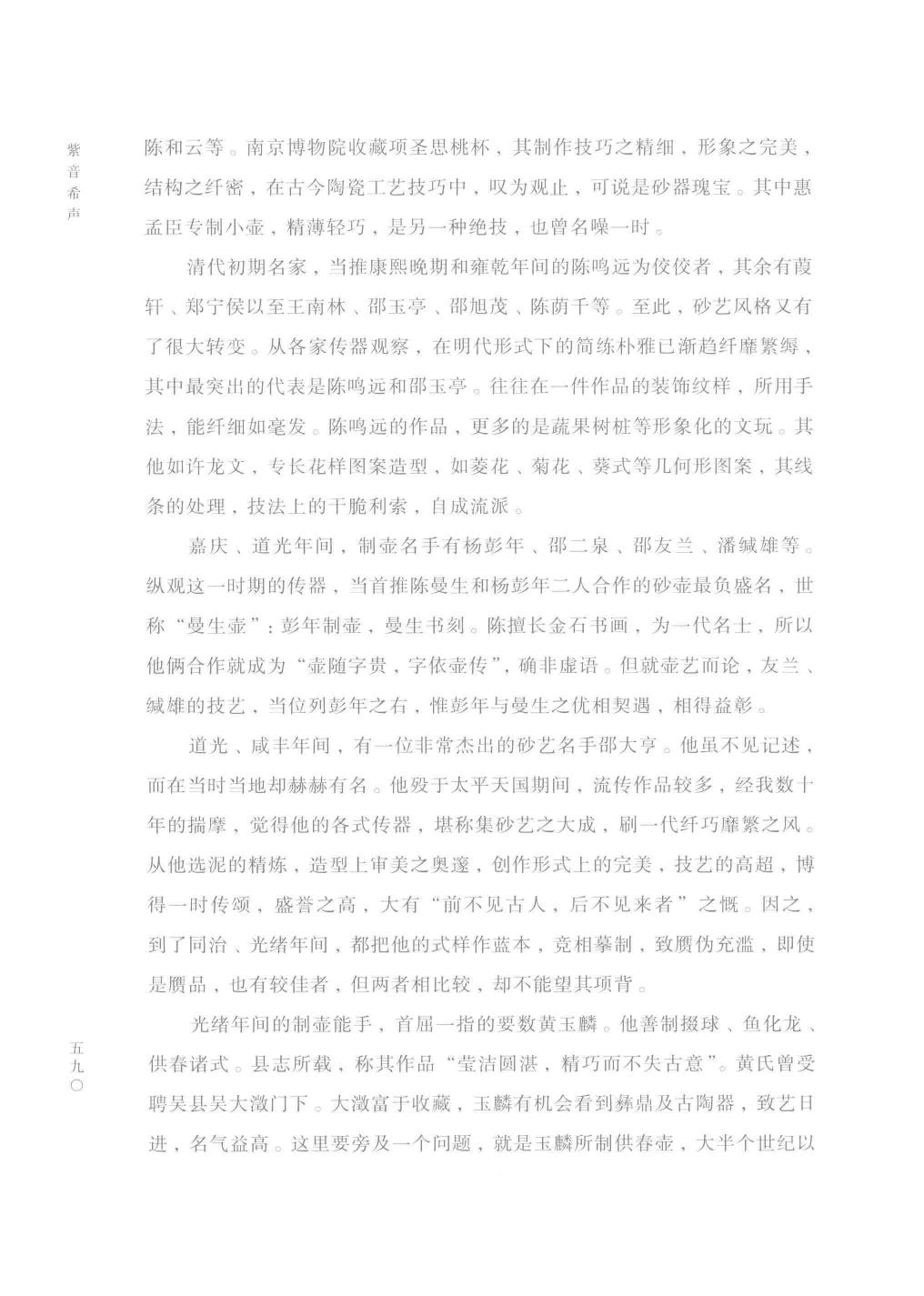
Chen Heyun and others. The Nanjing Museum houses Xiang Shengsi's peach cup, whose craftsmanship is so refined, form so perfect, and structure so intricate that it is breathtaking among ancient and modern ceramic techniques—truly a treasure of Yixing ware. Among these, Hui Mengchen specialized in small teapots, delicate and light, representing another supreme skill that once gained great renown.
The most distinguished masters of the early Qing dynasty were Chen Mingyuan of the late Kangxi and early Qianlong periods, followed by Xiang Xuan, Zheng Ninghou, Wang Nanlin, Shao Yuting, Shao Xumao, Chen Yinqian, and others. By this time, the style of Yixing ware had undergone significant transformation. Observing the surviving works of various masters, the simple elegance characteristic of Ming dynasty forms gradually gave way to elaborate ornamentation. The most prominent representatives of this trend were Chen Mingyuan and Shao Yuting. Often, the decorative patterns on a single piece employed techniques as fine as a hair. Chen Mingyuan's works were predominantly naturalistic scholar's objects in the form of vegetables, fruits, and tree stumps. Others, like Xu Longwen, specialized in floral and geometric patterns such as plum blossoms, chrysanthemums, and medicinal motifs, with a handling of lines and technical execution so crisp and decisive that he established his own school.
During the Jiaqing and Daoguang periods, renowned potters included Yang Pengnian, Shao Erquan, Shao Youlan, and Shao Chenxiong. Surveying the surviving works of this period, the most celebrated were undoubtedly the Yixing teapots created through the collaboration of Chen Hongshou and Yang Pengnian, known to the world as "Mansheng teapots": Pengnian made the pots, Mansheng inscribed them. Chen excelled in epigraphy, calligraphy, and painting, and was a renowned scholar of his generation. Thus their collaboration gave rise to the saying: "The pot gains value through the calligraphy, the calligraphy is transmitted through the pot"—no empty words indeed. Yet in terms of pottery skill alone, Youlan and Chenxiong's techniques should be ranked above Pengnian's; it was simply that Pengnian's fortuitous encounter with Mansheng created a synergy that enhanced both their achievements.
During the Daoguang and Xianfeng periods, there was an exceptionally outstanding Yixing master named Shao Daheng. Though he is not mentioned in historical records, he was tremendously famous locally at the time. He lived during the Taiping Rebellion period, and many of his works survive. After decades of study, I have come to believe that his various surviving pieces represent the culmination of Yixing artistry, sweeping away the ornate and elaborate style of the previous generation. From his refined clay selection, bold aesthetic in form, perfect creative expression, and superior technique, he earned widespread acclaim and such high reputation that one might say: "None before can compare, none after will follow." Consequently, during the Tongzhi and Guangxu periods, his styles were taken as models and widely imitated, leading to a flood of counterfeits. Even among the imitations, some were quite good, but when compared with the originals, they could not begin to approach them.
The foremost potter of the Guangxu period was undoubtedly Huang Yulin. He excelled at making teapots in the styles of twisted rope, fish transforming into dragon, and Gongchun. The county gazetteer records that his works were "lustrous and perfectly round, exquisite yet not losing the ancient spirit." Huang was employed by Wu Dacheng of Wu County. Wu was wealthy in his collection, and Yulin had the opportunity to see ancient bronzes and ceramics, which led to daily advancement in his art and ever-growing fame. Here we must touch upon an issue: the Gongchun teapots made by Yulin, for over half a century...
Chapter 10
附录
Appendix
Pages 526-651
View Chapter →
English Translation
## Part Five: Nine
Chen Heyun and others. The Nanjing Museum houses Xiang Shengsi's peach cup, whose craftsmanship is so refined, form so perfect, and structure so intricate that it is breathtaking among ancient and modern ceramic techniques—truly a treasure of Yixing ware. Among these, Hui Mengchen specialized in small teapots, delicate and light, representing another supreme skill that once gained great renown.
The most distinguished masters of the early Qing dynasty were Chen Mingyuan of the late Kangxi and early Qianlong periods, followed by Xiang Xuan, Zheng Ninghou, Wang Nanlin, Shao Yuting, Shao Xumao, Chen Yinqian, and others. By this time, the style of Yixing ware had undergone significant transformation. Observing the surviving works of various masters, the simple elegance characteristic of Ming dynasty forms gradually gave way to elaborate ornamentation. The most prominent representatives of this trend were Chen Mingyuan and Shao Yuting. Often, the decorative patterns on a single piece employed techniques as fine as a hair. Chen Mingyuan's works were predominantly naturalistic scholar's objects in the form of vegetables, fruits, and tree stumps. Others, like Xu Longwen, specialized in floral and geometric patterns such as plum blossoms, chrysanthemums, and medicinal motifs, with a handling of lines and technical execution so crisp and decisive that he established his own school.
During the Jiaqing and Daoguang periods, renowned potters included Yang Pengnian, Shao Erquan, Shao Youlan, and Shao Chenxiong. Surveying the surviving works of this period, the most celebrated were undoubtedly the Yixing teapots created through the collaboration of Chen Hongshou and Yang Pengnian, known to the world as "Mansheng teapots": Pengnian made the pots, Mansheng inscribed them. Chen excelled in epigraphy, calligraphy, and painting, and was a renowned scholar of his generation. Thus their collaboration gave rise to the saying: "The pot gains value through the calligraphy, the calligraphy is transmitted through the pot"—no empty words indeed. Yet in terms of pottery skill alone, Youlan and Chenxiong's techniques should be ranked above Pengnian's; it was simply that Pengnian's fortuitous encounter with Mansheng created a synergy that enhanced both their achievements.
During the Daoguang and Xianfeng periods, there was an exceptionally outstanding Yixing master named Shao Daheng. Though he is not mentioned in historical records, he was tremendously famous locally at the time. He lived during the Taiping Rebellion period, and many of his works survive. After decades of study, I have come to believe that his various surviving pieces represent the culmination of Yixing artistry, sweeping away the ornate and elaborate style of the previous generation. From his refined clay selection, bold aesthetic in form, perfect creative expression, and superior technique, he earned widespread acclaim and such high reputation that one might say: "None before can compare, none after will follow." Consequently, during the Tongzhi and Guangxu periods, his styles were taken as models and widely imitated, leading to a flood of counterfeits. Even among the imitations, some were quite good, but when compared with the originals, they could not begin to approach them.
The foremost potter of the Guangxu period was undoubtedly Huang Yulin. He excelled at making teapots in the styles of twisted rope, fish transforming into dragon, and Gongchun. The county gazetteer records that his works were "lustrous and perfectly round, exquisite yet not losing the ancient spirit." Huang was employed by Wu Dacheng of Wu County. Wu was wealthy in his collection, and Yulin had the opportunity to see ancient bronzes and ceramics, which led to daily advancement in his art and ever-growing fame. Here we must touch upon an issue: the Gongchun teapots made by Yulin, for over half a century...
章节导航 Chapter Navigation
Chapter 1
序文
Pages 6-6
Chapter 2
引言
Pages 28-31
Chapter 3
达变
Pages 32-133
Chapter 3
开宗立派
Pages 46-66
Chapter 3
传道授业
Pages 67-98
Chapter 3
大师淳友
Pages 99-120
Chapter 3
学艺谋生
Pages 121-133
Chapter 4
化神
Pages 134-141
Chapter 5
独妙
Pages 142-405
Chapter 5
匠心独运 不苟丝毫
Pages 142-179
Chapter 5
器利善事 物尽其用
Pages 180-199
Chapter 5
紫泥春华 研精究微
Pages 200-405
Chapter 6
驾简
Pages 406-427
Chapter 6
精雕细刻 文质合一
Pages 406-410
Chapter 6
师法自然 妙趣横生
Pages 411-415
Chapter 6
丝来线去 曲尽其妙
Pages 416-427
Chapter 7
明志
Pages 463-485
Chapter 7
高山仰止 淡泊明志
Pages 463-472
Chapter 7
啜墨看茶 气定神闲
Pages 473-478
Chapter 7
齿少心锐 怡志抒情
Pages 479-485
Chapter 8
存真
Pages 428-462
Chapter 8
规圆矩方 弃伪存真
Pages 428-436
Chapter 8
有物有则 钻尖仰高
Pages 437-462
Chapter 9
心营
Pages 506-525
Chapter 9
坚守传统 艺立潮头
Pages 506-513
Chapter 9
新型师承 桃李满园
Pages 514-525
Chapter 10
附录
Pages 526-651
Chapter 10
顾景舟紫艺论文
Pages 526-535
Chapter 10
技术课备课笔记
Pages 536-543
Chapter 10
顾景舟艺术年表
Pages 544-651
Chapter 11
参考文献
Pages 652-657
Chapter 12
鸣谢
Pages 658-659