Chapter 10
附录
Appendix
596
of 659
English Translation
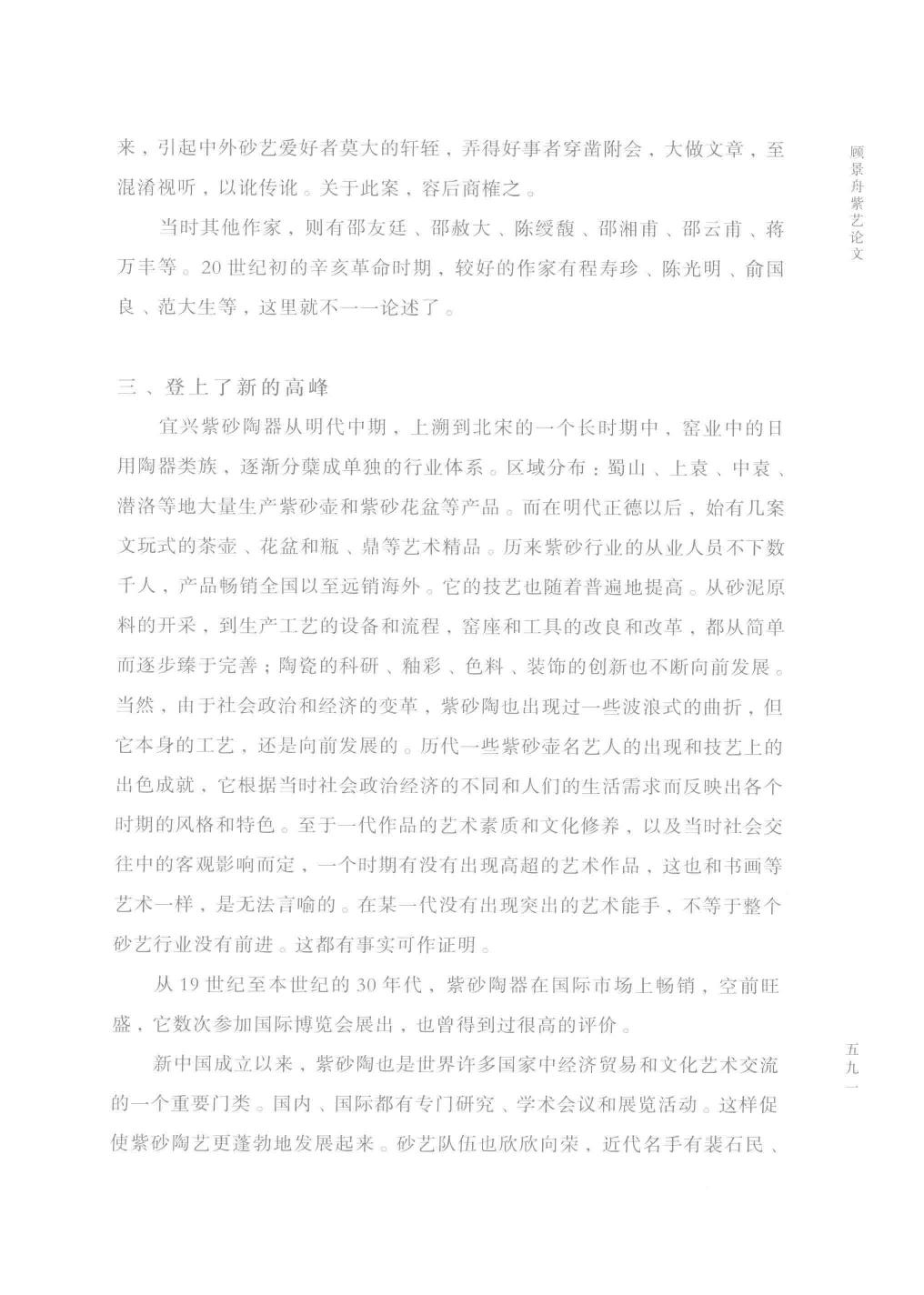
...causing great commotion among pottery art enthusiasts both in China and abroad, leading opportunists to engage in wild speculation and fabrication, making much ado about nothing, confusing public opinion with unfounded theories.
At that time, other artisans observed...
Regarding this case, it will be discussed later in detail.
Among them were Shao Youting, Shao Shefu, Chen Suidi, Shao Xiangfu, Shao Yunnan, Jiang Wanfeng, and others. In the early 20th century during the Xinhai Revolution period, notable artisans included Cheng Shouzhen, Chen Guangming, Yu Guoliang, and Fan Dasheng. Here, the first three...
## III. Ascending to New Heights
From the mid-Ming Dynasty onward, Yixing purple clay pottery gradually developed into an independent industrial system. Regional distribution: In areas such as Dingshu, Shushan, Shangyu, Zhongshu, Hongluo, and others, large quantities of purple clay daily-use pottery, scholar's teapots, flower pots, and purple clay planters were produced. After the Zhengde period of the Ming Dynasty, exquisite artistic pieces such as desk ornaments, vases, and tripods began to appear. Throughout history, the purple clay industry has employed no fewer than several thousand workers, with products selling well throughout the country and even exported overseas. Its craftsmanship has also generally improved over time. From the mining of clay materials to production techniques, equipment and processes, as well as the improvement and reform of vessels and tools, everything has gradually been perfected from simple beginnings. Research and development in glazes, pigments, and decorative innovations have also continuously advanced.
Of course, due to the objective influences of social, political, and economic changes, purple clay pottery has experienced some wave-like fluctuations, but its own craftsmanship has continued to develop forward. Like calligraphy and painting, it is ineffable. The appearance of renowned purple clay teapot artisans throughout history and their technical achievements reflected the different styles and characteristics of each historical period according to the social, political, and economic conditions of the time and people's living needs. Whether a particular period produced works of superior artistry depends on the artistic quality and cultural cultivation of that generation of artisans, as well as the objective influences of the social environment at the time.
The absence of outstanding artistic masters in a certain generation does not mean that the entire purple clay industry failed to advance... This can all be proven by facts.
From the 19th century to the 1930s, purple clay pottery enjoyed unprecedented prosperity in the international market. It participated in international expositions multiple times and received high acclaim.
Since the founding of New China, purple clay pottery has become an important category in economic trade and cultural and artistic exchanges between China and many countries worldwide. Both domestically and internationally, there are specialized research initiatives, academic conferences, and exhibition activities. This has promoted the more vigorous development of purple clay pottery art. The ranks of pottery artisans have also flourished. Modern masters include Pei Youmin, Feng Guiting, Yu Husi...
[Further discussion omitted.]
Chapter 10
附录
Appendix
Pages 526-651
View Chapter →
English Translation
...causing great commotion among pottery art enthusiasts both in China and abroad, leading opportunists to engage in wild speculation and fabrication, making much ado about nothing, confusing public opinion with unfounded theories.
At that time, other artisans observed...
Regarding this case, it will be discussed later in detail.
Among them were Shao Youting, Shao Shefu, Chen Suidi, Shao Xiangfu, Shao Yunnan, Jiang Wanfeng, and others. In the early 20th century during the Xinhai Revolution period, notable artisans included Cheng Shouzhen, Chen Guangming, Yu Guoliang, and Fan Dasheng. Here, the first three...
## III. Ascending to New Heights
From the mid-Ming Dynasty onward, Yixing purple clay pottery gradually developed into an independent industrial system. Regional distribution: In areas such as Dingshu, Shushan, Shangyu, Zhongshu, Hongluo, and others, large quantities of purple clay daily-use pottery, scholar's teapots, flower pots, and purple clay planters were produced. After the Zhengde period of the Ming Dynasty, exquisite artistic pieces such as desk ornaments, vases, and tripods began to appear. Throughout history, the purple clay industry has employed no fewer than several thousand workers, with products selling well throughout the country and even exported overseas. Its craftsmanship has also generally improved over time. From the mining of clay materials to production techniques, equipment and processes, as well as the improvement and reform of vessels and tools, everything has gradually been perfected from simple beginnings. Research and development in glazes, pigments, and decorative innovations have also continuously advanced.
Of course, due to the objective influences of social, political, and economic changes, purple clay pottery has experienced some wave-like fluctuations, but its own craftsmanship has continued to develop forward. Like calligraphy and painting, it is ineffable. The appearance of renowned purple clay teapot artisans throughout history and their technical achievements reflected the different styles and characteristics of each historical period according to the social, political, and economic conditions of the time and people's living needs. Whether a particular period produced works of superior artistry depends on the artistic quality and cultural cultivation of that generation of artisans, as well as the objective influences of the social environment at the time.
The absence of outstanding artistic masters in a certain generation does not mean that the entire purple clay industry failed to advance... This can all be proven by facts.
From the 19th century to the 1930s, purple clay pottery enjoyed unprecedented prosperity in the international market. It participated in international expositions multiple times and received high acclaim.
Since the founding of New China, purple clay pottery has become an important category in economic trade and cultural and artistic exchanges between China and many countries worldwide. Both domestically and internationally, there are specialized research initiatives, academic conferences, and exhibition activities. This has promoted the more vigorous development of purple clay pottery art. The ranks of pottery artisans have also flourished. Modern masters include Pei Youmin, Feng Guiting, Yu Husi...
[Further discussion omitted.]
章节导航 Chapter Navigation
Chapter 1
序文
Pages 6-6
Chapter 2
引言
Pages 28-31
Chapter 3
达变
Pages 32-133
Chapter 3
开宗立派
Pages 46-66
Chapter 3
传道授业
Pages 67-98
Chapter 3
大师淳友
Pages 99-120
Chapter 3
学艺谋生
Pages 121-133
Chapter 4
化神
Pages 134-141
Chapter 5
独妙
Pages 142-405
Chapter 5
匠心独运 不苟丝毫
Pages 142-179
Chapter 5
器利善事 物尽其用
Pages 180-199
Chapter 5
紫泥春华 研精究微
Pages 200-405
Chapter 6
驾简
Pages 406-427
Chapter 6
精雕细刻 文质合一
Pages 406-410
Chapter 6
师法自然 妙趣横生
Pages 411-415
Chapter 6
丝来线去 曲尽其妙
Pages 416-427
Chapter 7
明志
Pages 463-485
Chapter 7
高山仰止 淡泊明志
Pages 463-472
Chapter 7
啜墨看茶 气定神闲
Pages 473-478
Chapter 7
齿少心锐 怡志抒情
Pages 479-485
Chapter 8
存真
Pages 428-462
Chapter 8
规圆矩方 弃伪存真
Pages 428-436
Chapter 8
有物有则 钻尖仰高
Pages 437-462
Chapter 9
心营
Pages 506-525
Chapter 9
坚守传统 艺立潮头
Pages 506-513
Chapter 9
新型师承 桃李满园
Pages 514-525
Chapter 10
附录
Pages 526-651
Chapter 10
顾景舟紫艺论文
Pages 526-535
Chapter 10
技术课备课笔记
Pages 536-543
Chapter 10
顾景舟艺术年表
Pages 544-651
Chapter 11
参考文献
Pages 652-657
Chapter 12
鸣谢
Pages 658-659