Chapter 10
附录
Appendix
598
of 659
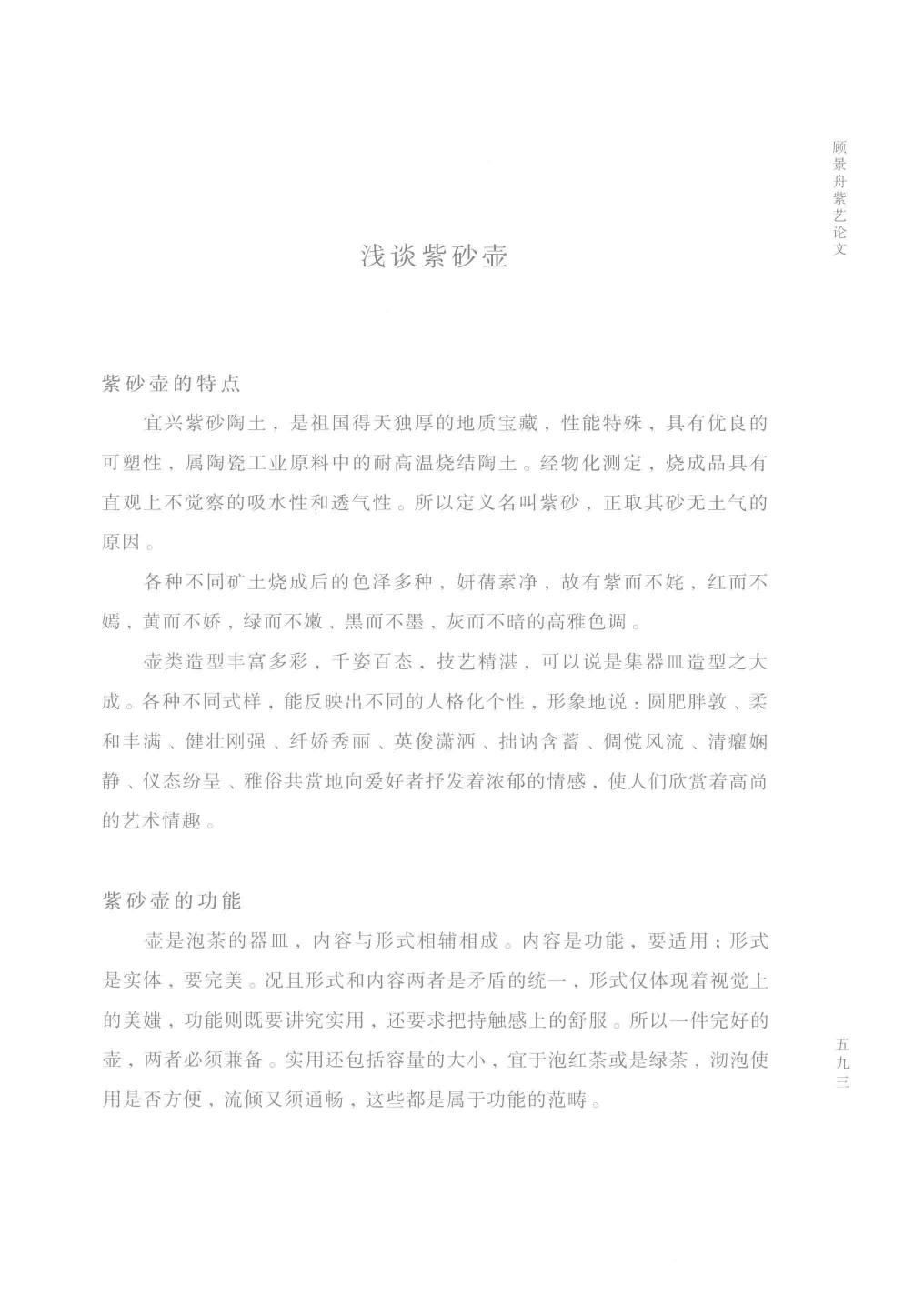
English Translation
## Characteristics of Zisha Teapots
The Yixing zisha clay is a uniquely endowed geological treasure of our nation, with special properties and excellent plasticity. It belongs to the category of high-temperature sintering clay among ceramic industrial raw materials. Through physical and chemical analysis, the fired products possess water absorption and air permeability that are imperceptible to direct observation. Therefore, it is defined and named zisha, precisely because of its sandy quality without earthiness.
Various mineral clays produce diverse colors after firing, elegant and refined. Thus they possess noble color tones: purple without vulgarity, red without garishness, yellow without showiness, green without tenderness, black without inkiness, and gray without dullness.
Teapot forms are rich and varied, displaying a thousand postures and myriad appearances with exquisite craftsmanship. It can be said that they represent the culmination of vessel modeling. Different styles reflect different personified characteristics. Figuratively speaking: round and plump, soft and full, robust and strong, delicate and graceful, handsome and elegant, simple and reserved, individually charming, slender and serene—presenting diverse demeanors that appeal to both refined and popular tastes, expressing rich emotions to enthusiasts and allowing people to appreciate elevated artistic sensibilities.
## Functions of Zisha Teapots
After all, they are vessels for brewing tea, where content and form complement each other. Content is function, which must be practical; form is substance, which must be perfect. Moreover, form and content are a unity of opposites. Form merely embodies visual beauty, while function must emphasize practicality and also demand comfortable tactile sensation when handled. Therefore, a perfect piece must possess both qualities. Practicality also includes considerations of capacity size, suitability for brewing black tea or green tea, convenience in brewing and use, and smooth pouring—all of these belong to the realm of function.
Chapter 10
附录
Appendix
Pages 526-651
View Chapter →
English Translation
## Characteristics of Zisha Teapots
The Yixing zisha clay is a uniquely endowed geological treasure of our nation, with special properties and excellent plasticity. It belongs to the category of high-temperature sintering clay among ceramic industrial raw materials. Through physical and chemical analysis, the fired products possess water absorption and air permeability that are imperceptible to direct observation. Therefore, it is defined and named zisha, precisely because of its sandy quality without earthiness.
Various mineral clays produce diverse colors after firing, elegant and refined. Thus they possess noble color tones: purple without vulgarity, red without garishness, yellow without showiness, green without tenderness, black without inkiness, and gray without dullness.
Teapot forms are rich and varied, displaying a thousand postures and myriad appearances with exquisite craftsmanship. It can be said that they represent the culmination of vessel modeling. Different styles reflect different personified characteristics. Figuratively speaking: round and plump, soft and full, robust and strong, delicate and graceful, handsome and elegant, simple and reserved, individually charming, slender and serene—presenting diverse demeanors that appeal to both refined and popular tastes, expressing rich emotions to enthusiasts and allowing people to appreciate elevated artistic sensibilities.
## Functions of Zisha Teapots
After all, they are vessels for brewing tea, where content and form complement each other. Content is function, which must be practical; form is substance, which must be perfect. Moreover, form and content are a unity of opposites. Form merely embodies visual beauty, while function must emphasize practicality and also demand comfortable tactile sensation when handled. Therefore, a perfect piece must possess both qualities. Practicality also includes considerations of capacity size, suitability for brewing black tea or green tea, convenience in brewing and use, and smooth pouring—all of these belong to the realm of function.
章节导航 Chapter Navigation
Chapter 1
序文
Pages 6-6
Chapter 2
引言
Pages 28-31
Chapter 3
达变
Pages 32-133
Chapter 3
开宗立派
Pages 46-66
Chapter 3
传道授业
Pages 67-98
Chapter 3
大师淳友
Pages 99-120
Chapter 3
学艺谋生
Pages 121-133
Chapter 4
化神
Pages 134-141
Chapter 5
独妙
Pages 142-405
Chapter 5
匠心独运 不苟丝毫
Pages 142-179
Chapter 5
器利善事 物尽其用
Pages 180-199
Chapter 5
紫泥春华 研精究微
Pages 200-405
Chapter 6
驾简
Pages 406-427
Chapter 6
精雕细刻 文质合一
Pages 406-410
Chapter 6
师法自然 妙趣横生
Pages 411-415
Chapter 6
丝来线去 曲尽其妙
Pages 416-427
Chapter 7
明志
Pages 463-485
Chapter 7
高山仰止 淡泊明志
Pages 463-472
Chapter 7
啜墨看茶 气定神闲
Pages 473-478
Chapter 7
齿少心锐 怡志抒情
Pages 479-485
Chapter 8
存真
Pages 428-462
Chapter 8
规圆矩方 弃伪存真
Pages 428-436
Chapter 8
有物有则 钻尖仰高
Pages 437-462
Chapter 9
心营
Pages 506-525
Chapter 9
坚守传统 艺立潮头
Pages 506-513
Chapter 9
新型师承 桃李满园
Pages 514-525
Chapter 10
附录
Pages 526-651
Chapter 10
顾景舟紫艺论文
Pages 526-535
Chapter 10
技术课备课笔记
Pages 536-543
Chapter 10
顾景舟艺术年表
Pages 544-651
Chapter 11
参考文献
Pages 652-657
Chapter 12
鸣谢
Pages 658-659