Chapter 10
附录
Appendix
611
of 659
English Translation
+ 口禾
地
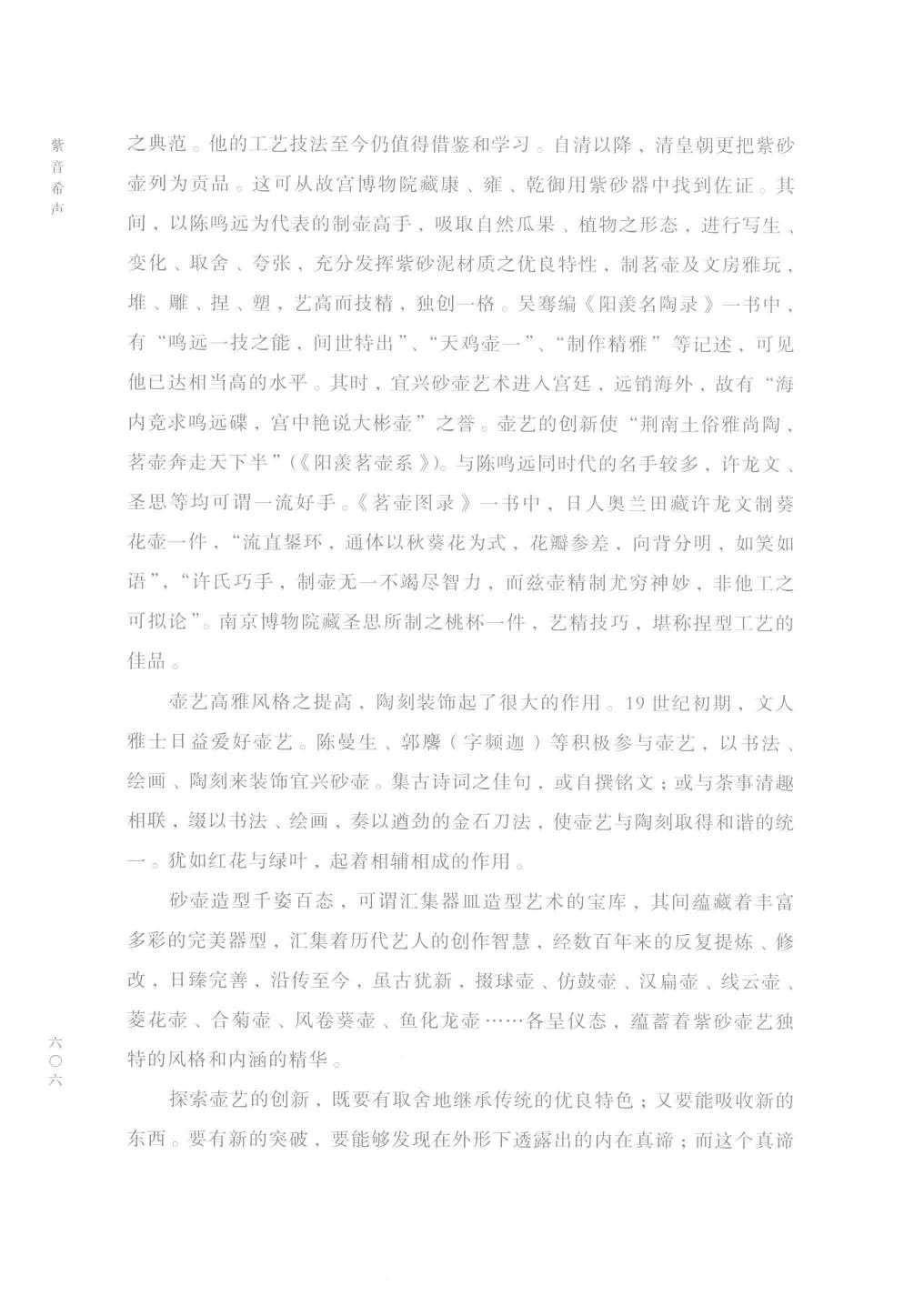
...a paragon of excellence—his craft techniques remain worthy of study and emulation to this day. From the Qing dynasty onward, the Qing imperial court elevated Yixing teapots to the status of tribute items. This can be corroborated by the Yixing wares used by the Kangxi, Yongzheng, and Qianlong emperors, now housed in the Palace Museum. During this period, master potters represented by Chen Mingyuan drew upon the forms of natural melons, fruits, and plants, sketching from life, transforming, selecting, and exaggerating, fully exploiting the excellent properties of Yixing clay to create teapots and elegant scholar's objects. Through piling, carving, molding, and sculpting—with consummate skill and refined technique—they established a unique style. In Wu Qian's book *Yangxian Ming Tao Lu* (*Record of Famous Pottery from Yangxian*), there are accounts such as "Mingyuan's singular skill emerged exceptionally in his generation" and "the Tianji teapot...exquisitely crafted," demonstrating that he had reached a remarkably high level. At that time, Yixing teapot art entered the imperial court and was exported overseas, hence the saying: "Throughout the realm, people seek Mingyuan's vessels; among the wealthy, they speak admiringly of Dabin's teapots." Innovation in teapot artistry led to "the customs of Jingnan elegantly favoring pottery, with teapots rushing across half the world" (from *Yangxian Pottery Records*). Many renowned craftsmen were contemporaries of Chen Mingyuan; Xu Longwen, Sheng Si, and others can all be considered first-rate masters. In the book *Teapot Illustrated Catalog*, the Japanese collector Okurada possessed a mallow flower teapot made by Xu Longwen: "the spout straight, the handle looped, the entire body fashioned in the form of autumn mallow flowers, the petals arranged in varying heights, their orientations distinct, as if smiling, as if speaking." "Master Xu's skillful hands crafted teapots, each exhausting his intelligence and strength, and this teapot's refined execution particularly reaches divine subtlety, beyond what other craftsmen can compare to." The Nanjing Museum houses a peach-shaped cup made by Sheng Si—artistically refined and technically skillful, it stands as an exemplary work of molding craftsmanship.
The elevation of teapot art's refined aesthetic owes much to the role of ceramic engraving decoration. In the early 19th century, literati and scholars increasingly developed a passion for teapot art. Chen Mansheng, Guo Mo (courtesy name Pinjia), and others actively participated in teapot artistry, decorating Yixing teapots with calligraphy, painting, and ceramic engraving. They selected fine lines from classical poetry, or composed their own inscriptions; or connected them with the refined pleasures of tea culture, embellishing them with calligraphy and painting, engraving them with vigorous seal-script knife techniques, achieving harmonious unity between teapot art and ceramic engraving—like red flowers and green leaves, playing complementary roles.
Yixing teapot forms are myriad and varied, truly a treasury of ceramic sculptural art, containing within them a rich and colorful array of perfect vessel forms, gathering the creative wisdom of generations of artisans. Through hundreds of years of repeated refinement and modification, they have been perfected day by day and transmitted to the present. Though ancient, they remain fresh: the Stone Ladle Teapot, the Drum Imitation Teapot, the Han Flat Teapot, the Coiled Cloud Teapot, the Lotus Flower Teapot, the Chrysanthemum Teapot, the Wind-Rolled Lotus Leaf Teapot, the Fish Transforming into Dragon Teapot...each displays its own bearing, embodying the unique style and essential spirit of Yixing teapot art.
In exploring innovation in teapot artistry, one must both selectively inherit the excellent characteristics of tradition and absorb new elements. To achieve new breakthroughs, one must be able to discover the inner truth revealed beneath the external form; and this truth...
Chapter 10
附录
Appendix
Pages 526-651
View Chapter →
English Translation
+ 口禾
地
...a paragon of excellence—his craft techniques remain worthy of study and emulation to this day. From the Qing dynasty onward, the Qing imperial court elevated Yixing teapots to the status of tribute items. This can be corroborated by the Yixing wares used by the Kangxi, Yongzheng, and Qianlong emperors, now housed in the Palace Museum. During this period, master potters represented by Chen Mingyuan drew upon the forms of natural melons, fruits, and plants, sketching from life, transforming, selecting, and exaggerating, fully exploiting the excellent properties of Yixing clay to create teapots and elegant scholar's objects. Through piling, carving, molding, and sculpting—with consummate skill and refined technique—they established a unique style. In Wu Qian's book *Yangxian Ming Tao Lu* (*Record of Famous Pottery from Yangxian*), there are accounts such as "Mingyuan's singular skill emerged exceptionally in his generation" and "the Tianji teapot...exquisitely crafted," demonstrating that he had reached a remarkably high level. At that time, Yixing teapot art entered the imperial court and was exported overseas, hence the saying: "Throughout the realm, people seek Mingyuan's vessels; among the wealthy, they speak admiringly of Dabin's teapots." Innovation in teapot artistry led to "the customs of Jingnan elegantly favoring pottery, with teapots rushing across half the world" (from *Yangxian Pottery Records*). Many renowned craftsmen were contemporaries of Chen Mingyuan; Xu Longwen, Sheng Si, and others can all be considered first-rate masters. In the book *Teapot Illustrated Catalog*, the Japanese collector Okurada possessed a mallow flower teapot made by Xu Longwen: "the spout straight, the handle looped, the entire body fashioned in the form of autumn mallow flowers, the petals arranged in varying heights, their orientations distinct, as if smiling, as if speaking." "Master Xu's skillful hands crafted teapots, each exhausting his intelligence and strength, and this teapot's refined execution particularly reaches divine subtlety, beyond what other craftsmen can compare to." The Nanjing Museum houses a peach-shaped cup made by Sheng Si—artistically refined and technically skillful, it stands as an exemplary work of molding craftsmanship.
The elevation of teapot art's refined aesthetic owes much to the role of ceramic engraving decoration. In the early 19th century, literati and scholars increasingly developed a passion for teapot art. Chen Mansheng, Guo Mo (courtesy name Pinjia), and others actively participated in teapot artistry, decorating Yixing teapots with calligraphy, painting, and ceramic engraving. They selected fine lines from classical poetry, or composed their own inscriptions; or connected them with the refined pleasures of tea culture, embellishing them with calligraphy and painting, engraving them with vigorous seal-script knife techniques, achieving harmonious unity between teapot art and ceramic engraving—like red flowers and green leaves, playing complementary roles.
Yixing teapot forms are myriad and varied, truly a treasury of ceramic sculptural art, containing within them a rich and colorful array of perfect vessel forms, gathering the creative wisdom of generations of artisans. Through hundreds of years of repeated refinement and modification, they have been perfected day by day and transmitted to the present. Though ancient, they remain fresh: the Stone Ladle Teapot, the Drum Imitation Teapot, the Han Flat Teapot, the Coiled Cloud Teapot, the Lotus Flower Teapot, the Chrysanthemum Teapot, the Wind-Rolled Lotus Leaf Teapot, the Fish Transforming into Dragon Teapot...each displays its own bearing, embodying the unique style and essential spirit of Yixing teapot art.
In exploring innovation in teapot artistry, one must both selectively inherit the excellent characteristics of tradition and absorb new elements. To achieve new breakthroughs, one must be able to discover the inner truth revealed beneath the external form; and this truth...
章节导航 Chapter Navigation
Chapter 1
序文
Pages 6-6
Chapter 2
引言
Pages 28-31
Chapter 3
达变
Pages 32-133
Chapter 3
开宗立派
Pages 46-66
Chapter 3
传道授业
Pages 67-98
Chapter 3
大师淳友
Pages 99-120
Chapter 3
学艺谋生
Pages 121-133
Chapter 4
化神
Pages 134-141
Chapter 5
独妙
Pages 142-405
Chapter 5
匠心独运 不苟丝毫
Pages 142-179
Chapter 5
器利善事 物尽其用
Pages 180-199
Chapter 5
紫泥春华 研精究微
Pages 200-405
Chapter 6
驾简
Pages 406-427
Chapter 6
精雕细刻 文质合一
Pages 406-410
Chapter 6
师法自然 妙趣横生
Pages 411-415
Chapter 6
丝来线去 曲尽其妙
Pages 416-427
Chapter 7
明志
Pages 463-485
Chapter 7
高山仰止 淡泊明志
Pages 463-472
Chapter 7
啜墨看茶 气定神闲
Pages 473-478
Chapter 7
齿少心锐 怡志抒情
Pages 479-485
Chapter 8
存真
Pages 428-462
Chapter 8
规圆矩方 弃伪存真
Pages 428-436
Chapter 8
有物有则 钻尖仰高
Pages 437-462
Chapter 9
心营
Pages 506-525
Chapter 9
坚守传统 艺立潮头
Pages 506-513
Chapter 9
新型师承 桃李满园
Pages 514-525
Chapter 10
附录
Pages 526-651
Chapter 10
顾景舟紫艺论文
Pages 526-535
Chapter 10
技术课备课笔记
Pages 536-543
Chapter 10
顾景舟艺术年表
Pages 544-651
Chapter 11
参考文献
Pages 652-657
Chapter 12
鸣谢
Pages 658-659