Chapter 10
附录
Appendix
612
of 659
English Translation
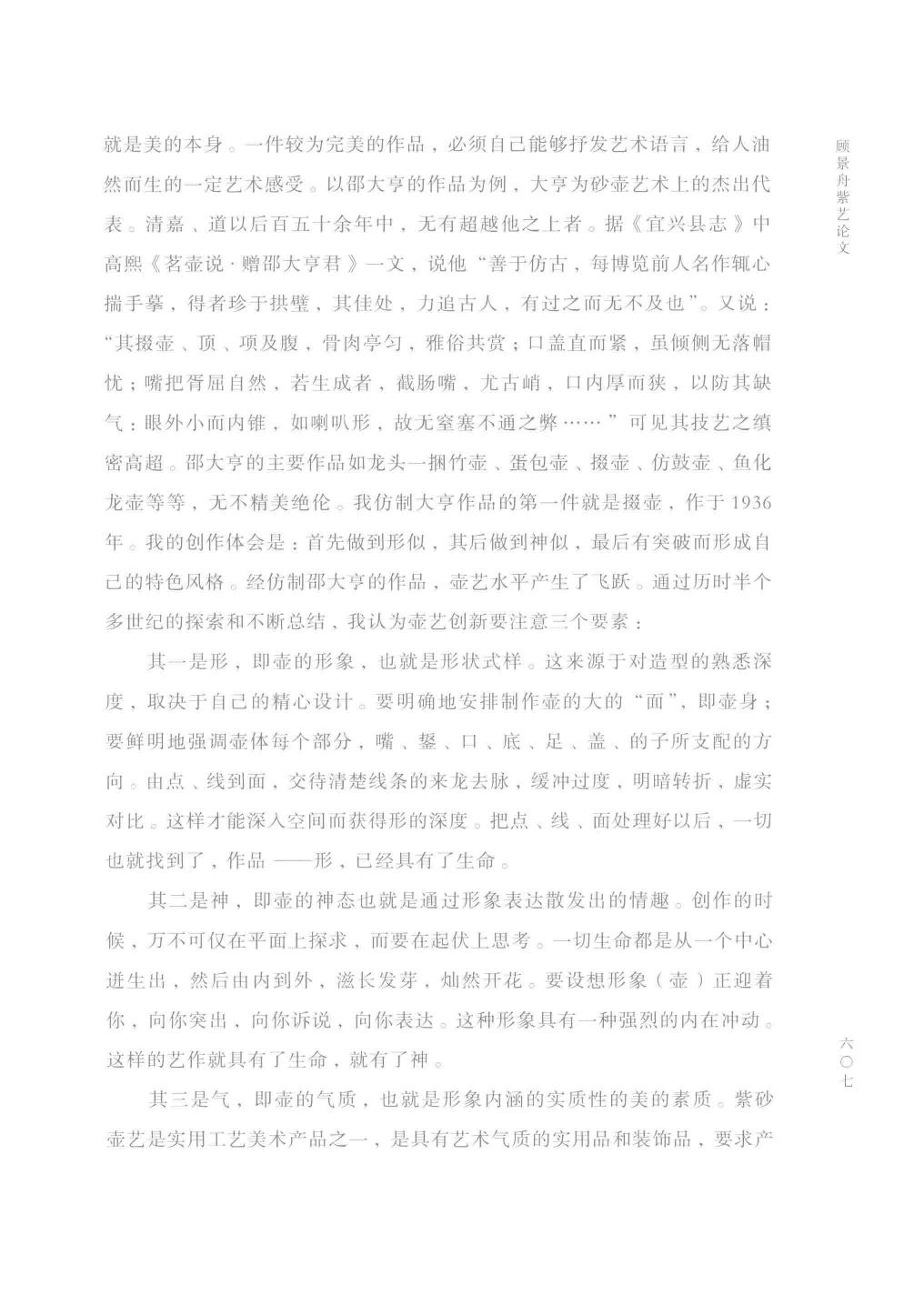
A relatively perfect work must be able to express its artistic language and naturally evoke a certain artistic feeling in the viewer. Taking the works of Shao Daheng as an example, Daheng was an outstanding representative in the art of clay teapots. In the more than 150 years since the Jiaqing and Daoguang periods of the Qing Dynasty, no one has surpassed him. According to Gao Ru's essay "On Teapots: Presented to Mr. Shao Daheng" in the *Yixing County Gazetteer*, he "excelled at imitating antiquity. He would extensively study famous works of predecessors, carefully examining and copying them by hand. Those who obtained his works treasured them like precious jade. In his finest achievements, he pursued the ancients with such dedication that he surpassed them, never falling short." The text further states:
> "His handles, lids, necks, and bodies achieve a balance of structure and form that appeals to both refined and common tastes. The mouth and lid fit straight and tight, so that even when tilted there is no worry of the lid falling off. The spout and handle curve naturally, as if formed by nature. The cut spout is especially ancient and elegant. The mouth is thick and narrow inside to prevent air leakage. The holes are small on the outside but conical inside, shaped like a trumpet, thus avoiding the problem of blockage."
This demonstrates the meticulous and superior nature of his craftsmanship. Shao Daheng's major works—such as the Dragon Head Yixing Bamboo Teapot, Egg-Wrapped Teapot, Handle Teapot, Imitation Drum Teapot, and Fish Transformation Teapot—are all exquisitely beautiful without exception. The first work I imitated from Daheng was the Handle Teapot, made in 1936. My creative experience is this: first achieve physical resemblance, then achieve spiritual resemblance, and finally break through to form one's own distinctive style. Through imitating Shao Daheng's works, my artistic level made a leap forward. Through more than half a century of exploration and continuous reflection, I believe that artistic innovation in teapot-making requires attention to three elements:
## Form
The first is *form* (xing), that is, the teapot's image—its shape and style. This derives from one's depth of familiarity with modeling and depends on one's careful design. One must clearly arrange the major "surfaces" of the teapot, namely the body. One must distinctly emphasize each part of the teapot body—the spout, handle, mouth, base, foot, lid, and knob—and the directions they govern. From point to line to surface, clearly account for the origins and development of the lines, the buffering transitions, the light and dark turns, and the contrasts between solid and void. Only in this way can one penetrate into space and achieve depth of form. Once the points, lines, and surfaces are handled well, everything falls into place, and the work's form already possesses life.
## Spirit
The second is *spirit* (shen), that is, the teapot's demeanor—the charm expressed and emanated through its form. When creating, one must never merely explore on a flat plane, but must think in terms of undulation. All life emerges from a center, then from inside to outside, gradually growing and sprouting, suddenly blossoming. One must envision the form (the teapot) facing you directly, protruding toward you, speaking to you, expressing itself to you. This kind of form possesses a strong internal momentum. Such an artistic work then possesses life and has spirit.
## Essence
The third is *essence* (qi), that is, the teapot's temperament—the substantial aesthetic quality of the form's inner content. Yixing clay is one of the practical craft art products, a utilitarian and decorative item with artistic temperament. The product requires...
Chapter 10
附录
Appendix
Pages 526-651
View Chapter →
English Translation
A relatively perfect work must be able to express its artistic language and naturally evoke a certain artistic feeling in the viewer. Taking the works of Shao Daheng as an example, Daheng was an outstanding representative in the art of clay teapots. In the more than 150 years since the Jiaqing and Daoguang periods of the Qing Dynasty, no one has surpassed him. According to Gao Ru's essay "On Teapots: Presented to Mr. Shao Daheng" in the *Yixing County Gazetteer*, he "excelled at imitating antiquity. He would extensively study famous works of predecessors, carefully examining and copying them by hand. Those who obtained his works treasured them like precious jade. In his finest achievements, he pursued the ancients with such dedication that he surpassed them, never falling short." The text further states:
> "His handles, lids, necks, and bodies achieve a balance of structure and form that appeals to both refined and common tastes. The mouth and lid fit straight and tight, so that even when tilted there is no worry of the lid falling off. The spout and handle curve naturally, as if formed by nature. The cut spout is especially ancient and elegant. The mouth is thick and narrow inside to prevent air leakage. The holes are small on the outside but conical inside, shaped like a trumpet, thus avoiding the problem of blockage."
This demonstrates the meticulous and superior nature of his craftsmanship. Shao Daheng's major works—such as the Dragon Head Yixing Bamboo Teapot, Egg-Wrapped Teapot, Handle Teapot, Imitation Drum Teapot, and Fish Transformation Teapot—are all exquisitely beautiful without exception. The first work I imitated from Daheng was the Handle Teapot, made in 1936. My creative experience is this: first achieve physical resemblance, then achieve spiritual resemblance, and finally break through to form one's own distinctive style. Through imitating Shao Daheng's works, my artistic level made a leap forward. Through more than half a century of exploration and continuous reflection, I believe that artistic innovation in teapot-making requires attention to three elements:
## Form
The first is *form* (xing), that is, the teapot's image—its shape and style. This derives from one's depth of familiarity with modeling and depends on one's careful design. One must clearly arrange the major "surfaces" of the teapot, namely the body. One must distinctly emphasize each part of the teapot body—the spout, handle, mouth, base, foot, lid, and knob—and the directions they govern. From point to line to surface, clearly account for the origins and development of the lines, the buffering transitions, the light and dark turns, and the contrasts between solid and void. Only in this way can one penetrate into space and achieve depth of form. Once the points, lines, and surfaces are handled well, everything falls into place, and the work's form already possesses life.
## Spirit
The second is *spirit* (shen), that is, the teapot's demeanor—the charm expressed and emanated through its form. When creating, one must never merely explore on a flat plane, but must think in terms of undulation. All life emerges from a center, then from inside to outside, gradually growing and sprouting, suddenly blossoming. One must envision the form (the teapot) facing you directly, protruding toward you, speaking to you, expressing itself to you. This kind of form possesses a strong internal momentum. Such an artistic work then possesses life and has spirit.
## Essence
The third is *essence* (qi), that is, the teapot's temperament—the substantial aesthetic quality of the form's inner content. Yixing clay is one of the practical craft art products, a utilitarian and decorative item with artistic temperament. The product requires...
章节导航 Chapter Navigation
Chapter 1
序文
Pages 6-6
Chapter 2
引言
Pages 28-31
Chapter 3
达变
Pages 32-133
Chapter 3
开宗立派
Pages 46-66
Chapter 3
传道授业
Pages 67-98
Chapter 3
大师淳友
Pages 99-120
Chapter 3
学艺谋生
Pages 121-133
Chapter 4
化神
Pages 134-141
Chapter 5
独妙
Pages 142-405
Chapter 5
匠心独运 不苟丝毫
Pages 142-179
Chapter 5
器利善事 物尽其用
Pages 180-199
Chapter 5
紫泥春华 研精究微
Pages 200-405
Chapter 6
驾简
Pages 406-427
Chapter 6
精雕细刻 文质合一
Pages 406-410
Chapter 6
师法自然 妙趣横生
Pages 411-415
Chapter 6
丝来线去 曲尽其妙
Pages 416-427
Chapter 7
明志
Pages 463-485
Chapter 7
高山仰止 淡泊明志
Pages 463-472
Chapter 7
啜墨看茶 气定神闲
Pages 473-478
Chapter 7
齿少心锐 怡志抒情
Pages 479-485
Chapter 8
存真
Pages 428-462
Chapter 8
规圆矩方 弃伪存真
Pages 428-436
Chapter 8
有物有则 钻尖仰高
Pages 437-462
Chapter 9
心营
Pages 506-525
Chapter 9
坚守传统 艺立潮头
Pages 506-513
Chapter 9
新型师承 桃李满园
Pages 514-525
Chapter 10
附录
Pages 526-651
Chapter 10
顾景舟紫艺论文
Pages 526-535
Chapter 10
技术课备课笔记
Pages 536-543
Chapter 10
顾景舟艺术年表
Pages 544-651
Chapter 11
参考文献
Pages 652-657
Chapter 12
鸣谢
Pages 658-659