Chapter 10
附录
Appendix
614
of 659
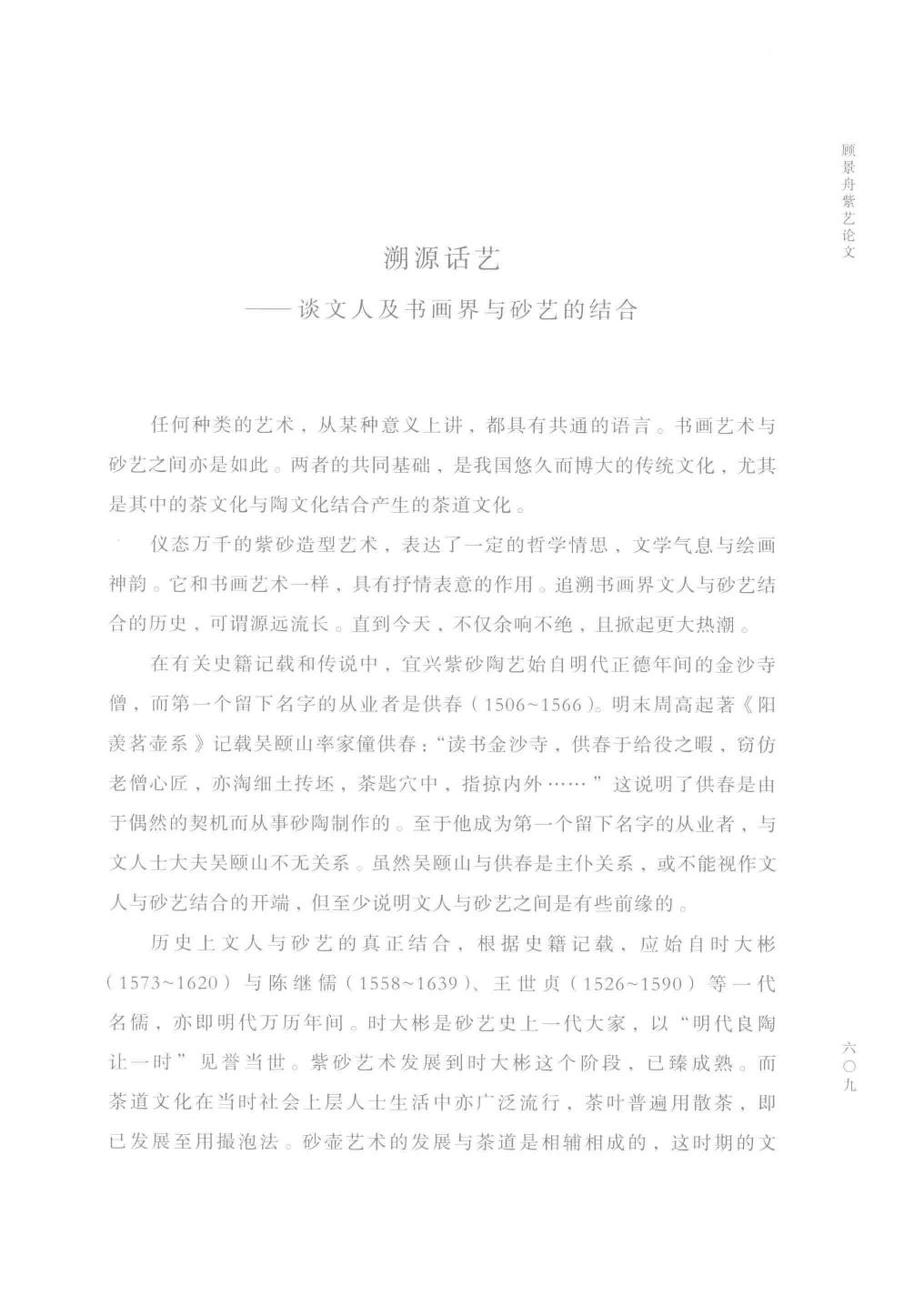
English Translation
# Tracing Origins and Discussing Art
## On the Integration of Literati and Calligraphy-Painting Circles with the Art of Purple Clay
Any form of art, in a certain sense, possesses a common language. This is true between the arts of calligraphy-painting and purple clay pottery. The shared foundation of both lies in China's long-standing and profound traditional culture, especially the tea ceremony culture born from the combination of tea culture and ceramic culture.
The myriad forms of purple clay pottery art express a certain philosophical sentiment, literary atmosphere, and painterly spirit. Like calligraphy and painting, it serves to convey emotion and meaning. Tracing the history of the integration between literati of the calligraphy-painting world and purple clay art reveals a long and continuous tradition. Even today, not only does its resonance persist, but it has sparked an even greater wave of enthusiasm.
According to historical records and legends, Yixing purple clay pottery art began with a monk from Jinsha Temple during the Zhengde period of the Ming Dynasty, while the first practitioner whose name was recorded was Gong Chun (1506–1566). Zhou Gaoqi of the Ming Dynasty wrote in *Yangxian Teapot System*: "Wu Yishan brought his servant Gong Chun when studying at Jinsha Temple. During his spare time from service, Gong Chun secretly imitated the old monk's craftsmanship, also refining fine clay to form vessels, [working] in the cave dwelling, shaping inside and out with his fingers..." This indicates that Gong Chun took up purple clay pottery making through a chance opportunity. As for his becoming the first practitioner whose name was recorded, this was not unrelated to the literatus Wu Yishan. Although Wu Yishan and Gong Chun had a master-servant relationship, which may not be considered the beginning of the integration between literati and purple clay art, it at least demonstrates that there was some prior connection between literati and purple clay art.
The true integration of literati and purple clay art in history, according to historical records, should begin with Shi Dabin (1573–1620) and a generation of renowned masters including Chen Jiru (1558–1639) and Wang Shizhen (1526–1590)—that is, during the Wanli period of the Ming Dynasty. Shi Dabin was a great master in the history of purple clay art, renowned in his time as "the finest potter of the Ming Dynasty." By the time purple clay art developed to Shi Dabin's stage, it had reached maturity. Tea ceremony culture was also widely popular among the upper classes of society at that time. Tea drinking commonly used loose tea leaves and had already developed the steeping method. The development of purple clay teapot art and the tea ceremony were mutually reinforcing. During this period, literati...
Chapter 10
附录
Appendix
Pages 526-651
View Chapter →
English Translation
# Tracing Origins and Discussing Art
## On the Integration of Literati and Calligraphy-Painting Circles with the Art of Purple Clay
Any form of art, in a certain sense, possesses a common language. This is true between the arts of calligraphy-painting and purple clay pottery. The shared foundation of both lies in China's long-standing and profound traditional culture, especially the tea ceremony culture born from the combination of tea culture and ceramic culture.
The myriad forms of purple clay pottery art express a certain philosophical sentiment, literary atmosphere, and painterly spirit. Like calligraphy and painting, it serves to convey emotion and meaning. Tracing the history of the integration between literati of the calligraphy-painting world and purple clay art reveals a long and continuous tradition. Even today, not only does its resonance persist, but it has sparked an even greater wave of enthusiasm.
According to historical records and legends, Yixing purple clay pottery art began with a monk from Jinsha Temple during the Zhengde period of the Ming Dynasty, while the first practitioner whose name was recorded was Gong Chun (1506–1566). Zhou Gaoqi of the Ming Dynasty wrote in *Yangxian Teapot System*: "Wu Yishan brought his servant Gong Chun when studying at Jinsha Temple. During his spare time from service, Gong Chun secretly imitated the old monk's craftsmanship, also refining fine clay to form vessels, [working] in the cave dwelling, shaping inside and out with his fingers..." This indicates that Gong Chun took up purple clay pottery making through a chance opportunity. As for his becoming the first practitioner whose name was recorded, this was not unrelated to the literatus Wu Yishan. Although Wu Yishan and Gong Chun had a master-servant relationship, which may not be considered the beginning of the integration between literati and purple clay art, it at least demonstrates that there was some prior connection between literati and purple clay art.
The true integration of literati and purple clay art in history, according to historical records, should begin with Shi Dabin (1573–1620) and a generation of renowned masters including Chen Jiru (1558–1639) and Wang Shizhen (1526–1590)—that is, during the Wanli period of the Ming Dynasty. Shi Dabin was a great master in the history of purple clay art, renowned in his time as "the finest potter of the Ming Dynasty." By the time purple clay art developed to Shi Dabin's stage, it had reached maturity. Tea ceremony culture was also widely popular among the upper classes of society at that time. Tea drinking commonly used loose tea leaves and had already developed the steeping method. The development of purple clay teapot art and the tea ceremony were mutually reinforcing. During this period, literati...
章节导航 Chapter Navigation
Chapter 1
序文
Pages 6-6
Chapter 2
引言
Pages 28-31
Chapter 3
达变
Pages 32-133
Chapter 3
开宗立派
Pages 46-66
Chapter 3
传道授业
Pages 67-98
Chapter 3
大师淳友
Pages 99-120
Chapter 3
学艺谋生
Pages 121-133
Chapter 4
化神
Pages 134-141
Chapter 5
独妙
Pages 142-405
Chapter 5
匠心独运 不苟丝毫
Pages 142-179
Chapter 5
器利善事 物尽其用
Pages 180-199
Chapter 5
紫泥春华 研精究微
Pages 200-405
Chapter 6
驾简
Pages 406-427
Chapter 6
精雕细刻 文质合一
Pages 406-410
Chapter 6
师法自然 妙趣横生
Pages 411-415
Chapter 6
丝来线去 曲尽其妙
Pages 416-427
Chapter 7
明志
Pages 463-485
Chapter 7
高山仰止 淡泊明志
Pages 463-472
Chapter 7
啜墨看茶 气定神闲
Pages 473-478
Chapter 7
齿少心锐 怡志抒情
Pages 479-485
Chapter 8
存真
Pages 428-462
Chapter 8
规圆矩方 弃伪存真
Pages 428-436
Chapter 8
有物有则 钻尖仰高
Pages 437-462
Chapter 9
心营
Pages 506-525
Chapter 9
坚守传统 艺立潮头
Pages 506-513
Chapter 9
新型师承 桃李满园
Pages 514-525
Chapter 10
附录
Pages 526-651
Chapter 10
顾景舟紫艺论文
Pages 526-535
Chapter 10
技术课备课笔记
Pages 536-543
Chapter 10
顾景舟艺术年表
Pages 544-651
Chapter 11
参考文献
Pages 652-657
Chapter 12
鸣谢
Pages 658-659