Chapter 10
附录
Appendix
619
of 659
English Translation
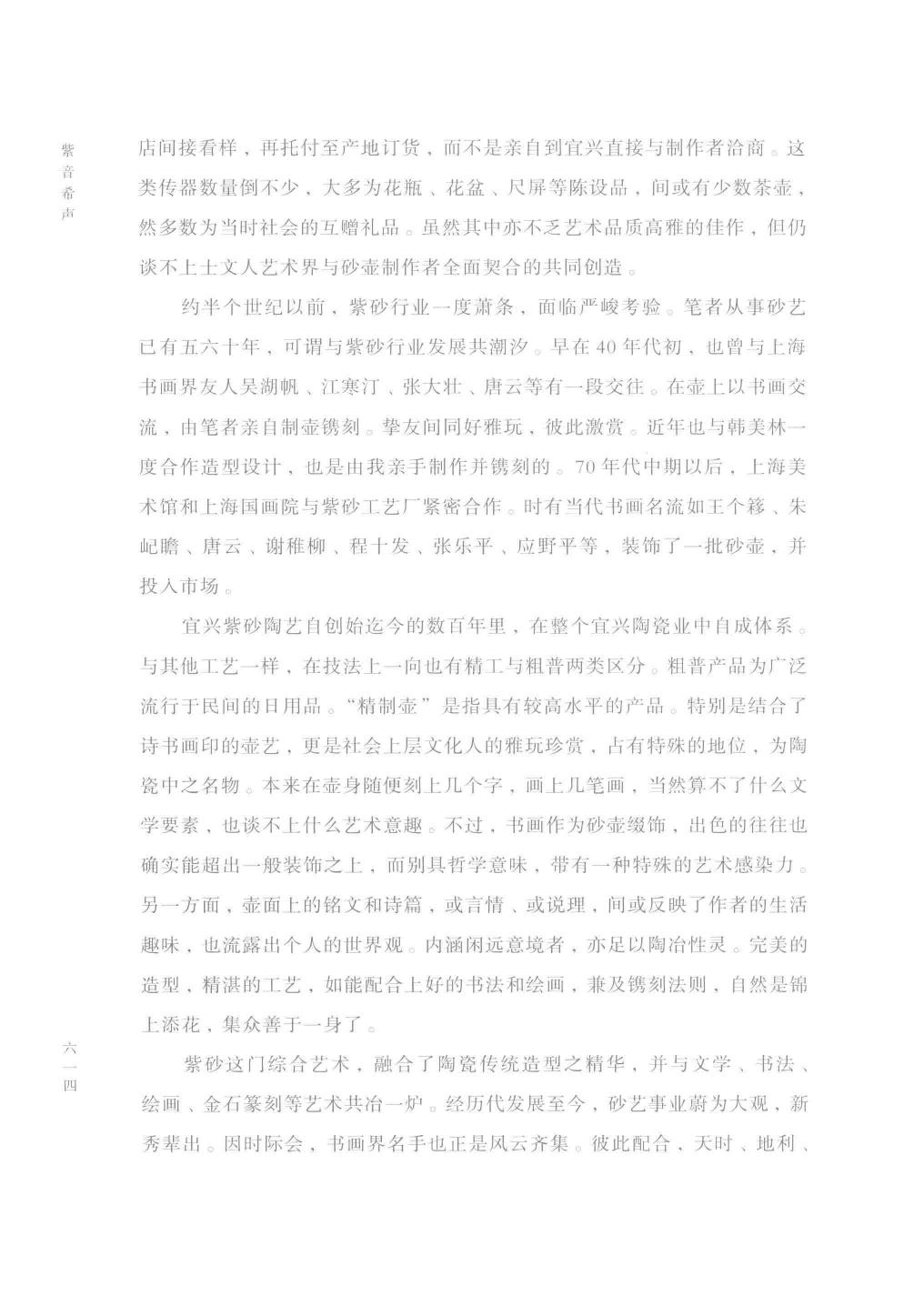
They would look at samples in shops, then entrust orders to be placed at the production site, rather than personally going to Yixing to negotiate directly with the makers. There were quite a few pieces transmitted through this method, mostly decorative items such as vases, flower pots, and table screens, with occasionally a few teapots. However, most were gifts exchanged in society at the time. Although among them there were certainly elegant works of high artistic quality, they still could not be considered a comprehensive integration and joint creation between the literati art world and purple clay teapot makers.
About half a century ago, the purple clay industry once declined and faced severe challenges. I have been engaged in the clay art for fifty or sixty years, and can be said to have risen and fallen with the development of the purple clay industry. In the early 1940s, I also had a period of association with friends from Shanghai's calligraphy and painting circles, including Wu Hufan, Jiang Handing, Zhang Dazhuang, and Tang Yun. We exchanged calligraphy and painting on teapots, which I personally made and carved. Among friends who shared the same refined interests, we appreciated each other's work. In recent years, I also collaborated with Han Meilin on design modeling, which was also made and carved by my own hands. After the mid-1970s, the Shanghai Art Museum and Shanghai Chinese Painting Academy cooperated closely with the Purple Clay Craft Factory. Contemporary calligraphy and painting luminaries such as Wang Geyi, Zhu Qizhan, Tang Yun, Xie Zhiliu, Cheng Shifa, Zhang Leping, and Ying Yeping decorated a batch of clay teapots that were then released to the market.
In the several hundred years since its inception, Yixing purple clay ceramic art has formed its own system within the entire Yixing ceramics industry. Like other crafts, it has always had two categories in terms of technique: fine workmanship and rough commonness. Rough common products were daily-use items widely popular among the common people. "Fine craftsmanship" refers to products of relatively high quality. Particularly teapot art that combined poetry, calligraphy, painting, and seal carving occupied a special position as elegant treasures appreciated by cultured people of the upper social classes, becoming renowned objects among ceramics. Originally, casually carving a few characters or painting a few strokes on a teapot body naturally could not be considered any literary element, nor could it be called artistic interest. However, as decoration on clay teapots, excellent calligraphy and painting often could indeed transcend ordinary decoration and possess philosophical meaning with a special artistic appeal. On the other hand, inscriptions and poems on teapot surfaces—whether expressing emotions or reasoning, occasionally reflecting the author's life interests—also revealed personal worldviews. Those with profound connotations and distant artistic conceptions were sufficient to cultivate the spirit. Perfect form and exquisite craftsmanship, when combined with fine calligraphy and painting, along with carving techniques, naturally added splendor upon splendor, gathering all virtues in one body.
This comprehensive art of purple clay integrates the essence of traditional ceramic modeling and merges with literature, calligraphy, painting, and seal carving arts into one furnace. Through generations of development to the present, the clay art enterprise has become magnificent, with new talents emerging in succession. Meeting at the right time, masters from the calligraphy and painting world are also gathering like clouds. Cooperating with each other—favorable timing, advantageous terrain...
Chapter 10
附录
Appendix
Pages 526-651
View Chapter →
English Translation
They would look at samples in shops, then entrust orders to be placed at the production site, rather than personally going to Yixing to negotiate directly with the makers. There were quite a few pieces transmitted through this method, mostly decorative items such as vases, flower pots, and table screens, with occasionally a few teapots. However, most were gifts exchanged in society at the time. Although among them there were certainly elegant works of high artistic quality, they still could not be considered a comprehensive integration and joint creation between the literati art world and purple clay teapot makers.
About half a century ago, the purple clay industry once declined and faced severe challenges. I have been engaged in the clay art for fifty or sixty years, and can be said to have risen and fallen with the development of the purple clay industry. In the early 1940s, I also had a period of association with friends from Shanghai's calligraphy and painting circles, including Wu Hufan, Jiang Handing, Zhang Dazhuang, and Tang Yun. We exchanged calligraphy and painting on teapots, which I personally made and carved. Among friends who shared the same refined interests, we appreciated each other's work. In recent years, I also collaborated with Han Meilin on design modeling, which was also made and carved by my own hands. After the mid-1970s, the Shanghai Art Museum and Shanghai Chinese Painting Academy cooperated closely with the Purple Clay Craft Factory. Contemporary calligraphy and painting luminaries such as Wang Geyi, Zhu Qizhan, Tang Yun, Xie Zhiliu, Cheng Shifa, Zhang Leping, and Ying Yeping decorated a batch of clay teapots that were then released to the market.
In the several hundred years since its inception, Yixing purple clay ceramic art has formed its own system within the entire Yixing ceramics industry. Like other crafts, it has always had two categories in terms of technique: fine workmanship and rough commonness. Rough common products were daily-use items widely popular among the common people. "Fine craftsmanship" refers to products of relatively high quality. Particularly teapot art that combined poetry, calligraphy, painting, and seal carving occupied a special position as elegant treasures appreciated by cultured people of the upper social classes, becoming renowned objects among ceramics. Originally, casually carving a few characters or painting a few strokes on a teapot body naturally could not be considered any literary element, nor could it be called artistic interest. However, as decoration on clay teapots, excellent calligraphy and painting often could indeed transcend ordinary decoration and possess philosophical meaning with a special artistic appeal. On the other hand, inscriptions and poems on teapot surfaces—whether expressing emotions or reasoning, occasionally reflecting the author's life interests—also revealed personal worldviews. Those with profound connotations and distant artistic conceptions were sufficient to cultivate the spirit. Perfect form and exquisite craftsmanship, when combined with fine calligraphy and painting, along with carving techniques, naturally added splendor upon splendor, gathering all virtues in one body.
This comprehensive art of purple clay integrates the essence of traditional ceramic modeling and merges with literature, calligraphy, painting, and seal carving arts into one furnace. Through generations of development to the present, the clay art enterprise has become magnificent, with new talents emerging in succession. Meeting at the right time, masters from the calligraphy and painting world are also gathering like clouds. Cooperating with each other—favorable timing, advantageous terrain...
章节导航 Chapter Navigation
Chapter 1
序文
Pages 6-6
Chapter 2
引言
Pages 28-31
Chapter 3
达变
Pages 32-133
Chapter 3
开宗立派
Pages 46-66
Chapter 3
传道授业
Pages 67-98
Chapter 3
大师淳友
Pages 99-120
Chapter 3
学艺谋生
Pages 121-133
Chapter 4
化神
Pages 134-141
Chapter 5
独妙
Pages 142-405
Chapter 5
匠心独运 不苟丝毫
Pages 142-179
Chapter 5
器利善事 物尽其用
Pages 180-199
Chapter 5
紫泥春华 研精究微
Pages 200-405
Chapter 6
驾简
Pages 406-427
Chapter 6
精雕细刻 文质合一
Pages 406-410
Chapter 6
师法自然 妙趣横生
Pages 411-415
Chapter 6
丝来线去 曲尽其妙
Pages 416-427
Chapter 7
明志
Pages 463-485
Chapter 7
高山仰止 淡泊明志
Pages 463-472
Chapter 7
啜墨看茶 气定神闲
Pages 473-478
Chapter 7
齿少心锐 怡志抒情
Pages 479-485
Chapter 8
存真
Pages 428-462
Chapter 8
规圆矩方 弃伪存真
Pages 428-436
Chapter 8
有物有则 钻尖仰高
Pages 437-462
Chapter 9
心营
Pages 506-525
Chapter 9
坚守传统 艺立潮头
Pages 506-513
Chapter 9
新型师承 桃李满园
Pages 514-525
Chapter 10
附录
Pages 526-651
Chapter 10
顾景舟紫艺论文
Pages 526-535
Chapter 10
技术课备课笔记
Pages 536-543
Chapter 10
顾景舟艺术年表
Pages 544-651
Chapter 11
参考文献
Pages 652-657
Chapter 12
鸣谢
Pages 658-659