Chapter 10
附录
Appendix
626
of 659
English Translation
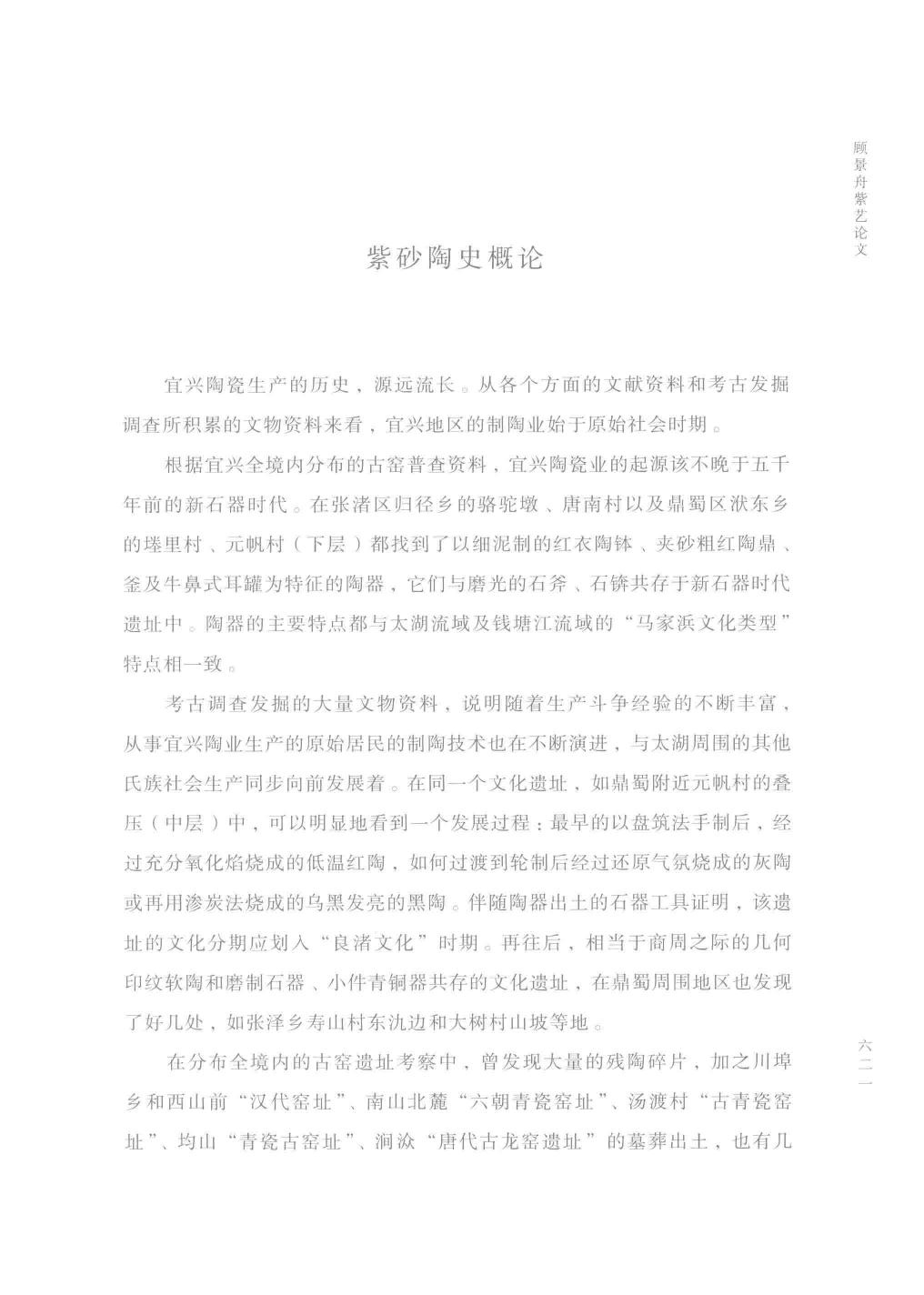
The history of ceramic production in Yixing has a long and distant origin. Based on documentary materials from various sources and archaeological excavation surveys that have accumulated cultural relics, the pottery industry in the Yixing region began in the primitive society period. According to the census data of ancient kiln sites distributed throughout Yixing, the origin of Yixing's ceramic industry should be no later than the Neolithic Age of five thousand years ago. In Luotuodun and Tangnan Village of Guijing Township in Zhangzhu District, as well as in Kanli Village and Yuanfan Village (lower layer) of Yudong Township in Yiding District, red-slipped pottery bowls made of fine clay, coarse red pottery jars with sand temper, and pottery vessels characterized by ox-nose-style lug handles have been found. These coexisted with polished stone axes and stone adzes in Neolithic sites. The main characteristics of these pottery pieces are consistent with the features of the "Majiabang Culture Type" of the Taihu Lake basin and Qiantang River basin.
The abundant cultural relics discovered through archaeological surveys demonstrate that as experience in production struggles continuously enriched, the pottery-making techniques of the primitive inhabitants engaged in Yixing's pottery industry also continuously evolved, developing in step with other clan societies around Taihu Lake. At the same cultural site, such as in Dayao (middle layer) of Yuanfan Village near Dingshu, one can clearly observe a developmental process: how the earliest low-temperature red pottery, hand-built by the coiling method and fired in a fully oxidizing flame, transitioned to wheel-thrown grey pottery fired in a reducing atmosphere, or black pottery fired using the carbon-permeation method that produced a lustrous black finish. The stone tools excavated alongside the pottery prove that the cultural periodization of this site should be classified within the "Hemudu Culture" period. Later still, cultural sites where geometric stamped soft pottery coexisted with polished stone tools and small bronze artifacts, dating to approximately the Shang-Zhou transition, have also been discovered in several locations around the Dingshu area, such as along the eastern edge of Shoushan Village in Zhangze Township and on the hillside of Dashu Village.
During the investigation of ancient kiln sites distributed throughout the region, large quantities of broken pottery shards have been discovered. In addition, the excavation and unearthing of the "Han Dynasty kiln site" at Chuanbu Township and Xishan, the "Six Dynasties celadon kiln site" at the northern foot of Nanshan, the "ancient celadon kiln site" at Tangshu Village, the "celadon kiln site" at Junshan, and the "Tang Dynasty ancient dragon kiln site" at Renshu have also yielded several
Chapter 10
附录
Appendix
Pages 526-651
View Chapter →
English Translation
The history of ceramic production in Yixing has a long and distant origin. Based on documentary materials from various sources and archaeological excavation surveys that have accumulated cultural relics, the pottery industry in the Yixing region began in the primitive society period. According to the census data of ancient kiln sites distributed throughout Yixing, the origin of Yixing's ceramic industry should be no later than the Neolithic Age of five thousand years ago. In Luotuodun and Tangnan Village of Guijing Township in Zhangzhu District, as well as in Kanli Village and Yuanfan Village (lower layer) of Yudong Township in Yiding District, red-slipped pottery bowls made of fine clay, coarse red pottery jars with sand temper, and pottery vessels characterized by ox-nose-style lug handles have been found. These coexisted with polished stone axes and stone adzes in Neolithic sites. The main characteristics of these pottery pieces are consistent with the features of the "Majiabang Culture Type" of the Taihu Lake basin and Qiantang River basin.
The abundant cultural relics discovered through archaeological surveys demonstrate that as experience in production struggles continuously enriched, the pottery-making techniques of the primitive inhabitants engaged in Yixing's pottery industry also continuously evolved, developing in step with other clan societies around Taihu Lake. At the same cultural site, such as in Dayao (middle layer) of Yuanfan Village near Dingshu, one can clearly observe a developmental process: how the earliest low-temperature red pottery, hand-built by the coiling method and fired in a fully oxidizing flame, transitioned to wheel-thrown grey pottery fired in a reducing atmosphere, or black pottery fired using the carbon-permeation method that produced a lustrous black finish. The stone tools excavated alongside the pottery prove that the cultural periodization of this site should be classified within the "Hemudu Culture" period. Later still, cultural sites where geometric stamped soft pottery coexisted with polished stone tools and small bronze artifacts, dating to approximately the Shang-Zhou transition, have also been discovered in several locations around the Dingshu area, such as along the eastern edge of Shoushan Village in Zhangze Township and on the hillside of Dashu Village.
During the investigation of ancient kiln sites distributed throughout the region, large quantities of broken pottery shards have been discovered. In addition, the excavation and unearthing of the "Han Dynasty kiln site" at Chuanbu Township and Xishan, the "Six Dynasties celadon kiln site" at the northern foot of Nanshan, the "ancient celadon kiln site" at Tangshu Village, the "celadon kiln site" at Junshan, and the "Tang Dynasty ancient dragon kiln site" at Renshu have also yielded several
章节导航 Chapter Navigation
Chapter 1
序文
Pages 6-6
Chapter 2
引言
Pages 28-31
Chapter 3
达变
Pages 32-133
Chapter 3
开宗立派
Pages 46-66
Chapter 3
传道授业
Pages 67-98
Chapter 3
大师淳友
Pages 99-120
Chapter 3
学艺谋生
Pages 121-133
Chapter 4
化神
Pages 134-141
Chapter 5
独妙
Pages 142-405
Chapter 5
匠心独运 不苟丝毫
Pages 142-179
Chapter 5
器利善事 物尽其用
Pages 180-199
Chapter 5
紫泥春华 研精究微
Pages 200-405
Chapter 6
驾简
Pages 406-427
Chapter 6
精雕细刻 文质合一
Pages 406-410
Chapter 6
师法自然 妙趣横生
Pages 411-415
Chapter 6
丝来线去 曲尽其妙
Pages 416-427
Chapter 7
明志
Pages 463-485
Chapter 7
高山仰止 淡泊明志
Pages 463-472
Chapter 7
啜墨看茶 气定神闲
Pages 473-478
Chapter 7
齿少心锐 怡志抒情
Pages 479-485
Chapter 8
存真
Pages 428-462
Chapter 8
规圆矩方 弃伪存真
Pages 428-436
Chapter 8
有物有则 钻尖仰高
Pages 437-462
Chapter 9
心营
Pages 506-525
Chapter 9
坚守传统 艺立潮头
Pages 506-513
Chapter 9
新型师承 桃李满园
Pages 514-525
Chapter 10
附录
Pages 526-651
Chapter 10
顾景舟紫艺论文
Pages 526-535
Chapter 10
技术课备课笔记
Pages 536-543
Chapter 10
顾景舟艺术年表
Pages 544-651
Chapter 11
参考文献
Pages 652-657
Chapter 12
鸣谢
Pages 658-659