Chapter 10
附录
Appendix
627
of 659
English Translation
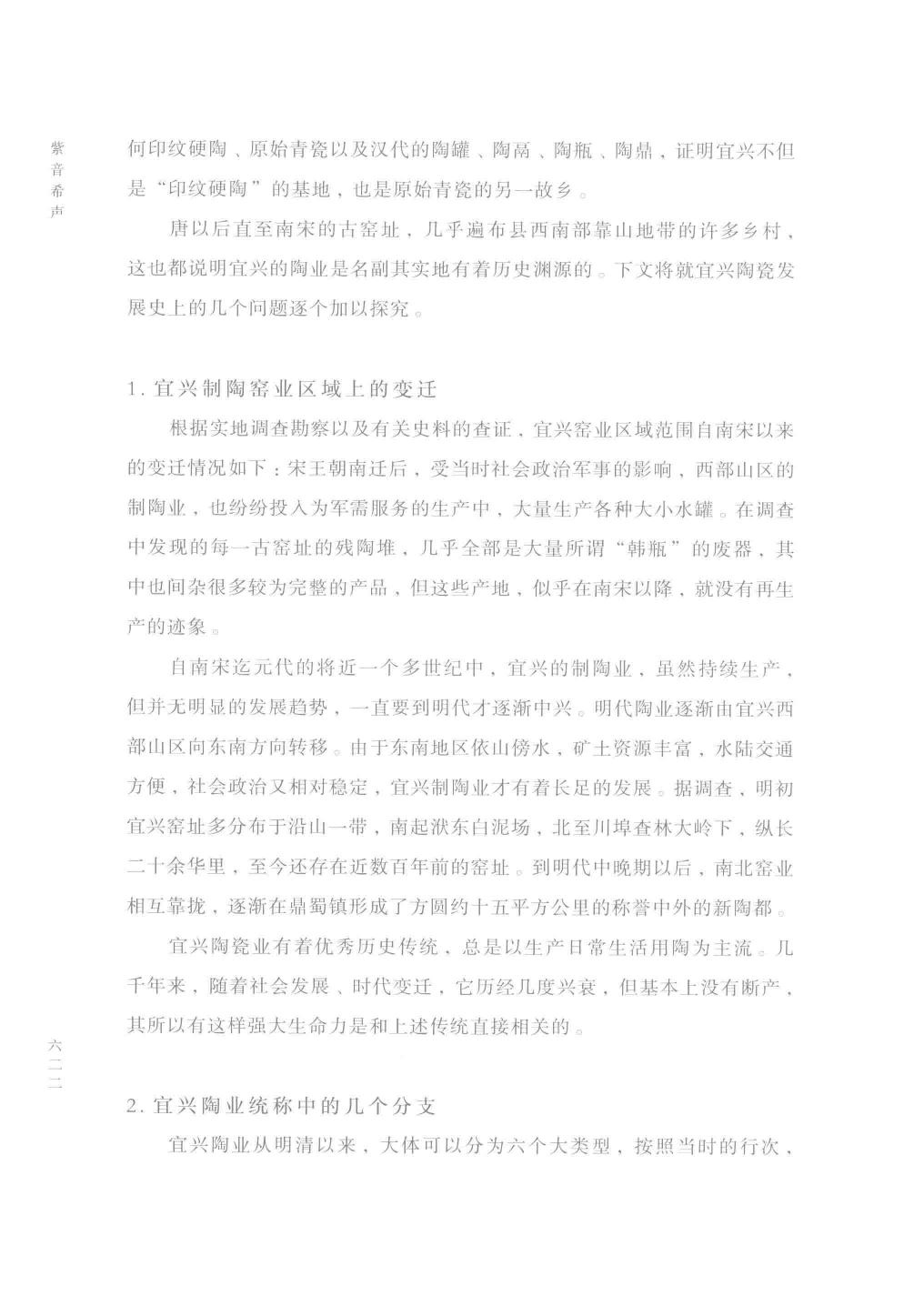
According to archaeological discoveries, the unearthed cord-marked hard pottery, primitive celadon, as well as Han dynasty pottery cauldrons, pottery stoves, pottery bottles, and pottery jars prove that Yixing was not only a base for "cord-marked hard pottery" but also another birthplace of primitive celadon.
From the Tang dynasty through the Southern Song dynasty, kiln sites were scattered throughout many villages in the mountainous areas of the southwestern part of the county. This all demonstrates that Yixing's pottery industry genuinely has deep historical roots. The following sections will explore several issues in the history of Yixing ceramics development one by one.
## 1. Regional Changes in Yixing's Pottery Industry
Based on field investigations and verification of relevant historical materials, the changes in the regional scope of Yixing's pottery industry since the Southern Song dynasty are as follows: After the Song court moved south, influenced by the social, political, and military circumstances of the time, the pottery industry in the western mountainous areas also threw itself into production serving military needs, mass-producing various sizes of water containers. In the investigations, the ceramic waste heaps at every ancient kiln site discovered consisted almost entirely of large quantities of discarded so-called "Han bottles." Among these were also many relatively intact products, but these production sites seem to show no signs of continued production after the Southern Song dynasty.
From the Southern Song through the Yuan dynasty, spanning nearly more than a century, Yixing's pottery industry, though continuing production, showed no obvious development trend. It was not until the Ming dynasty that it gradually revived. During the Ming dynasty, the pottery industry gradually shifted from the western mountainous areas of Yixing toward the southeast. Because the southeastern region was situated by mountains and water, with abundant mineral clay resources, convenient water and land transportation, and relatively stable social and political conditions, Yixing's pottery industry experienced substantial development. According to investigations, in the early Ming dynasty, Yixing kiln sites were mostly distributed along the mountainous belt, stretching from Yudong and Nichang in the south to Chuanbu and Chalin Daling in the north, spanning more than twenty *li*[1] in length, with kiln sites from several hundred years ago still existing today. By the mid to late Ming period, the northern and southern pottery industries gradually converged, forming a new pottery capital of approximately fifteen square kilometers centered around Dingshu Town, renowned both domestically and internationally.
Yixing's pottery industry has an excellent historical tradition, always maintaining daily-use pottery as its mainstream production. Over thousands of years, as society developed and times changed, it experienced several cycles of prosperity and decline, but production essentially never ceased. The reason it has such strong vitality is directly related to the aforementioned tradition.
## 2. Several Branches Within the General Category of Yixing Pottery
Since the Ming and Qing dynasties, Yixing pottery can be broadly divided into six major types. According to the trade classifications of that time—
---
[1] A traditional Chinese unit of distance, approximately 500 meters
Chapter 10
附录
Appendix
Pages 526-651
View Chapter →
English Translation
According to archaeological discoveries, the unearthed cord-marked hard pottery, primitive celadon, as well as Han dynasty pottery cauldrons, pottery stoves, pottery bottles, and pottery jars prove that Yixing was not only a base for "cord-marked hard pottery" but also another birthplace of primitive celadon.
From the Tang dynasty through the Southern Song dynasty, kiln sites were scattered throughout many villages in the mountainous areas of the southwestern part of the county. This all demonstrates that Yixing's pottery industry genuinely has deep historical roots. The following sections will explore several issues in the history of Yixing ceramics development one by one.
## 1. Regional Changes in Yixing's Pottery Industry
Based on field investigations and verification of relevant historical materials, the changes in the regional scope of Yixing's pottery industry since the Southern Song dynasty are as follows: After the Song court moved south, influenced by the social, political, and military circumstances of the time, the pottery industry in the western mountainous areas also threw itself into production serving military needs, mass-producing various sizes of water containers. In the investigations, the ceramic waste heaps at every ancient kiln site discovered consisted almost entirely of large quantities of discarded so-called "Han bottles." Among these were also many relatively intact products, but these production sites seem to show no signs of continued production after the Southern Song dynasty.
From the Southern Song through the Yuan dynasty, spanning nearly more than a century, Yixing's pottery industry, though continuing production, showed no obvious development trend. It was not until the Ming dynasty that it gradually revived. During the Ming dynasty, the pottery industry gradually shifted from the western mountainous areas of Yixing toward the southeast. Because the southeastern region was situated by mountains and water, with abundant mineral clay resources, convenient water and land transportation, and relatively stable social and political conditions, Yixing's pottery industry experienced substantial development. According to investigations, in the early Ming dynasty, Yixing kiln sites were mostly distributed along the mountainous belt, stretching from Yudong and Nichang in the south to Chuanbu and Chalin Daling in the north, spanning more than twenty *li*[1] in length, with kiln sites from several hundred years ago still existing today. By the mid to late Ming period, the northern and southern pottery industries gradually converged, forming a new pottery capital of approximately fifteen square kilometers centered around Dingshu Town, renowned both domestically and internationally.
Yixing's pottery industry has an excellent historical tradition, always maintaining daily-use pottery as its mainstream production. Over thousands of years, as society developed and times changed, it experienced several cycles of prosperity and decline, but production essentially never ceased. The reason it has such strong vitality is directly related to the aforementioned tradition.
## 2. Several Branches Within the General Category of Yixing Pottery
Since the Ming and Qing dynasties, Yixing pottery can be broadly divided into six major types. According to the trade classifications of that time—
---
[1] A traditional Chinese unit of distance, approximately 500 meters
章节导航 Chapter Navigation
Chapter 1
序文
Pages 6-6
Chapter 2
引言
Pages 28-31
Chapter 3
达变
Pages 32-133
Chapter 3
开宗立派
Pages 46-66
Chapter 3
传道授业
Pages 67-98
Chapter 3
大师淳友
Pages 99-120
Chapter 3
学艺谋生
Pages 121-133
Chapter 4
化神
Pages 134-141
Chapter 5
独妙
Pages 142-405
Chapter 5
匠心独运 不苟丝毫
Pages 142-179
Chapter 5
器利善事 物尽其用
Pages 180-199
Chapter 5
紫泥春华 研精究微
Pages 200-405
Chapter 6
驾简
Pages 406-427
Chapter 6
精雕细刻 文质合一
Pages 406-410
Chapter 6
师法自然 妙趣横生
Pages 411-415
Chapter 6
丝来线去 曲尽其妙
Pages 416-427
Chapter 7
明志
Pages 463-485
Chapter 7
高山仰止 淡泊明志
Pages 463-472
Chapter 7
啜墨看茶 气定神闲
Pages 473-478
Chapter 7
齿少心锐 怡志抒情
Pages 479-485
Chapter 8
存真
Pages 428-462
Chapter 8
规圆矩方 弃伪存真
Pages 428-436
Chapter 8
有物有则 钻尖仰高
Pages 437-462
Chapter 9
心营
Pages 506-525
Chapter 9
坚守传统 艺立潮头
Pages 506-513
Chapter 9
新型师承 桃李满园
Pages 514-525
Chapter 10
附录
Pages 526-651
Chapter 10
顾景舟紫艺论文
Pages 526-535
Chapter 10
技术课备课笔记
Pages 536-543
Chapter 10
顾景舟艺术年表
Pages 544-651
Chapter 11
参考文献
Pages 652-657
Chapter 12
鸣谢
Pages 658-659