Chapter 10
附录
Appendix
628
of 659
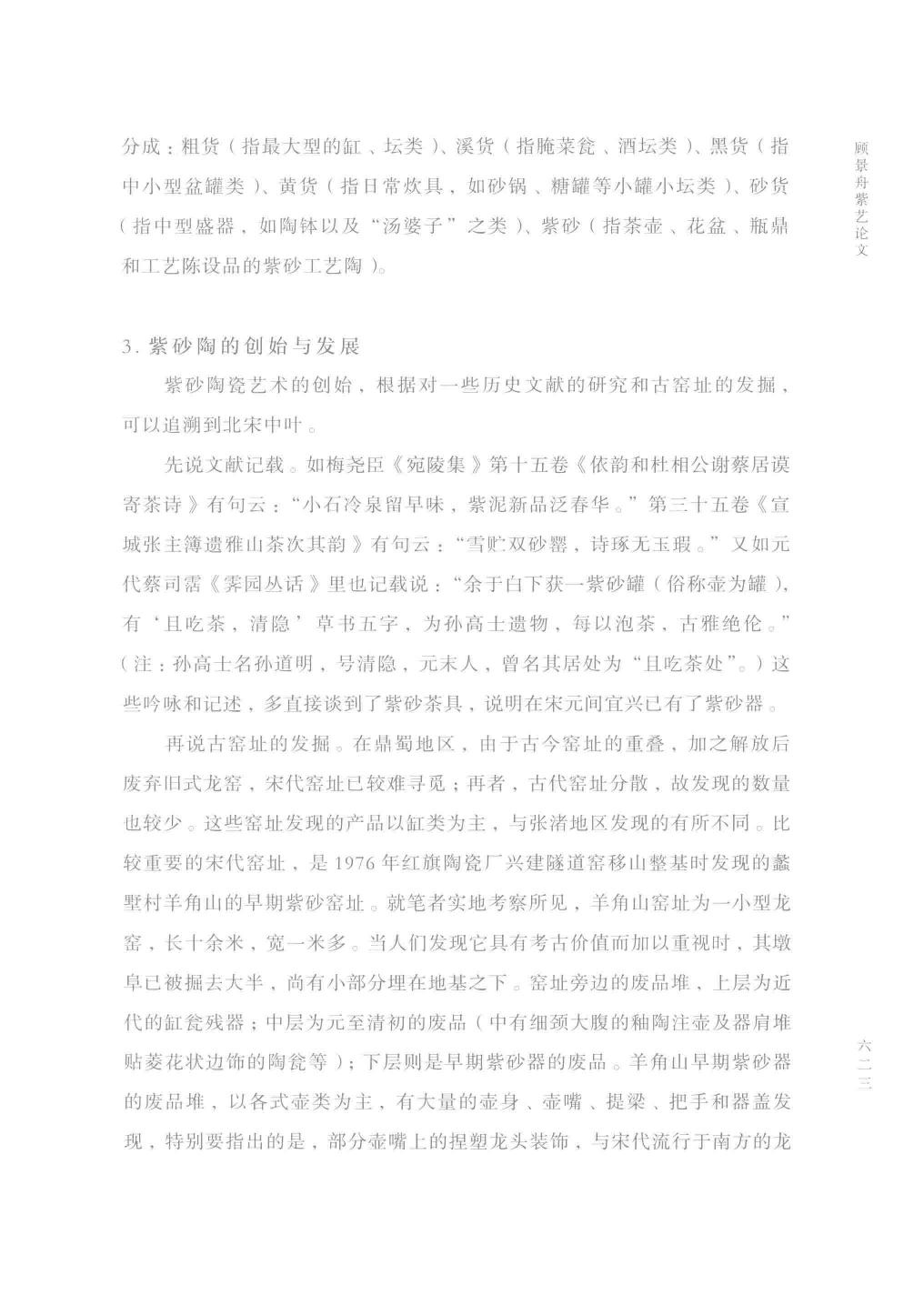
English Translation
The pottery is divided into: coarse wares (referring to the largest jars and urns), creek wares (referring to wine jars and similar vessels), black wares (referring to medium and small basins and vats), yellow wares (referring to daily cooking utensils such as clay pots, sugar jars, and other small jars), sand wares (referring to medium-sized containers such as pottery bowls and "soup warmers"), and zisha (referring to zisha craft pottery including teapots, flower pots, vases, and decorative art pieces).
## 3. The Origin and Development of Zisha Pottery
The origin of zisha ceramic art, based on research of historical documents and discoveries from kiln sites, can be traced back to the mid-Northern Song Dynasty.
First, regarding documentary records: For example, in Mei Yaochen's *Wanling Collection*, Volume 15, "Following the Rhyme of Minister Du's Thanks to Cai for Sending Tea" contains the lines: "Small stone cold spring preserves the early flavor, purple clay new vessels float with spring splendor." Volume 35, "Xuancheng Zhang Presented Elegant Mountain Tea, Following His Rhyme" contains the lines: "Snow stored in double sand vessels, poetry carved without jade flaw." Also, Yuan Dynasty writer Cai Siyong's *Huiyuan Conghua* records: "I obtained a zisha jar in Baixia (commonly called a guan), inscribed with five characters in cursive script: 'Just drink tea, Qingyin,' a relic of Master Sun Gao. Whenever used to brew tea, it is elegantly antique and unparalleled." (Note: Master Sun Gao's name was Sun Daoming, styled Qingyin, a late Yuan Dynasty figure who named his dwelling "Just Drink Tea Place.") These poems and records directly mention zisha tea utensils, indicating that Yixing already had zisha wares during the Song and Yuan periods.
Now regarding excavations of ancient kiln sites: In the Dingshu area, due to the overlap of ancient and modern kiln sites, combined with the abandonment of old-style dragon kilns after Liberation, Song Dynasty kiln sites have become rather difficult to locate. Moreover, ancient kiln sites were scattered, so the number discovered is relatively small. The products found at these kiln sites are mainly jars, differing somewhat from those discovered in the Zhangjiagang area. A particularly important Song Dynasty kiln site was discovered in 1976 at Yangjiao Mountain in Gongyecun when the Hongqi Pottery Factory was building a tunnel kiln and leveling the foundation. Based on this author's field investigation, the Yangjiao Mountain kiln site was a small dragon kiln, over ten meters long and more than one meter wide. By the time people recognized its archaeological value and began to pay attention to it, more than half of its structure had already been removed, with only a small portion remaining buried beneath the foundation. The waste heap beside the kiln site had an upper layer of modern jar fragments; a middle layer of waste from the Ming to early Qing periods (including glazed pottery pouring vessels with thin necks and large bellies, and pottery figurines with appliqué petal-shaped decorations on the shoulders); the lower layer consisted of waste from early zisha wares. The waste heap of early zisha wares from Yangjiao Mountain was primarily composed of various types of pots, with large quantities of pot bodies, spouts, handles, and lids discovered. It is particularly noteworthy that the molded dragon head decorations on some of the spouts are consistent with the dragon motifs popular in southern regions during the Song Dynasty.
Chapter 10
附录
Appendix
Pages 526-651
View Chapter →
English Translation
The pottery is divided into: coarse wares (referring to the largest jars and urns), creek wares (referring to wine jars and similar vessels), black wares (referring to medium and small basins and vats), yellow wares (referring to daily cooking utensils such as clay pots, sugar jars, and other small jars), sand wares (referring to medium-sized containers such as pottery bowls and "soup warmers"), and zisha (referring to zisha craft pottery including teapots, flower pots, vases, and decorative art pieces).
## 3. The Origin and Development of Zisha Pottery
The origin of zisha ceramic art, based on research of historical documents and discoveries from kiln sites, can be traced back to the mid-Northern Song Dynasty.
First, regarding documentary records: For example, in Mei Yaochen's *Wanling Collection*, Volume 15, "Following the Rhyme of Minister Du's Thanks to Cai for Sending Tea" contains the lines: "Small stone cold spring preserves the early flavor, purple clay new vessels float with spring splendor." Volume 35, "Xuancheng Zhang Presented Elegant Mountain Tea, Following His Rhyme" contains the lines: "Snow stored in double sand vessels, poetry carved without jade flaw." Also, Yuan Dynasty writer Cai Siyong's *Huiyuan Conghua* records: "I obtained a zisha jar in Baixia (commonly called a guan), inscribed with five characters in cursive script: 'Just drink tea, Qingyin,' a relic of Master Sun Gao. Whenever used to brew tea, it is elegantly antique and unparalleled." (Note: Master Sun Gao's name was Sun Daoming, styled Qingyin, a late Yuan Dynasty figure who named his dwelling "Just Drink Tea Place.") These poems and records directly mention zisha tea utensils, indicating that Yixing already had zisha wares during the Song and Yuan periods.
Now regarding excavations of ancient kiln sites: In the Dingshu area, due to the overlap of ancient and modern kiln sites, combined with the abandonment of old-style dragon kilns after Liberation, Song Dynasty kiln sites have become rather difficult to locate. Moreover, ancient kiln sites were scattered, so the number discovered is relatively small. The products found at these kiln sites are mainly jars, differing somewhat from those discovered in the Zhangjiagang area. A particularly important Song Dynasty kiln site was discovered in 1976 at Yangjiao Mountain in Gongyecun when the Hongqi Pottery Factory was building a tunnel kiln and leveling the foundation. Based on this author's field investigation, the Yangjiao Mountain kiln site was a small dragon kiln, over ten meters long and more than one meter wide. By the time people recognized its archaeological value and began to pay attention to it, more than half of its structure had already been removed, with only a small portion remaining buried beneath the foundation. The waste heap beside the kiln site had an upper layer of modern jar fragments; a middle layer of waste from the Ming to early Qing periods (including glazed pottery pouring vessels with thin necks and large bellies, and pottery figurines with appliqué petal-shaped decorations on the shoulders); the lower layer consisted of waste from early zisha wares. The waste heap of early zisha wares from Yangjiao Mountain was primarily composed of various types of pots, with large quantities of pot bodies, spouts, handles, and lids discovered. It is particularly noteworthy that the molded dragon head decorations on some of the spouts are consistent with the dragon motifs popular in southern regions during the Song Dynasty.
章节导航 Chapter Navigation
Chapter 1
序文
Pages 6-6
Chapter 2
引言
Pages 28-31
Chapter 3
达变
Pages 32-133
Chapter 3
开宗立派
Pages 46-66
Chapter 3
传道授业
Pages 67-98
Chapter 3
大师淳友
Pages 99-120
Chapter 3
学艺谋生
Pages 121-133
Chapter 4
化神
Pages 134-141
Chapter 5
独妙
Pages 142-405
Chapter 5
匠心独运 不苟丝毫
Pages 142-179
Chapter 5
器利善事 物尽其用
Pages 180-199
Chapter 5
紫泥春华 研精究微
Pages 200-405
Chapter 6
驾简
Pages 406-427
Chapter 6
精雕细刻 文质合一
Pages 406-410
Chapter 6
师法自然 妙趣横生
Pages 411-415
Chapter 6
丝来线去 曲尽其妙
Pages 416-427
Chapter 7
明志
Pages 463-485
Chapter 7
高山仰止 淡泊明志
Pages 463-472
Chapter 7
啜墨看茶 气定神闲
Pages 473-478
Chapter 7
齿少心锐 怡志抒情
Pages 479-485
Chapter 8
存真
Pages 428-462
Chapter 8
规圆矩方 弃伪存真
Pages 428-436
Chapter 8
有物有则 钻尖仰高
Pages 437-462
Chapter 9
心营
Pages 506-525
Chapter 9
坚守传统 艺立潮头
Pages 506-513
Chapter 9
新型师承 桃李满园
Pages 514-525
Chapter 10
附录
Pages 526-651
Chapter 10
顾景舟紫艺论文
Pages 526-535
Chapter 10
技术课备课笔记
Pages 536-543
Chapter 10
顾景舟艺术年表
Pages 544-651
Chapter 11
参考文献
Pages 652-657
Chapter 12
鸣谢
Pages 658-659