Chapter 10
附录
Appendix
629
of 659
English Translation
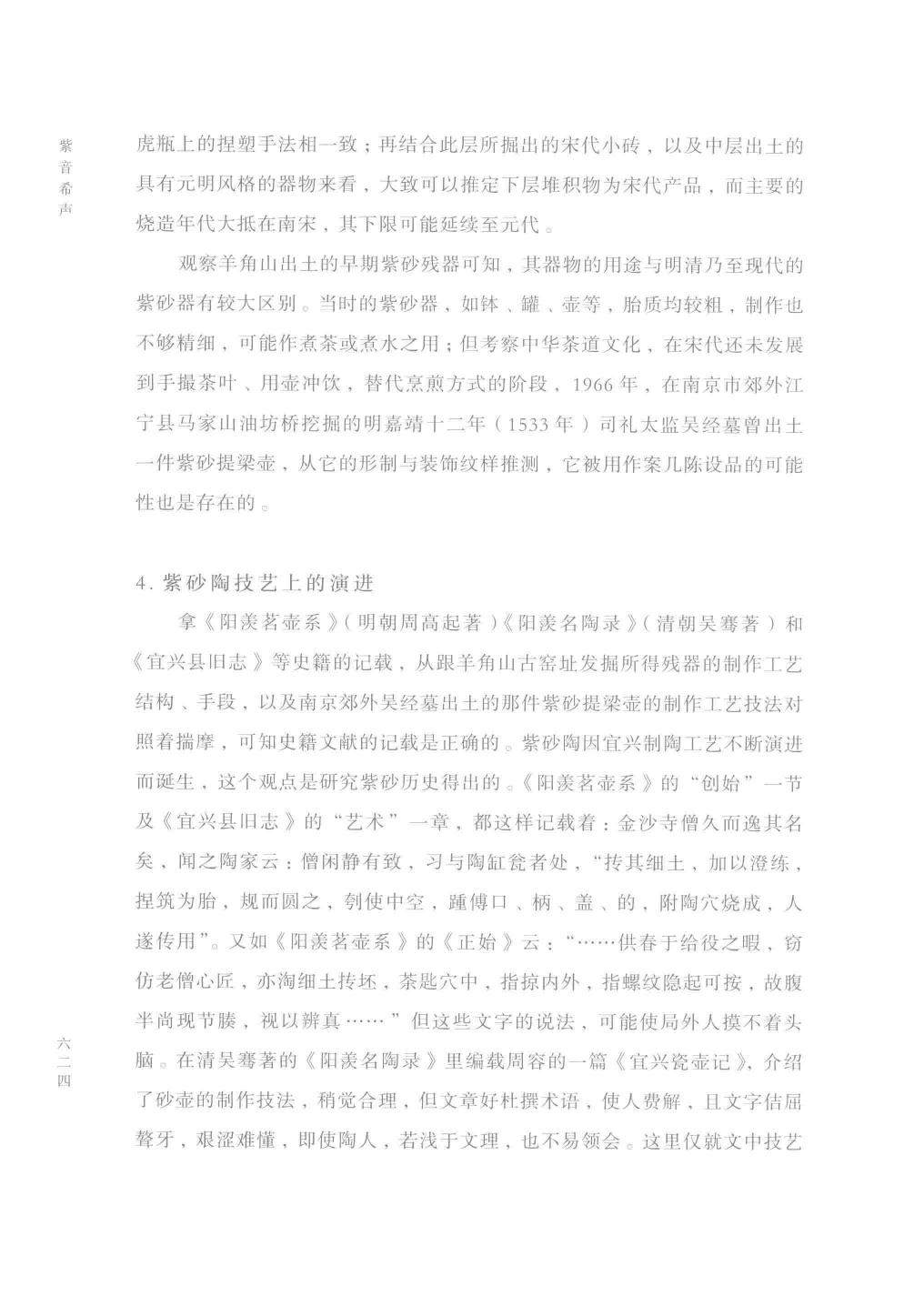
The sculpting technique on the tiger vase is consistent; combined with the Song dynasty small bricks excavated from this layer, as well as artifacts with Yuan and Ming stylistic characteristics unearthed from the middle layer, it can be roughly determined that the lower layer accumulation consists of Song dynasty products, with the main firing period generally in the Southern Song, and its lower limit possibly extending into the Yuan dynasty.
Observation of the early zisha (purple clay) fragments unearthed from Yangjiao Mountain reveals that the function of these vessels differs considerably from the zisha ware of the Ming and Qing dynasties and even modern times. The zisha vessels of that period, such as bowls, jars, and basins, all had relatively coarse body texture and were not finely crafted, possibly used for storing tea or boiling water. However, examining Chinese tea culture, the Song dynasty had not yet developed to the stage of hand-holding tea leaves and brewing with pots in the manner of tea appreciation. In 1966, a zisha teapot with a lifting handle was unearthed from the tomb of Wu Jing, a eunuch director of ceremonies, dated to the twelfth year of the Jiajing reign of the Ming dynasty (1533), excavated at Youfangqiao, Majishan, Jiangning County in the suburbs of Nanjing. Judging from its form and decorative patterns, the possibility that it was used as a decorative piece for tables and desks also exists.
## 4. Technical Evolution of Zisha Pottery
According to the records in historical texts such as *Yangxian Minghu Xi* (written by Zhou Gaoqi of the Ming dynasty), *Yangxian Mingtao Lu* (written by Wu Qian of the Qing dynasty), and *Yixing County Old Gazetteer*, and by comparing and examining the manufacturing techniques, structure, and methods of the fragments obtained from the excavation of the kiln site at Yangjiao Mountain, as well as the manufacturing techniques of the zisha teapot with lifting handle unearthed from Wu Jing's tomb in the Nanjing suburbs, it can be known that the records in historical documents are correct. The view that zisha pottery was born from the continuous evolution of Yixing pottery-making techniques is a conclusion drawn from research into zisha history. The "Genesis" section of *Yangxian Minghu Xi* and the "Arts" chapter of *Yixing County Old Gazetteer* both record as follows: A monk from Jinsha Temple, whose name has been lost to time, was heard among pottery makers to say: "The monk, being quiet and refined, habitually associated with pottery workers, 'selecting fine clay and adding refinement, kneading and building it into a body, shaping it round, carving to make the interior hollow, then forming the spout, handle, and lid, attaching them and firing in the pottery kiln, and people then transmitted its use.'" Also, as stated in the "True Beginning" section of *Yangxian Minghu Xi*: "Gong Chun, during his leisure from service, secretly imitated the old monk's devoted work, also selecting fine clay to form the body, firing it in the kiln, shaping inside and outside with fingers, with spiral patterns subtly raised and palpable, thus half the belly still shows knots, which can be examined to distinguish authenticity..." However, these textual descriptions may leave outsiders bewildered. In *Yangxian Mingtao Lu* compiled by Wu Qian of the Qing dynasty, there is an article by Zhou Rong titled "Record of Yixing Ceramic Teapots" that introduces the manufacturing techniques of teapots, which seems somewhat more reasonable, but the article is filled with technical terminology that makes it difficult to understand, and the text is convoluted and obscure, making it hard to read. Even pottery workers, if shallow in literary understanding, would not easily comprehend it. Here, only the technical aspects mentioned in the text are discussed.
Chapter 10
附录
Appendix
Pages 526-651
View Chapter →
English Translation
The sculpting technique on the tiger vase is consistent; combined with the Song dynasty small bricks excavated from this layer, as well as artifacts with Yuan and Ming stylistic characteristics unearthed from the middle layer, it can be roughly determined that the lower layer accumulation consists of Song dynasty products, with the main firing period generally in the Southern Song, and its lower limit possibly extending into the Yuan dynasty.
Observation of the early zisha (purple clay) fragments unearthed from Yangjiao Mountain reveals that the function of these vessels differs considerably from the zisha ware of the Ming and Qing dynasties and even modern times. The zisha vessels of that period, such as bowls, jars, and basins, all had relatively coarse body texture and were not finely crafted, possibly used for storing tea or boiling water. However, examining Chinese tea culture, the Song dynasty had not yet developed to the stage of hand-holding tea leaves and brewing with pots in the manner of tea appreciation. In 1966, a zisha teapot with a lifting handle was unearthed from the tomb of Wu Jing, a eunuch director of ceremonies, dated to the twelfth year of the Jiajing reign of the Ming dynasty (1533), excavated at Youfangqiao, Majishan, Jiangning County in the suburbs of Nanjing. Judging from its form and decorative patterns, the possibility that it was used as a decorative piece for tables and desks also exists.
## 4. Technical Evolution of Zisha Pottery
According to the records in historical texts such as *Yangxian Minghu Xi* (written by Zhou Gaoqi of the Ming dynasty), *Yangxian Mingtao Lu* (written by Wu Qian of the Qing dynasty), and *Yixing County Old Gazetteer*, and by comparing and examining the manufacturing techniques, structure, and methods of the fragments obtained from the excavation of the kiln site at Yangjiao Mountain, as well as the manufacturing techniques of the zisha teapot with lifting handle unearthed from Wu Jing's tomb in the Nanjing suburbs, it can be known that the records in historical documents are correct. The view that zisha pottery was born from the continuous evolution of Yixing pottery-making techniques is a conclusion drawn from research into zisha history. The "Genesis" section of *Yangxian Minghu Xi* and the "Arts" chapter of *Yixing County Old Gazetteer* both record as follows: A monk from Jinsha Temple, whose name has been lost to time, was heard among pottery makers to say: "The monk, being quiet and refined, habitually associated with pottery workers, 'selecting fine clay and adding refinement, kneading and building it into a body, shaping it round, carving to make the interior hollow, then forming the spout, handle, and lid, attaching them and firing in the pottery kiln, and people then transmitted its use.'" Also, as stated in the "True Beginning" section of *Yangxian Minghu Xi*: "Gong Chun, during his leisure from service, secretly imitated the old monk's devoted work, also selecting fine clay to form the body, firing it in the kiln, shaping inside and outside with fingers, with spiral patterns subtly raised and palpable, thus half the belly still shows knots, which can be examined to distinguish authenticity..." However, these textual descriptions may leave outsiders bewildered. In *Yangxian Mingtao Lu* compiled by Wu Qian of the Qing dynasty, there is an article by Zhou Rong titled "Record of Yixing Ceramic Teapots" that introduces the manufacturing techniques of teapots, which seems somewhat more reasonable, but the article is filled with technical terminology that makes it difficult to understand, and the text is convoluted and obscure, making it hard to read. Even pottery workers, if shallow in literary understanding, would not easily comprehend it. Here, only the technical aspects mentioned in the text are discussed.
章节导航 Chapter Navigation
Chapter 1
序文
Pages 6-6
Chapter 2
引言
Pages 28-31
Chapter 3
达变
Pages 32-133
Chapter 3
开宗立派
Pages 46-66
Chapter 3
传道授业
Pages 67-98
Chapter 3
大师淳友
Pages 99-120
Chapter 3
学艺谋生
Pages 121-133
Chapter 4
化神
Pages 134-141
Chapter 5
独妙
Pages 142-405
Chapter 5
匠心独运 不苟丝毫
Pages 142-179
Chapter 5
器利善事 物尽其用
Pages 180-199
Chapter 5
紫泥春华 研精究微
Pages 200-405
Chapter 6
驾简
Pages 406-427
Chapter 6
精雕细刻 文质合一
Pages 406-410
Chapter 6
师法自然 妙趣横生
Pages 411-415
Chapter 6
丝来线去 曲尽其妙
Pages 416-427
Chapter 7
明志
Pages 463-485
Chapter 7
高山仰止 淡泊明志
Pages 463-472
Chapter 7
啜墨看茶 气定神闲
Pages 473-478
Chapter 7
齿少心锐 怡志抒情
Pages 479-485
Chapter 8
存真
Pages 428-462
Chapter 8
规圆矩方 弃伪存真
Pages 428-436
Chapter 8
有物有则 钻尖仰高
Pages 437-462
Chapter 9
心营
Pages 506-525
Chapter 9
坚守传统 艺立潮头
Pages 506-513
Chapter 9
新型师承 桃李满园
Pages 514-525
Chapter 10
附录
Pages 526-651
Chapter 10
顾景舟紫艺论文
Pages 526-535
Chapter 10
技术课备课笔记
Pages 536-543
Chapter 10
顾景舟艺术年表
Pages 544-651
Chapter 11
参考文献
Pages 652-657
Chapter 12
鸣谢
Pages 658-659