Chapter 10
附录
Appendix
630
of 659
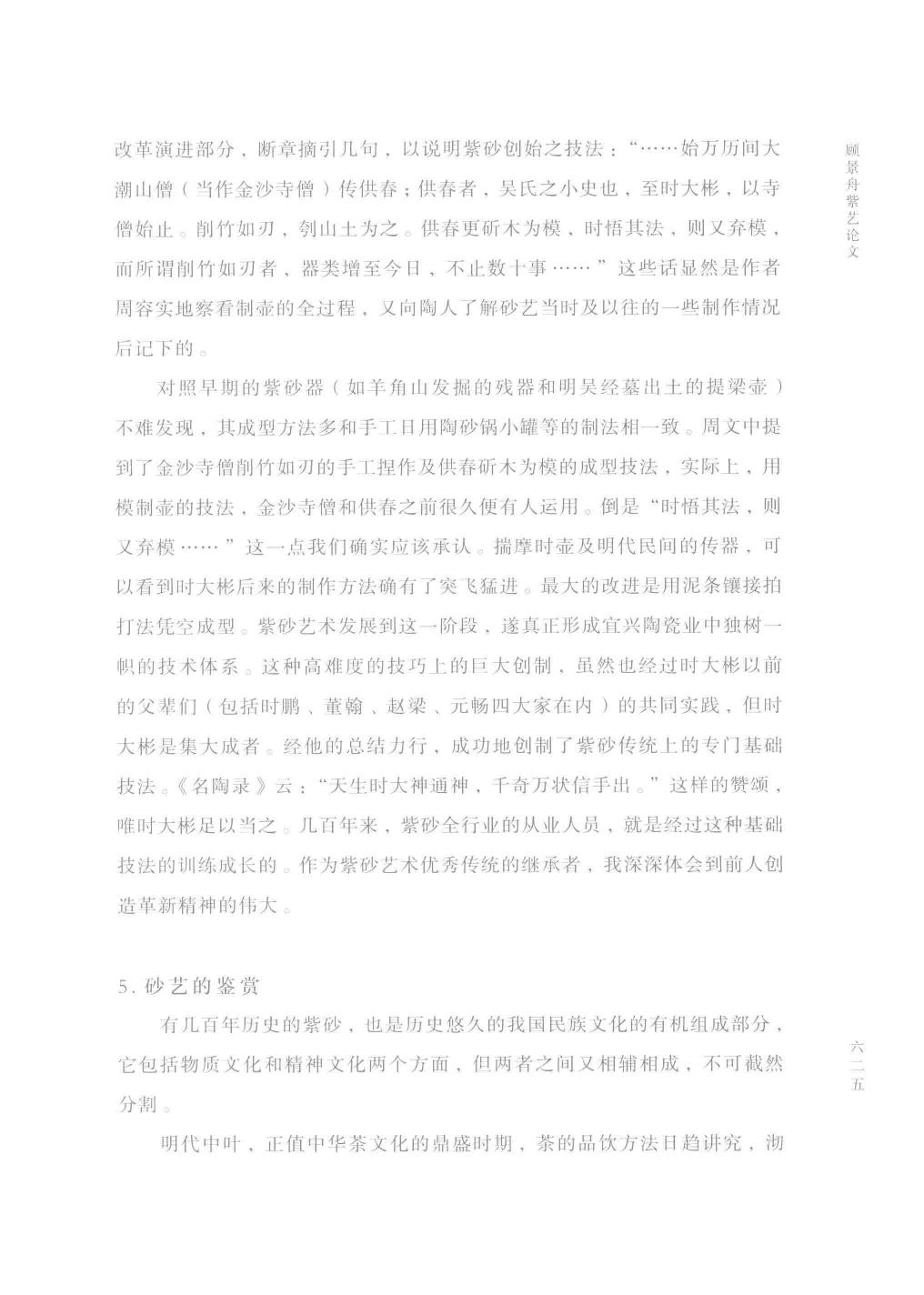
English Translation
Let me excerpt a few passages to illustrate the founding techniques of zisha pottery: "It began during the Wanli period when the monk from Jinsha Temple (should be 'a monk from Jinsha Temple') transmitted [the art] to Gong Chun; Gong Chun was a young servant of the Wu family. By the time of Shi Dabin, [the technique] started and stopped with the temple monk: cutting bamboo like a blade, scraping mountain clay to make [vessels]. Gong Chun further ground wood to make molds, and in time comprehended the method, then abandoned the molds. As for the so-called 'cutting bamboo like a blade,' the types of vessels have increased to this day, numbering no less than several dozen..."[1] These words clearly show that the author Zhou Rong personally observed the entire teapot-making process on site, and also inquired with potters about the production methods of zisha craft at that time and in the past, before recording this.
Comparing early zisha vessels (such as the damaged pieces excavated from Yangjiao Hill and the ti liang pot unearthed from the Ming Sima tomb), it is not difficult to discover that their forming methods were largely consistent with handmade utilitarian pottery such as clay cooking pots and small basins. Zhou's text mentions the hand-pinching technique of the Jinsha Temple monk who cut bamboo like a blade, and Gong Chun's forming technique of grinding wood to make molds. In reality, the technique of using molds to make teapots had been employed by people long before the Jinsha Temple monk and Gong Chun. However, we should indeed acknowledge the point that "in time [he] comprehended the method, then abandoned the molds..." Examining Shi Dabin's teapots and Ming dynasty folk heirlooms, one can see that Shi Dabin's later production methods indeed made tremendous leaps forward. The greatest improvement was the use of clay coil construction with paddling to form hollow vessels. When zisha art developed to this stage, it truly formed a unique technical system within Yixing's ceramic industry—this tremendous innovation in highly difficult techniques, although also achieved through the collective practice of Shi Dabin's predecessors (including the four masters Shi Peng, Dong Han, Zhao Liang, and Yuan Chang), Shi Dabin was the one who synthesized it all. Through his summarization and vigorous practice, he successfully created the specialized foundational techniques of the zisha tradition. *Mingtao Lu* (*Record of Famous Pottery*) states: "Heaven-born Shi Dabin possessed divine skill, a thousand wonders and myriad forms emerged from his hands." Such praise, only Shi Dabin was worthy of it. For several hundred years, practitioners throughout the entire zisha industry have grown through training in these foundational techniques. As an inheritor of the excellent traditions of zisha art, I deeply appreciate the greatness of our predecessors' creative and innovative spirit.
## 5. The Appreciation of Zisha Art
Zisha, with its several hundred years of history, is also an organic component of our nation's long-standing culture. It encompasses both material culture and spiritual culture, yet these two aspects complement each other and cannot be rigidly separated.
In the mid-Ming dynasty, during a transformative period in Chinese tea culture, methods of tea drinking became increasingly refined...
---
[1] This passage appears to be from Zhou Rong's writings on zisha pottery production techniques.
Chapter 10
附录
Appendix
Pages 526-651
View Chapter →
English Translation
Let me excerpt a few passages to illustrate the founding techniques of zisha pottery: "It began during the Wanli period when the monk from Jinsha Temple (should be 'a monk from Jinsha Temple') transmitted [the art] to Gong Chun; Gong Chun was a young servant of the Wu family. By the time of Shi Dabin, [the technique] started and stopped with the temple monk: cutting bamboo like a blade, scraping mountain clay to make [vessels]. Gong Chun further ground wood to make molds, and in time comprehended the method, then abandoned the molds. As for the so-called 'cutting bamboo like a blade,' the types of vessels have increased to this day, numbering no less than several dozen..."[1] These words clearly show that the author Zhou Rong personally observed the entire teapot-making process on site, and also inquired with potters about the production methods of zisha craft at that time and in the past, before recording this.
Comparing early zisha vessels (such as the damaged pieces excavated from Yangjiao Hill and the ti liang pot unearthed from the Ming Sima tomb), it is not difficult to discover that their forming methods were largely consistent with handmade utilitarian pottery such as clay cooking pots and small basins. Zhou's text mentions the hand-pinching technique of the Jinsha Temple monk who cut bamboo like a blade, and Gong Chun's forming technique of grinding wood to make molds. In reality, the technique of using molds to make teapots had been employed by people long before the Jinsha Temple monk and Gong Chun. However, we should indeed acknowledge the point that "in time [he] comprehended the method, then abandoned the molds..." Examining Shi Dabin's teapots and Ming dynasty folk heirlooms, one can see that Shi Dabin's later production methods indeed made tremendous leaps forward. The greatest improvement was the use of clay coil construction with paddling to form hollow vessels. When zisha art developed to this stage, it truly formed a unique technical system within Yixing's ceramic industry—this tremendous innovation in highly difficult techniques, although also achieved through the collective practice of Shi Dabin's predecessors (including the four masters Shi Peng, Dong Han, Zhao Liang, and Yuan Chang), Shi Dabin was the one who synthesized it all. Through his summarization and vigorous practice, he successfully created the specialized foundational techniques of the zisha tradition. *Mingtao Lu* (*Record of Famous Pottery*) states: "Heaven-born Shi Dabin possessed divine skill, a thousand wonders and myriad forms emerged from his hands." Such praise, only Shi Dabin was worthy of it. For several hundred years, practitioners throughout the entire zisha industry have grown through training in these foundational techniques. As an inheritor of the excellent traditions of zisha art, I deeply appreciate the greatness of our predecessors' creative and innovative spirit.
## 5. The Appreciation of Zisha Art
Zisha, with its several hundred years of history, is also an organic component of our nation's long-standing culture. It encompasses both material culture and spiritual culture, yet these two aspects complement each other and cannot be rigidly separated.
In the mid-Ming dynasty, during a transformative period in Chinese tea culture, methods of tea drinking became increasingly refined...
---
[1] This passage appears to be from Zhou Rong's writings on zisha pottery production techniques.
章节导航 Chapter Navigation
Chapter 1
序文
Pages 6-6
Chapter 2
引言
Pages 28-31
Chapter 3
达变
Pages 32-133
Chapter 3
开宗立派
Pages 46-66
Chapter 3
传道授业
Pages 67-98
Chapter 3
大师淳友
Pages 99-120
Chapter 3
学艺谋生
Pages 121-133
Chapter 4
化神
Pages 134-141
Chapter 5
独妙
Pages 142-405
Chapter 5
匠心独运 不苟丝毫
Pages 142-179
Chapter 5
器利善事 物尽其用
Pages 180-199
Chapter 5
紫泥春华 研精究微
Pages 200-405
Chapter 6
驾简
Pages 406-427
Chapter 6
精雕细刻 文质合一
Pages 406-410
Chapter 6
师法自然 妙趣横生
Pages 411-415
Chapter 6
丝来线去 曲尽其妙
Pages 416-427
Chapter 7
明志
Pages 463-485
Chapter 7
高山仰止 淡泊明志
Pages 463-472
Chapter 7
啜墨看茶 气定神闲
Pages 473-478
Chapter 7
齿少心锐 怡志抒情
Pages 479-485
Chapter 8
存真
Pages 428-462
Chapter 8
规圆矩方 弃伪存真
Pages 428-436
Chapter 8
有物有则 钻尖仰高
Pages 437-462
Chapter 9
心营
Pages 506-525
Chapter 9
坚守传统 艺立潮头
Pages 506-513
Chapter 9
新型师承 桃李满园
Pages 514-525
Chapter 10
附录
Pages 526-651
Chapter 10
顾景舟紫艺论文
Pages 526-535
Chapter 10
技术课备课笔记
Pages 536-543
Chapter 10
顾景舟艺术年表
Pages 544-651
Chapter 11
参考文献
Pages 652-657
Chapter 12
鸣谢
Pages 658-659