Chapter 10
附录
Appendix
642
of 659
English Translation
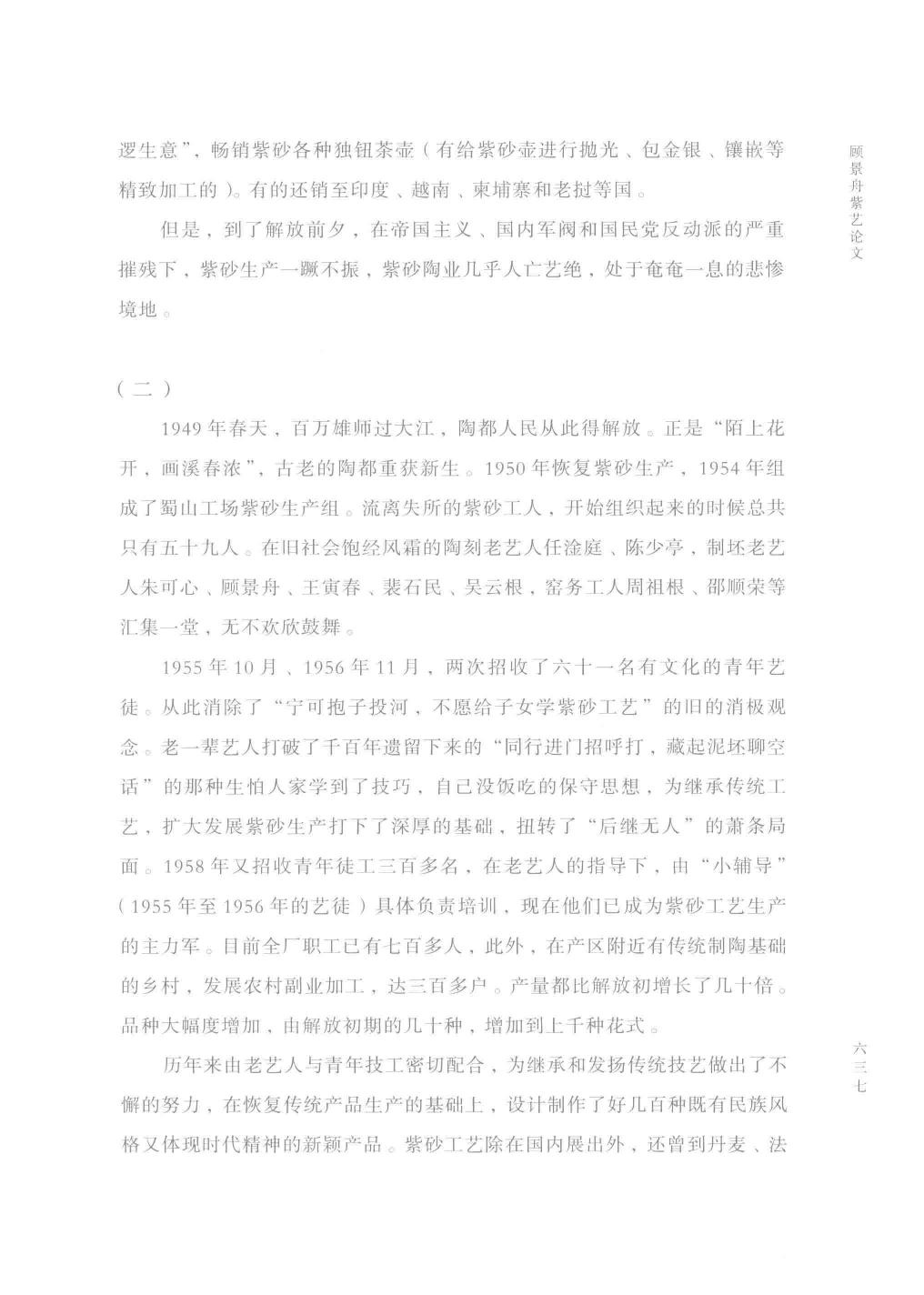
bestselling purple clay teapots of various unique knob styles (including those with refined processing such as polishing, gold and silver inlay, and久和甬 decoration). Some were even exported to India, Vietnam, Cambodia, and Laos.
However, by the eve of Liberation, under the severe devastation of imperialism, domestic warlords, and the Kuomintang reactionaries, purple clay production remained stagnant. The purple clay pottery industry was nearly extinct, with both craftsmen and their art disappearing, leaving it in a tragic state of barely surviving.
## (II)
In the spring of 1949, a million-strong army crossed the Yangtze River, and the people of the pottery capital were finally liberated. As the saying goes, "flowers bloom along the paths, spring deepens by the painted stream"—the ancient pottery capital was reborn. Purple clay production resumed in 1950, and in 1954, the Shushan Workshop Purple Clay Production Group was formed. When the displaced purple clay workers first organized, there were only fifty-nine people in total. The pottery engraving master craftsmen Ren Ganting and Chen Shaoting, who had weathered many hardships in the old society, along with the molding master craftsmen Zhu Kexin, Gu Jingzhou, Wang Yinchun, Pei Shimin, and Wu Yungen, and the密务 workers Zhou Zugen and Shao Shunqiang, all gathered together, filled with joy and excitement.
In October 1955 and November 1956, sixty-one educated young apprentices were recruited twice. This eliminated the old negative mindset of "rather throw one's child into the river than let them learn purple clay craftsmanship." The older generation of craftsmen broke through the conservative thinking inherited over thousands of years—"when colleagues enter, greet them but hide the clay blanks and chat idly"—that fear of others learning their techniques and leaving them without a livelihood. This laid a solid foundation for inheriting traditional craftsmanship and expanding purple clay production, reversing the bleak situation of "no successors." In 1958, over three hundred more young apprentices were recruited. Under the guidance of the old craftsmen and with specific training responsibility given to the "junior instructors" (apprentices from 1955 to 1956), they have now become the main force in purple clay craft production. Currently, the factory has over seven hundred employees. In addition, in villages near the production area with traditional pottery-making foundations, rural sideline processing has developed to over three hundred households. Output has increased dozens of times compared to the early Liberation period. Varieties have increased dramatically, from dozens of styles in the early Liberation period to over a thousand designs.
Over the years, through close cooperation between old craftsmen and young technicians, unremitting efforts have been made to inherit and develop traditional techniques. Building on the foundation of restoring traditional product production, several hundred novel products have been designed and created that embody both national style and the spirit of the times. In addition to domestic exhibitions, purple clay crafts have also been displayed in Denmark, France
Chapter 10
附录
Appendix
Pages 526-651
View Chapter →
English Translation
bestselling purple clay teapots of various unique knob styles (including those with refined processing such as polishing, gold and silver inlay, and久和甬 decoration). Some were even exported to India, Vietnam, Cambodia, and Laos.
However, by the eve of Liberation, under the severe devastation of imperialism, domestic warlords, and the Kuomintang reactionaries, purple clay production remained stagnant. The purple clay pottery industry was nearly extinct, with both craftsmen and their art disappearing, leaving it in a tragic state of barely surviving.
## (II)
In the spring of 1949, a million-strong army crossed the Yangtze River, and the people of the pottery capital were finally liberated. As the saying goes, "flowers bloom along the paths, spring deepens by the painted stream"—the ancient pottery capital was reborn. Purple clay production resumed in 1950, and in 1954, the Shushan Workshop Purple Clay Production Group was formed. When the displaced purple clay workers first organized, there were only fifty-nine people in total. The pottery engraving master craftsmen Ren Ganting and Chen Shaoting, who had weathered many hardships in the old society, along with the molding master craftsmen Zhu Kexin, Gu Jingzhou, Wang Yinchun, Pei Shimin, and Wu Yungen, and the密务 workers Zhou Zugen and Shao Shunqiang, all gathered together, filled with joy and excitement.
In October 1955 and November 1956, sixty-one educated young apprentices were recruited twice. This eliminated the old negative mindset of "rather throw one's child into the river than let them learn purple clay craftsmanship." The older generation of craftsmen broke through the conservative thinking inherited over thousands of years—"when colleagues enter, greet them but hide the clay blanks and chat idly"—that fear of others learning their techniques and leaving them without a livelihood. This laid a solid foundation for inheriting traditional craftsmanship and expanding purple clay production, reversing the bleak situation of "no successors." In 1958, over three hundred more young apprentices were recruited. Under the guidance of the old craftsmen and with specific training responsibility given to the "junior instructors" (apprentices from 1955 to 1956), they have now become the main force in purple clay craft production. Currently, the factory has over seven hundred employees. In addition, in villages near the production area with traditional pottery-making foundations, rural sideline processing has developed to over three hundred households. Output has increased dozens of times compared to the early Liberation period. Varieties have increased dramatically, from dozens of styles in the early Liberation period to over a thousand designs.
Over the years, through close cooperation between old craftsmen and young technicians, unremitting efforts have been made to inherit and develop traditional techniques. Building on the foundation of restoring traditional product production, several hundred novel products have been designed and created that embody both national style and the spirit of the times. In addition to domestic exhibitions, purple clay crafts have also been displayed in Denmark, France
章节导航 Chapter Navigation
Chapter 1
序文
Pages 6-6
Chapter 2
引言
Pages 28-31
Chapter 3
达变
Pages 32-133
Chapter 3
开宗立派
Pages 46-66
Chapter 3
传道授业
Pages 67-98
Chapter 3
大师淳友
Pages 99-120
Chapter 3
学艺谋生
Pages 121-133
Chapter 4
化神
Pages 134-141
Chapter 5
独妙
Pages 142-405
Chapter 5
匠心独运 不苟丝毫
Pages 142-179
Chapter 5
器利善事 物尽其用
Pages 180-199
Chapter 5
紫泥春华 研精究微
Pages 200-405
Chapter 6
驾简
Pages 406-427
Chapter 6
精雕细刻 文质合一
Pages 406-410
Chapter 6
师法自然 妙趣横生
Pages 411-415
Chapter 6
丝来线去 曲尽其妙
Pages 416-427
Chapter 7
明志
Pages 463-485
Chapter 7
高山仰止 淡泊明志
Pages 463-472
Chapter 7
啜墨看茶 气定神闲
Pages 473-478
Chapter 7
齿少心锐 怡志抒情
Pages 479-485
Chapter 8
存真
Pages 428-462
Chapter 8
规圆矩方 弃伪存真
Pages 428-436
Chapter 8
有物有则 钻尖仰高
Pages 437-462
Chapter 9
心营
Pages 506-525
Chapter 9
坚守传统 艺立潮头
Pages 506-513
Chapter 9
新型师承 桃李满园
Pages 514-525
Chapter 10
附录
Pages 526-651
Chapter 10
顾景舟紫艺论文
Pages 526-535
Chapter 10
技术课备课笔记
Pages 536-543
Chapter 10
顾景舟艺术年表
Pages 544-651
Chapter 11
参考文献
Pages 652-657
Chapter 12
鸣谢
Pages 658-659