Chapter 10
附录
Appendix
643
of 659
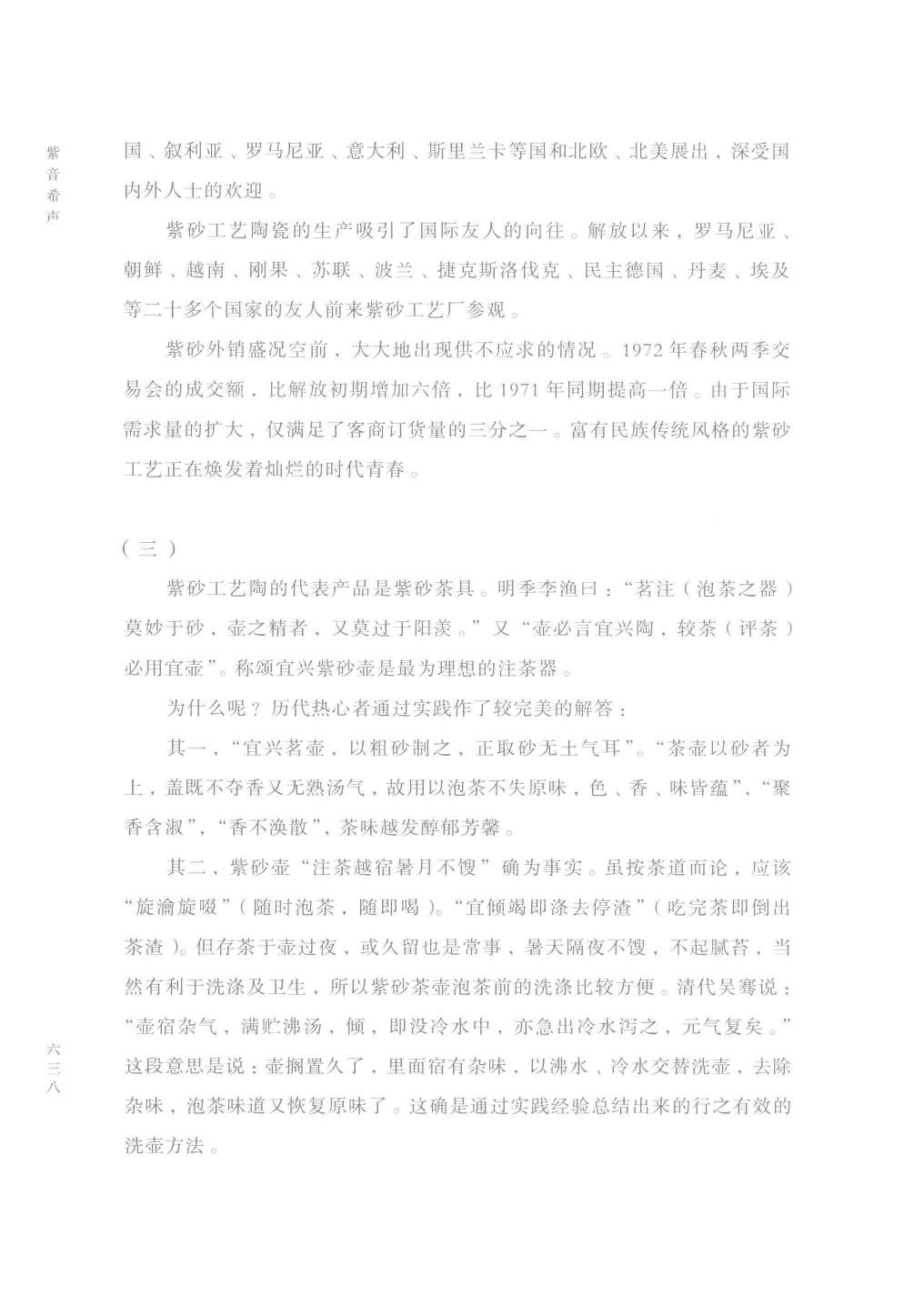
English Translation
Countries including Hungary, Romania, Italy, Sri Lanka, and regions in Northern Europe and North America have exhibited these works, receiving warm welcome from international audiences.
The production of Yixing zisha (purple clay) ceramic art has attracted the interest of international friends. Since Liberation, friends from more than twenty countries including Romania, North Korea, Vietnam, Congo, the Soviet Union, Poland, Czechoslovakia, the German Democratic Republic, Denmark, and Egypt have visited the Yixing zisha ceramic factory.
The export of zisha pottery has reached unprecedented prosperity, with supply far exceeding demand. The transaction volume at the Spring and Autumn Trade Fairs of 1972 increased sixfold compared to the early post-Liberation period, and doubled compared to the same period in 1971. Due to expanding international demand, only one-third of merchants' orders could be fulfilled. The zisha craft, rich in traditional national style, is radiating with brilliant contemporary vitality.
## (III)
The representative product of zisha ceramic art is the zisha tea set. Li Yu of the Ming dynasty said: "For brewing vessels (tea-making implements), nothing is more wonderful than sand [clay], and among fine teapots, none surpass those of Yangxian." He also stated, "When speaking of teapots, one must mention Yixing pottery," and "tea evaluation must use Yixing teapots." This praises the Yixing zisha teapot as the most ideal vessel for brewing tea.
Why is this so? Throughout the ages, enthusiasts have provided rather complete answers through practice:
First, "Yixing teapots are made from coarse sand, precisely because the sand lacks earthiness." "For tea vessels, those made of sand are superior, as they neither rob the fragrance nor impart a cooked water taste. Therefore, when used to brew tea, they preserve the original flavor, with color, fragrance, and taste all intact."
Second, the zisha teapot's ability to "keep tea overnight without spoiling even in summer months" is indeed factual. Although according to tea ceremony principles, one should "brew and drink immediately" (make tea and drink it right away) and "should pour out and rinse clean immediately after finishing" (pour out the tea liquor after drinking). However, leaving tea in the pot overnight or for extended periods is common practice. That it does not spoil or develop a greasy film when left overnight in summer is naturally beneficial for washing and hygiene, making the zisha teapot relatively convenient to clean before brewing tea. Wu Qian of the Qing dynasty said: "When a pot has accumulated stale odors, fill it with boiling water, pour it out, then immediately immerse it in cold water, and quickly remove it to rinse with cold water; its original essence will be restored." This passage means: when a pot has been set aside for a long time and has developed stale flavors inside, by alternately washing the pot with boiling and cold water to remove the stale odors, the tea's flavor will return to its original taste. This is indeed an effective pot-cleaning method summarized through practical experience.
Chapter 10
附录
Appendix
Pages 526-651
View Chapter →
English Translation
Countries including Hungary, Romania, Italy, Sri Lanka, and regions in Northern Europe and North America have exhibited these works, receiving warm welcome from international audiences.
The production of Yixing zisha (purple clay) ceramic art has attracted the interest of international friends. Since Liberation, friends from more than twenty countries including Romania, North Korea, Vietnam, Congo, the Soviet Union, Poland, Czechoslovakia, the German Democratic Republic, Denmark, and Egypt have visited the Yixing zisha ceramic factory.
The export of zisha pottery has reached unprecedented prosperity, with supply far exceeding demand. The transaction volume at the Spring and Autumn Trade Fairs of 1972 increased sixfold compared to the early post-Liberation period, and doubled compared to the same period in 1971. Due to expanding international demand, only one-third of merchants' orders could be fulfilled. The zisha craft, rich in traditional national style, is radiating with brilliant contemporary vitality.
## (III)
The representative product of zisha ceramic art is the zisha tea set. Li Yu of the Ming dynasty said: "For brewing vessels (tea-making implements), nothing is more wonderful than sand [clay], and among fine teapots, none surpass those of Yangxian." He also stated, "When speaking of teapots, one must mention Yixing pottery," and "tea evaluation must use Yixing teapots." This praises the Yixing zisha teapot as the most ideal vessel for brewing tea.
Why is this so? Throughout the ages, enthusiasts have provided rather complete answers through practice:
First, "Yixing teapots are made from coarse sand, precisely because the sand lacks earthiness." "For tea vessels, those made of sand are superior, as they neither rob the fragrance nor impart a cooked water taste. Therefore, when used to brew tea, they preserve the original flavor, with color, fragrance, and taste all intact."
Second, the zisha teapot's ability to "keep tea overnight without spoiling even in summer months" is indeed factual. Although according to tea ceremony principles, one should "brew and drink immediately" (make tea and drink it right away) and "should pour out and rinse clean immediately after finishing" (pour out the tea liquor after drinking). However, leaving tea in the pot overnight or for extended periods is common practice. That it does not spoil or develop a greasy film when left overnight in summer is naturally beneficial for washing and hygiene, making the zisha teapot relatively convenient to clean before brewing tea. Wu Qian of the Qing dynasty said: "When a pot has accumulated stale odors, fill it with boiling water, pour it out, then immediately immerse it in cold water, and quickly remove it to rinse with cold water; its original essence will be restored." This passage means: when a pot has been set aside for a long time and has developed stale flavors inside, by alternately washing the pot with boiling and cold water to remove the stale odors, the tea's flavor will return to its original taste. This is indeed an effective pot-cleaning method summarized through practical experience.
章节导航 Chapter Navigation
Chapter 1
序文
Pages 6-6
Chapter 2
引言
Pages 28-31
Chapter 3
达变
Pages 32-133
Chapter 3
开宗立派
Pages 46-66
Chapter 3
传道授业
Pages 67-98
Chapter 3
大师淳友
Pages 99-120
Chapter 3
学艺谋生
Pages 121-133
Chapter 4
化神
Pages 134-141
Chapter 5
独妙
Pages 142-405
Chapter 5
匠心独运 不苟丝毫
Pages 142-179
Chapter 5
器利善事 物尽其用
Pages 180-199
Chapter 5
紫泥春华 研精究微
Pages 200-405
Chapter 6
驾简
Pages 406-427
Chapter 6
精雕细刻 文质合一
Pages 406-410
Chapter 6
师法自然 妙趣横生
Pages 411-415
Chapter 6
丝来线去 曲尽其妙
Pages 416-427
Chapter 7
明志
Pages 463-485
Chapter 7
高山仰止 淡泊明志
Pages 463-472
Chapter 7
啜墨看茶 气定神闲
Pages 473-478
Chapter 7
齿少心锐 怡志抒情
Pages 479-485
Chapter 8
存真
Pages 428-462
Chapter 8
规圆矩方 弃伪存真
Pages 428-436
Chapter 8
有物有则 钻尖仰高
Pages 437-462
Chapter 9
心营
Pages 506-525
Chapter 9
坚守传统 艺立潮头
Pages 506-513
Chapter 9
新型师承 桃李满园
Pages 514-525
Chapter 10
附录
Pages 526-651
Chapter 10
顾景舟紫艺论文
Pages 526-535
Chapter 10
技术课备课笔记
Pages 536-543
Chapter 10
顾景舟艺术年表
Pages 544-651
Chapter 11
参考文献
Pages 652-657
Chapter 12
鸣谢
Pages 658-659