Chapter 10
附录
Appendix
644
of 659
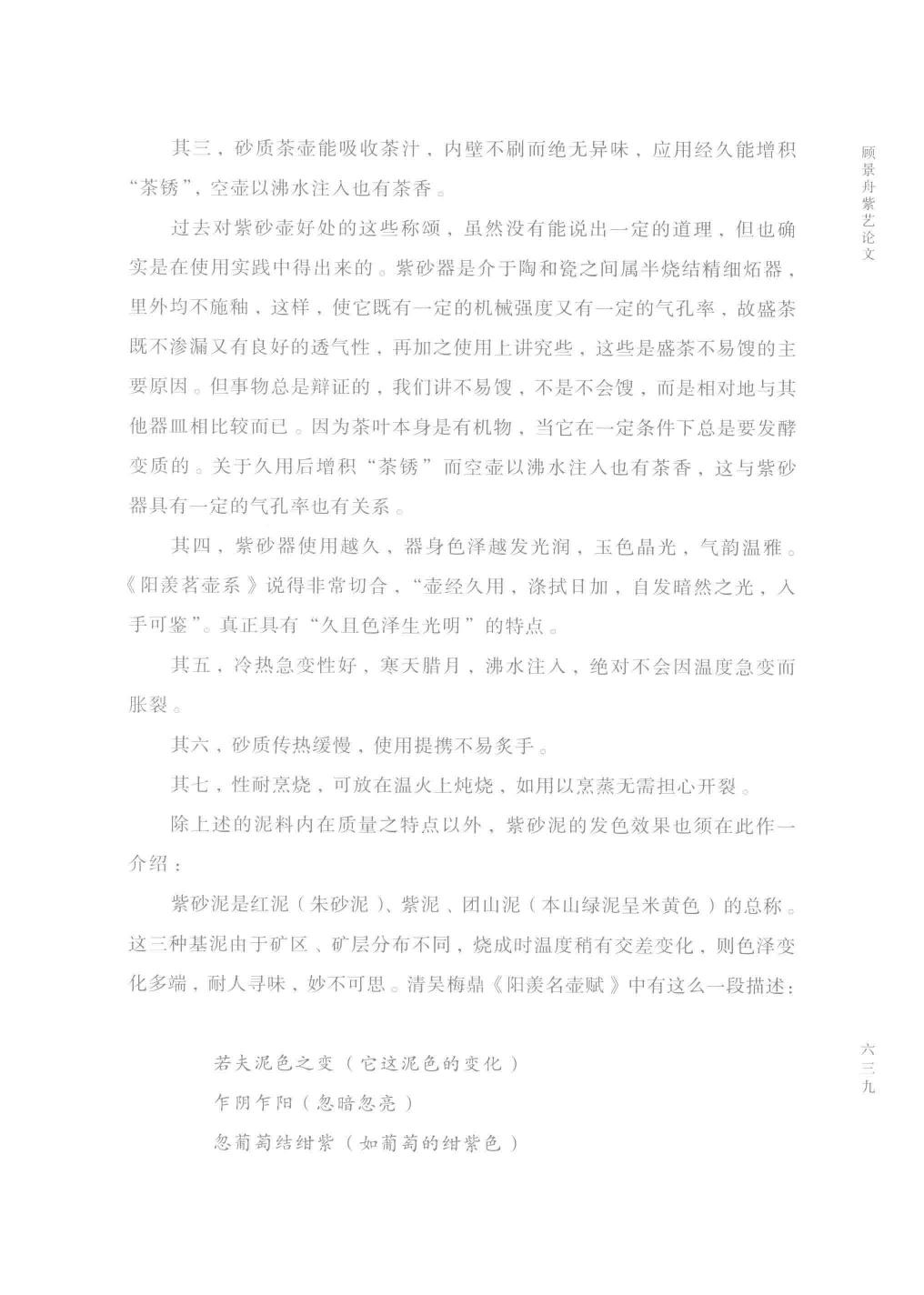
English Translation
Clay teapots can absorb tea essence. The inner walls need not be scrubbed yet remain free of any odor. With prolonged use, they accumulate deposits, and when boiling water is poured into an empty pot, it still carries the fragrance of tea.
In the past, these claims about the benefits of purple clay teapots, though unable to explain the definite principles, were indeed derived from practical use. Purple clay ware falls between pottery and porcelain, belonging to semi-vitrified fine stoneware. Neither the interior nor exterior is glazed. This gives it both a certain mechanical strength and a certain porosity. Therefore, when holding tea, it neither leaks nor lacks good breathability. Combined with careful use, these are the main reasons why tea stored in it does not easily spoil. But things are always dialectical—when we say it does not easily spoil, we do not mean it will never spoil, but rather that it is relatively better compared to other vessels. Because tea leaves themselves are organic matter, under certain conditions they will inevitably ferment and deteriorate. Regarding the accumulation of "tea stains" after use, such that an empty pot poured with boiling water still carries tea fragrance—this is also related to the purple clay's certain porosity.
Fourth, the longer a purple clay vessel is used, the more lustrous its surface becomes—jade-like crystalline brilliance, with a warm and elegant aura. *Yangxian Ming Hu Xi* describes this most aptly: "After long use and repeated cleaning, it naturally develops a subdued luster that can reflect one's image." It truly possesses the characteristic of "with age, its color produces luminous brightness."
Fifth, it has good resistance to thermal shock. In the depths of winter's coldest month, when boiling water is poured in, it absolutely will not crack due to sudden temperature change.
Sixth, the clay transmits heat slowly, so when handling it, one's hands are not easily burned.
Seventh, it is resistant to prolonged heating and can be placed over a gentle fire for simmering. When used for brewing, there is no need to worry about cracking.
Beyond the above characteristics of the clay's intrinsic quality, the color development effects of purple clay must also be mentioned here.
Purple clay is the collective term for red clay (cinnabar clay), purple clay, and Tuanshan clay (Benshan green clay, which appears rice-yellow). These three base clays, due to differences in mining areas and ore layer distribution, and slight variations in firing temperature, produce endlessly changing colors that are intriguing and wonderfully ineffable. In Wu Meiding's *Yangxian Ming Hu Fu* from the Qing dynasty, there is this passage describing:
> As for the transformations of clay color
> Now dark, now bright
> Sometimes grape-like deep purple
Chapter 10
附录
Appendix
Pages 526-651
View Chapter →
English Translation
Clay teapots can absorb tea essence. The inner walls need not be scrubbed yet remain free of any odor. With prolonged use, they accumulate deposits, and when boiling water is poured into an empty pot, it still carries the fragrance of tea.
In the past, these claims about the benefits of purple clay teapots, though unable to explain the definite principles, were indeed derived from practical use. Purple clay ware falls between pottery and porcelain, belonging to semi-vitrified fine stoneware. Neither the interior nor exterior is glazed. This gives it both a certain mechanical strength and a certain porosity. Therefore, when holding tea, it neither leaks nor lacks good breathability. Combined with careful use, these are the main reasons why tea stored in it does not easily spoil. But things are always dialectical—when we say it does not easily spoil, we do not mean it will never spoil, but rather that it is relatively better compared to other vessels. Because tea leaves themselves are organic matter, under certain conditions they will inevitably ferment and deteriorate. Regarding the accumulation of "tea stains" after use, such that an empty pot poured with boiling water still carries tea fragrance—this is also related to the purple clay's certain porosity.
Fourth, the longer a purple clay vessel is used, the more lustrous its surface becomes—jade-like crystalline brilliance, with a warm and elegant aura. *Yangxian Ming Hu Xi* describes this most aptly: "After long use and repeated cleaning, it naturally develops a subdued luster that can reflect one's image." It truly possesses the characteristic of "with age, its color produces luminous brightness."
Fifth, it has good resistance to thermal shock. In the depths of winter's coldest month, when boiling water is poured in, it absolutely will not crack due to sudden temperature change.
Sixth, the clay transmits heat slowly, so when handling it, one's hands are not easily burned.
Seventh, it is resistant to prolonged heating and can be placed over a gentle fire for simmering. When used for brewing, there is no need to worry about cracking.
Beyond the above characteristics of the clay's intrinsic quality, the color development effects of purple clay must also be mentioned here.
Purple clay is the collective term for red clay (cinnabar clay), purple clay, and Tuanshan clay (Benshan green clay, which appears rice-yellow). These three base clays, due to differences in mining areas and ore layer distribution, and slight variations in firing temperature, produce endlessly changing colors that are intriguing and wonderfully ineffable. In Wu Meiding's *Yangxian Ming Hu Fu* from the Qing dynasty, there is this passage describing:
> As for the transformations of clay color
> Now dark, now bright
> Sometimes grape-like deep purple
章节导航 Chapter Navigation
Chapter 1
序文
Pages 6-6
Chapter 2
引言
Pages 28-31
Chapter 3
达变
Pages 32-133
Chapter 3
开宗立派
Pages 46-66
Chapter 3
传道授业
Pages 67-98
Chapter 3
大师淳友
Pages 99-120
Chapter 3
学艺谋生
Pages 121-133
Chapter 4
化神
Pages 134-141
Chapter 5
独妙
Pages 142-405
Chapter 5
匠心独运 不苟丝毫
Pages 142-179
Chapter 5
器利善事 物尽其用
Pages 180-199
Chapter 5
紫泥春华 研精究微
Pages 200-405
Chapter 6
驾简
Pages 406-427
Chapter 6
精雕细刻 文质合一
Pages 406-410
Chapter 6
师法自然 妙趣横生
Pages 411-415
Chapter 6
丝来线去 曲尽其妙
Pages 416-427
Chapter 7
明志
Pages 463-485
Chapter 7
高山仰止 淡泊明志
Pages 463-472
Chapter 7
啜墨看茶 气定神闲
Pages 473-478
Chapter 7
齿少心锐 怡志抒情
Pages 479-485
Chapter 8
存真
Pages 428-462
Chapter 8
规圆矩方 弃伪存真
Pages 428-436
Chapter 8
有物有则 钻尖仰高
Pages 437-462
Chapter 9
心营
Pages 506-525
Chapter 9
坚守传统 艺立潮头
Pages 506-513
Chapter 9
新型师承 桃李满园
Pages 514-525
Chapter 10
附录
Pages 526-651
Chapter 10
顾景舟紫艺论文
Pages 526-535
Chapter 10
技术课备课笔记
Pages 536-543
Chapter 10
顾景舟艺术年表
Pages 544-651
Chapter 11
参考文献
Pages 652-657
Chapter 12
鸣谢
Pages 658-659