Chapter 10
附录
Appendix
645
of 659
English Translation
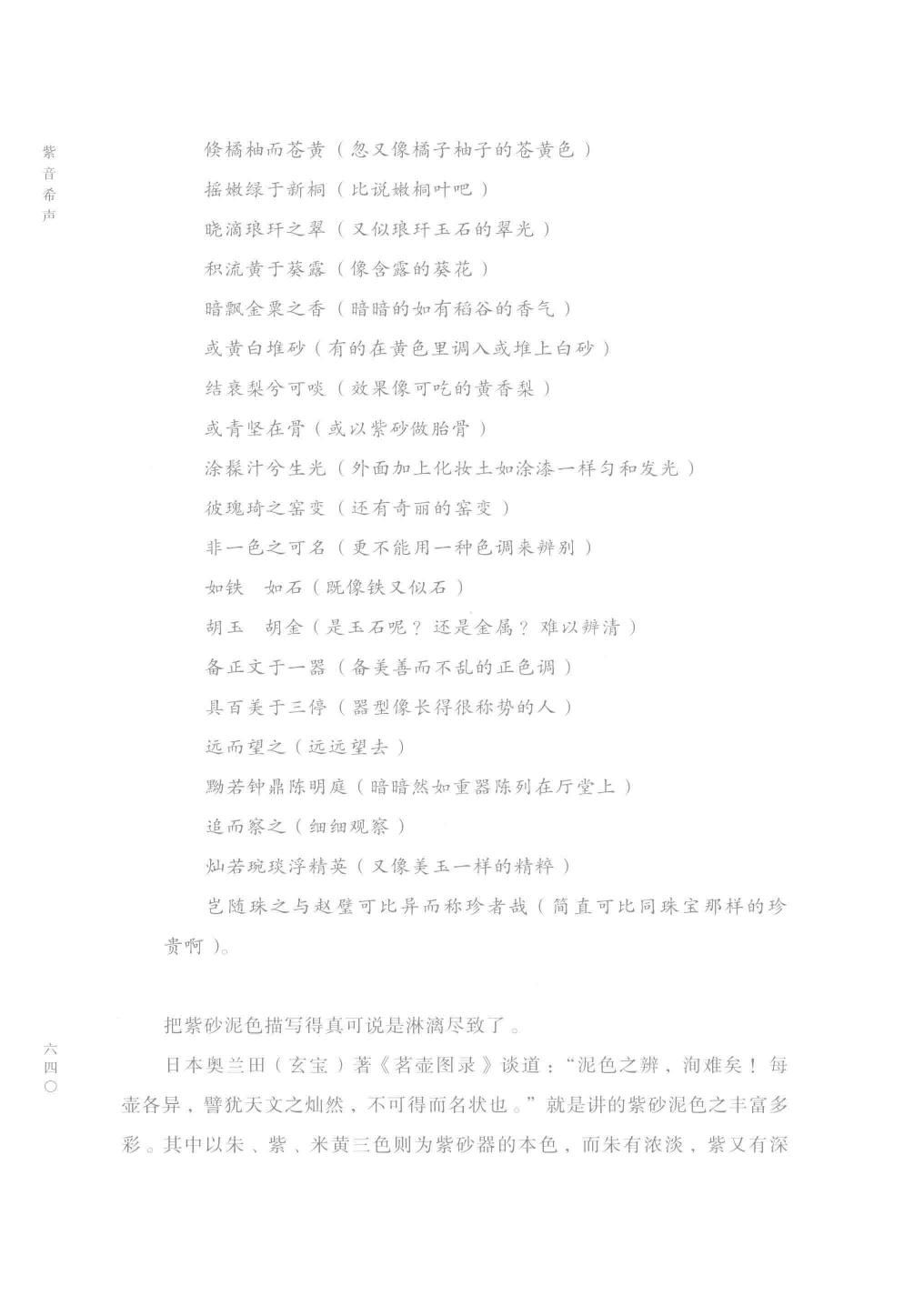
> Like the pale yellow of oranges and pomelos (suddenly resembling the pale yellow of barrel-shaped citrons)
> Swaying tender green upon fresh paulownia (comparable to young paulownia leaves)
> Morning dew dripping with the luster of jade (also like the emerald gleam of jade stone)
> Accumulating flowing yellow in the yellow dew (like dew-laden blossoms)
> The dark fragrance of golden chestnuts (subtly carrying the scent of grain and millet)
> Some with yellow and white piled sand (some blending or layering white sand into the yellow)
> Resembling ripe pears, delightfully edible (the effect like delicious fragrant yellow pears)
> Or with firmness deep in the bone (or using purple clay as the body)
> Coated with slip that generates luster (the exterior covered with slip, smooth and lustrous as lacquer)
> Those marvelous transformations in the firing (there are also wondrous kiln changes)
> Cannot be named by a single color (even more impossible to distinguish with one color tone)
> Like iron, like stone (resembling iron yet似 stone)
> Is it jade? Is it metal? (Is it jade? Or is it metal? Difficult to discern)
> Embodying proper refinement in a single vessel (possessing beautiful and harmonious proper color tones)
> Having complete beauty in three sections (the vessel form like a well-proportioned person)
> Viewing from afar (gazing from a distance)
> Magnificent as bronze vessels displayed in a bright hall (gleaming like important ritual vessels arranged in the reception hall)
> Examining closely (observing carefully)
> Brilliant as jade with floating essence (also like the refined purity of beautiful jade)
> How can the Pearl of Sui or the Jade of Zhao compare to such treasured distinction? (truly comparable to jewels and treasures in their preciousness!)
The description of purple clay colors can truly be said to be exhaustively vivid.
The Japanese scholar Okura Tada (Genpō) wrote in his *Teapot Catalogue*: "Distinguishing clay colors is extremely difficult! Each pot differs, brilliant as the stars in the heavens, impossible to name and describe." This speaks to the rich and varied colors of purple clay. Among them, vermilion, purple, and rice yellow are the fundamental colors of purple clay wares, while vermilion has gradations of light and dark, and purple has variations of deep and...
Chapter 10
附录
Appendix
Pages 526-651
View Chapter →
English Translation
> Like the pale yellow of oranges and pomelos (suddenly resembling the pale yellow of barrel-shaped citrons)
> Swaying tender green upon fresh paulownia (comparable to young paulownia leaves)
> Morning dew dripping with the luster of jade (also like the emerald gleam of jade stone)
> Accumulating flowing yellow in the yellow dew (like dew-laden blossoms)
> The dark fragrance of golden chestnuts (subtly carrying the scent of grain and millet)
> Some with yellow and white piled sand (some blending or layering white sand into the yellow)
> Resembling ripe pears, delightfully edible (the effect like delicious fragrant yellow pears)
> Or with firmness deep in the bone (or using purple clay as the body)
> Coated with slip that generates luster (the exterior covered with slip, smooth and lustrous as lacquer)
> Those marvelous transformations in the firing (there are also wondrous kiln changes)
> Cannot be named by a single color (even more impossible to distinguish with one color tone)
> Like iron, like stone (resembling iron yet似 stone)
> Is it jade? Is it metal? (Is it jade? Or is it metal? Difficult to discern)
> Embodying proper refinement in a single vessel (possessing beautiful and harmonious proper color tones)
> Having complete beauty in three sections (the vessel form like a well-proportioned person)
> Viewing from afar (gazing from a distance)
> Magnificent as bronze vessels displayed in a bright hall (gleaming like important ritual vessels arranged in the reception hall)
> Examining closely (observing carefully)
> Brilliant as jade with floating essence (also like the refined purity of beautiful jade)
> How can the Pearl of Sui or the Jade of Zhao compare to such treasured distinction? (truly comparable to jewels and treasures in their preciousness!)
The description of purple clay colors can truly be said to be exhaustively vivid.
The Japanese scholar Okura Tada (Genpō) wrote in his *Teapot Catalogue*: "Distinguishing clay colors is extremely difficult! Each pot differs, brilliant as the stars in the heavens, impossible to name and describe." This speaks to the rich and varied colors of purple clay. Among them, vermilion, purple, and rice yellow are the fundamental colors of purple clay wares, while vermilion has gradations of light and dark, and purple has variations of deep and...
章节导航 Chapter Navigation
Chapter 1
序文
Pages 6-6
Chapter 2
引言
Pages 28-31
Chapter 3
达变
Pages 32-133
Chapter 3
开宗立派
Pages 46-66
Chapter 3
传道授业
Pages 67-98
Chapter 3
大师淳友
Pages 99-120
Chapter 3
学艺谋生
Pages 121-133
Chapter 4
化神
Pages 134-141
Chapter 5
独妙
Pages 142-405
Chapter 5
匠心独运 不苟丝毫
Pages 142-179
Chapter 5
器利善事 物尽其用
Pages 180-199
Chapter 5
紫泥春华 研精究微
Pages 200-405
Chapter 6
驾简
Pages 406-427
Chapter 6
精雕细刻 文质合一
Pages 406-410
Chapter 6
师法自然 妙趣横生
Pages 411-415
Chapter 6
丝来线去 曲尽其妙
Pages 416-427
Chapter 7
明志
Pages 463-485
Chapter 7
高山仰止 淡泊明志
Pages 463-472
Chapter 7
啜墨看茶 气定神闲
Pages 473-478
Chapter 7
齿少心锐 怡志抒情
Pages 479-485
Chapter 8
存真
Pages 428-462
Chapter 8
规圆矩方 弃伪存真
Pages 428-436
Chapter 8
有物有则 钻尖仰高
Pages 437-462
Chapter 9
心营
Pages 506-525
Chapter 9
坚守传统 艺立潮头
Pages 506-513
Chapter 9
新型师承 桃李满园
Pages 514-525
Chapter 10
附录
Pages 526-651
Chapter 10
顾景舟紫艺论文
Pages 526-535
Chapter 10
技术课备课笔记
Pages 536-543
Chapter 10
顾景舟艺术年表
Pages 544-651
Chapter 11
参考文献
Pages 652-657
Chapter 12
鸣谢
Pages 658-659