Chapter 10
附录
Appendix
646
of 659
English Translation
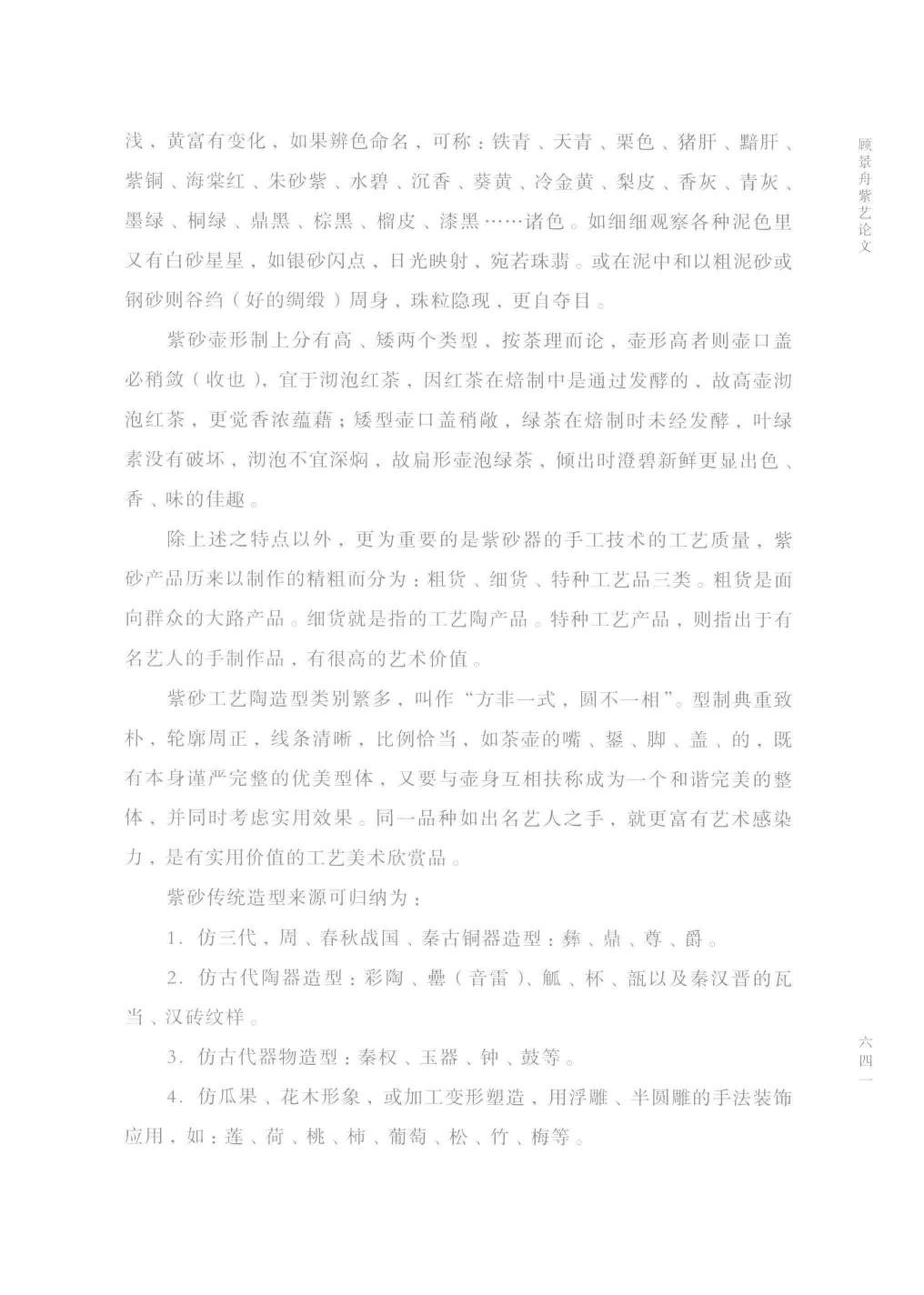
The shallow yellow hues are rich in variation. If we were to distinguish and name them by color, they could be called: iron blue, sky blue, chestnut, pig liver, dark liver, purple copper, crabapple red, cinnabar purple, water blue, agarwood, sunflower yellow, cold golden yellow, pear skin, incense ash, blue-gray, ink green, paulownia green, dark black, brown-black, cotton skin, lacquer black... and many other colors. Upon closer observation of these various clay colors, one can also see fine sandy particles, like silver sand dotted within. When reflected in sunlight, they appear like scattered pearls—or when coarse clay sand or steel sand is mixed into the clay, a fine texture (like good silk) covers the entire surface, with granular particles appearing and disappearing, making it even more striking.
In terms of form, purple clay teapots are divided into two types: tall and short. According to tea principles, tall-form pots have slightly constricted mouths and lids (meaning gathered inward), making them suitable for brewing black tea. Since black tea undergoes fermentation during processing, brewing black tea in a tall pot brings out a richer and more concentrated fragrance. Short-form pots have slightly open mouths and lids. Green tea is not fermented during processing, so the chlorophyll remains intact. Brewing should not be too deep or prolonged, therefore brewing green tea in a short-form pot produces a fresh, clear infusion that better displays the excellent qualities of color, aroma, and taste.
Beyond the characteristics mentioned above, what is even more important is the handcraft technique and workmanship quality of purple clay ware. Purple clay products have traditionally been classified into three categories based on the refinement of their craftsmanship: coarse ware, fine ware, and special craft pieces. Coarse ware refers to mass-market products aimed at the general public. Fine ware refers to craft ceramic products. Special craft products refer to pieces handmade by renowned artisans, possessing very high artistic value.
Purple clay craft ceramics encompass numerous types of forms, described as "no two squares are alike, no two rounds are the same." The forms are dignified and simple, with proper contours, clear lines, and appropriate proportions. For example, a teapot's spout, handle, foot, lid, and knob each possess their own complete and beautiful form, while also complementing the pot body to create a harmonious and perfect whole, with practical functionality considered simultaneously. When the same variety comes from the hand of a renowned artisan, it possesses even greater artistic appeal—it is a craft art appreciation piece with practical value.
The sources of traditional purple clay forms can be summarized as follows:
1. Imitating bronze vessel forms from the Three Dynasties, Zhou, Spring and Autumn, Warring States, and Qin periods: ding, zun, yi, and lei vessels.
2. Imitating ancient ceramic forms: painted pottery, lei (pronounced "lei"), vases, cups, bowls, as well as roof tiles, Han brick patterns from the Qin, Han, and Jin dynasties.
3. Imitating ancient object forms: Qin weights, jade objects, bells, drums, etc.
4. Imitating or transforming the shapes of melons, fruits, and flowers, decorated using relief and semi-round carving techniques, such as: lotus, sunflower, peach, persimmon, grape, pine, bamboo, plum, etc.
Chapter 10
附录
Appendix
Pages 526-651
View Chapter →
English Translation
The shallow yellow hues are rich in variation. If we were to distinguish and name them by color, they could be called: iron blue, sky blue, chestnut, pig liver, dark liver, purple copper, crabapple red, cinnabar purple, water blue, agarwood, sunflower yellow, cold golden yellow, pear skin, incense ash, blue-gray, ink green, paulownia green, dark black, brown-black, cotton skin, lacquer black... and many other colors. Upon closer observation of these various clay colors, one can also see fine sandy particles, like silver sand dotted within. When reflected in sunlight, they appear like scattered pearls—or when coarse clay sand or steel sand is mixed into the clay, a fine texture (like good silk) covers the entire surface, with granular particles appearing and disappearing, making it even more striking.
In terms of form, purple clay teapots are divided into two types: tall and short. According to tea principles, tall-form pots have slightly constricted mouths and lids (meaning gathered inward), making them suitable for brewing black tea. Since black tea undergoes fermentation during processing, brewing black tea in a tall pot brings out a richer and more concentrated fragrance. Short-form pots have slightly open mouths and lids. Green tea is not fermented during processing, so the chlorophyll remains intact. Brewing should not be too deep or prolonged, therefore brewing green tea in a short-form pot produces a fresh, clear infusion that better displays the excellent qualities of color, aroma, and taste.
Beyond the characteristics mentioned above, what is even more important is the handcraft technique and workmanship quality of purple clay ware. Purple clay products have traditionally been classified into three categories based on the refinement of their craftsmanship: coarse ware, fine ware, and special craft pieces. Coarse ware refers to mass-market products aimed at the general public. Fine ware refers to craft ceramic products. Special craft products refer to pieces handmade by renowned artisans, possessing very high artistic value.
Purple clay craft ceramics encompass numerous types of forms, described as "no two squares are alike, no two rounds are the same." The forms are dignified and simple, with proper contours, clear lines, and appropriate proportions. For example, a teapot's spout, handle, foot, lid, and knob each possess their own complete and beautiful form, while also complementing the pot body to create a harmonious and perfect whole, with practical functionality considered simultaneously. When the same variety comes from the hand of a renowned artisan, it possesses even greater artistic appeal—it is a craft art appreciation piece with practical value.
The sources of traditional purple clay forms can be summarized as follows:
1. Imitating bronze vessel forms from the Three Dynasties, Zhou, Spring and Autumn, Warring States, and Qin periods: ding, zun, yi, and lei vessels.
2. Imitating ancient ceramic forms: painted pottery, lei (pronounced "lei"), vases, cups, bowls, as well as roof tiles, Han brick patterns from the Qin, Han, and Jin dynasties.
3. Imitating ancient object forms: Qin weights, jade objects, bells, drums, etc.
4. Imitating or transforming the shapes of melons, fruits, and flowers, decorated using relief and semi-round carving techniques, such as: lotus, sunflower, peach, persimmon, grape, pine, bamboo, plum, etc.
章节导航 Chapter Navigation
Chapter 1
序文
Pages 6-6
Chapter 2
引言
Pages 28-31
Chapter 3
达变
Pages 32-133
Chapter 3
开宗立派
Pages 46-66
Chapter 3
传道授业
Pages 67-98
Chapter 3
大师淳友
Pages 99-120
Chapter 3
学艺谋生
Pages 121-133
Chapter 4
化神
Pages 134-141
Chapter 5
独妙
Pages 142-405
Chapter 5
匠心独运 不苟丝毫
Pages 142-179
Chapter 5
器利善事 物尽其用
Pages 180-199
Chapter 5
紫泥春华 研精究微
Pages 200-405
Chapter 6
驾简
Pages 406-427
Chapter 6
精雕细刻 文质合一
Pages 406-410
Chapter 6
师法自然 妙趣横生
Pages 411-415
Chapter 6
丝来线去 曲尽其妙
Pages 416-427
Chapter 7
明志
Pages 463-485
Chapter 7
高山仰止 淡泊明志
Pages 463-472
Chapter 7
啜墨看茶 气定神闲
Pages 473-478
Chapter 7
齿少心锐 怡志抒情
Pages 479-485
Chapter 8
存真
Pages 428-462
Chapter 8
规圆矩方 弃伪存真
Pages 428-436
Chapter 8
有物有则 钻尖仰高
Pages 437-462
Chapter 9
心营
Pages 506-525
Chapter 9
坚守传统 艺立潮头
Pages 506-513
Chapter 9
新型师承 桃李满园
Pages 514-525
Chapter 10
附录
Pages 526-651
Chapter 10
顾景舟紫艺论文
Pages 526-535
Chapter 10
技术课备课笔记
Pages 536-543
Chapter 10
顾景舟艺术年表
Pages 544-651
Chapter 11
参考文献
Pages 652-657
Chapter 12
鸣谢
Pages 658-659