Chapter 10
附录
Appendix
647
of 659
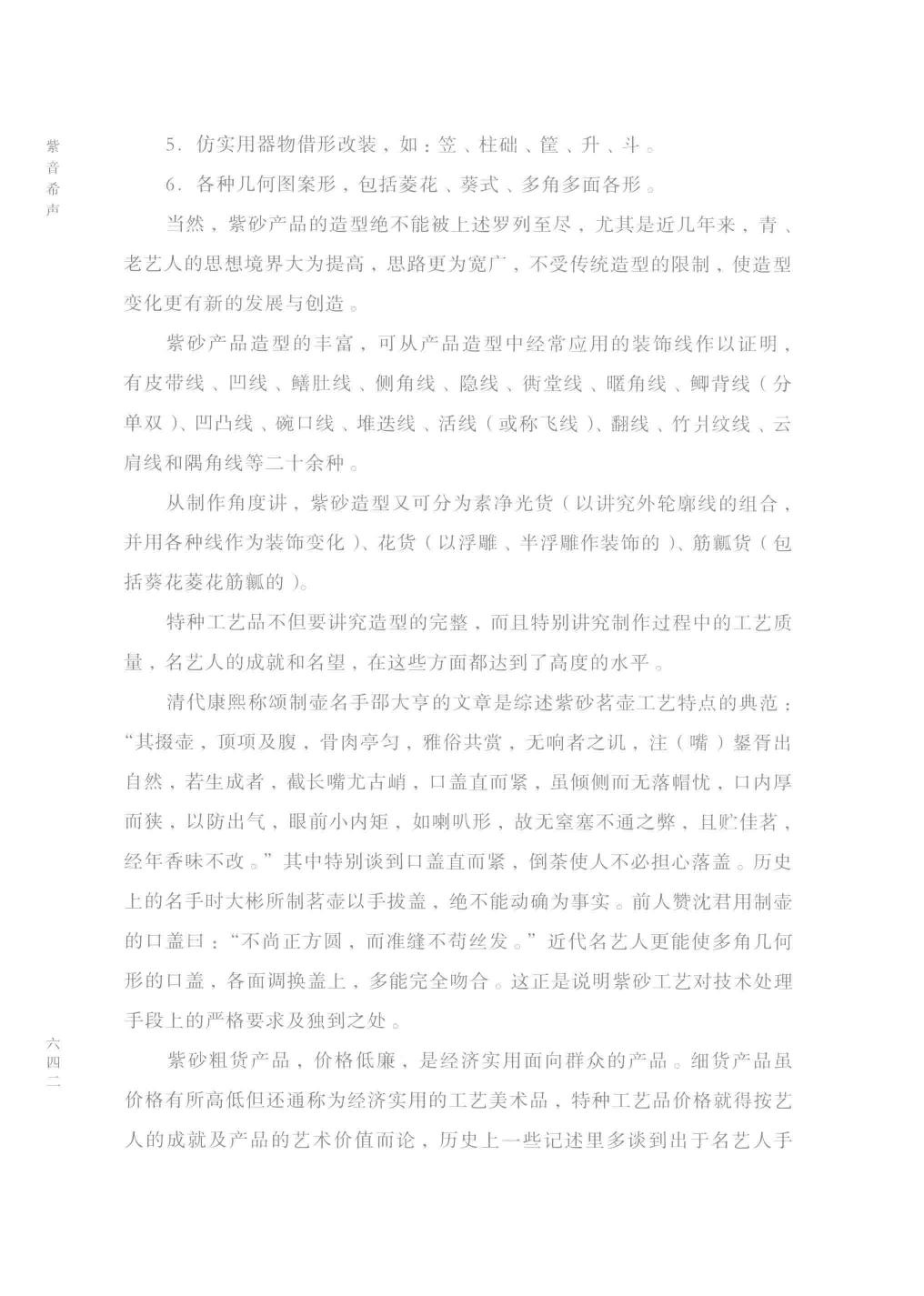
English Translation
5. Imitations and adaptations of practical utensils, such as: drums, column bases, tubes, sheng (measuring units), and dou (measuring vessels).
6. Various geometric patterns, including chrysanthemum flowers, sunflower styles, and multi-angled, multi-faceted forms.
Of course, the forms of Yixing pottery products can by no means be exhaustively enumerated above. Especially in recent years, the ideological realm of young and old artisans has greatly improved, their thinking has become broader, and they are no longer constrained by traditional forms, allowing for new developments and innovations in form variations.
The richness of Yixing pottery forms can be demonstrated by the decorative lines frequently applied in product design. These include belt lines, four lines, eel-belly lines, side-angle lines, hidden lines, street-hall lines, staring-angle lines, crucian carp lines (divided into single and double), concave-convex lines, large-mouth lines, piled-harmony lines, living lines (also called flying lines), turning lines, bamboo-pattern lines, cloud-shoulder lines, and corner lines—more than twenty varieties in total.
From a manufacturing perspective, Yixing pottery forms can be divided into plain smooth ware (emphasizing the combination of external contour lines and using various lines as decorative variations), flower ware (decorated with relief and semi-relief), and ribbed ware (including sunflower and chrysanthemum ribbed patterns).
These craft products not only emphasize the integrity of form but also pay particular attention to the quality of craftsmanship during the manufacturing process. The achievements and reputation of master artisans have reached the highest levels in these aspects.
The Qing Dynasty's Kang Si's article praising the famous teapot maker Shao Dapeng is a model for comprehensively describing the craft characteristics of Yixing teapots: "Its handle, lid, and body have well-proportioned structure, appreciated by both refined and common tastes, without the vulgarity of inferior work. The spout and handle emerge naturally, as if born that way. The cut of the long spout is especially steep. The mouth and lid fit straight and tight—even when tilted sideways, there is no worry of the lid falling off. The mouth interior is thick and narrow to prevent air escape. The spout opening is small inside and square, shaped like a trumpet, thus avoiding the problem of blockage. Moreover, when storing fine tea, the fragrance and flavor remain unchanged even after years." The text particularly mentions that the mouth and lid fit straight and tight, so when pouring tea, one need not worry about the lid falling. It is indeed a fact that teapots made by the historical master Shi Dabin could not be moved even when the lid was pulled by hand. The predecessor Shen Junong described the mouth and lid of teapot making thus: "Not merely pursuing perfect squares and circles, but achieving precision without the slightest deviation." Modern master artisans can make multi-angled geometric lids that, when rotated and placed on different sides, fit perfectly in all positions. This precisely demonstrates the strict requirements and unique features of Yixing pottery craftsmanship in technical handling.
Yixing coarse ware products are inexpensive and are economical, practical products oriented toward the masses. Fine ware products, though varying in price, are still generally called economical and practical craft art pieces. The price of special craft products must be determined according to the artisan's achievements and the artistic value of the product. Many historical records discuss pieces from the hands of famous artisans...
Chapter 10
附录
Appendix
Pages 526-651
View Chapter →
English Translation
5. Imitations and adaptations of practical utensils, such as: drums, column bases, tubes, sheng (measuring units), and dou (measuring vessels).
6. Various geometric patterns, including chrysanthemum flowers, sunflower styles, and multi-angled, multi-faceted forms.
Of course, the forms of Yixing pottery products can by no means be exhaustively enumerated above. Especially in recent years, the ideological realm of young and old artisans has greatly improved, their thinking has become broader, and they are no longer constrained by traditional forms, allowing for new developments and innovations in form variations.
The richness of Yixing pottery forms can be demonstrated by the decorative lines frequently applied in product design. These include belt lines, four lines, eel-belly lines, side-angle lines, hidden lines, street-hall lines, staring-angle lines, crucian carp lines (divided into single and double), concave-convex lines, large-mouth lines, piled-harmony lines, living lines (also called flying lines), turning lines, bamboo-pattern lines, cloud-shoulder lines, and corner lines—more than twenty varieties in total.
From a manufacturing perspective, Yixing pottery forms can be divided into plain smooth ware (emphasizing the combination of external contour lines and using various lines as decorative variations), flower ware (decorated with relief and semi-relief), and ribbed ware (including sunflower and chrysanthemum ribbed patterns).
These craft products not only emphasize the integrity of form but also pay particular attention to the quality of craftsmanship during the manufacturing process. The achievements and reputation of master artisans have reached the highest levels in these aspects.
The Qing Dynasty's Kang Si's article praising the famous teapot maker Shao Dapeng is a model for comprehensively describing the craft characteristics of Yixing teapots: "Its handle, lid, and body have well-proportioned structure, appreciated by both refined and common tastes, without the vulgarity of inferior work. The spout and handle emerge naturally, as if born that way. The cut of the long spout is especially steep. The mouth and lid fit straight and tight—even when tilted sideways, there is no worry of the lid falling off. The mouth interior is thick and narrow to prevent air escape. The spout opening is small inside and square, shaped like a trumpet, thus avoiding the problem of blockage. Moreover, when storing fine tea, the fragrance and flavor remain unchanged even after years." The text particularly mentions that the mouth and lid fit straight and tight, so when pouring tea, one need not worry about the lid falling. It is indeed a fact that teapots made by the historical master Shi Dabin could not be moved even when the lid was pulled by hand. The predecessor Shen Junong described the mouth and lid of teapot making thus: "Not merely pursuing perfect squares and circles, but achieving precision without the slightest deviation." Modern master artisans can make multi-angled geometric lids that, when rotated and placed on different sides, fit perfectly in all positions. This precisely demonstrates the strict requirements and unique features of Yixing pottery craftsmanship in technical handling.
Yixing coarse ware products are inexpensive and are economical, practical products oriented toward the masses. Fine ware products, though varying in price, are still generally called economical and practical craft art pieces. The price of special craft products must be determined according to the artisan's achievements and the artistic value of the product. Many historical records discuss pieces from the hands of famous artisans...
章节导航 Chapter Navigation
Chapter 1
序文
Pages 6-6
Chapter 2
引言
Pages 28-31
Chapter 3
达变
Pages 32-133
Chapter 3
开宗立派
Pages 46-66
Chapter 3
传道授业
Pages 67-98
Chapter 3
大师淳友
Pages 99-120
Chapter 3
学艺谋生
Pages 121-133
Chapter 4
化神
Pages 134-141
Chapter 5
独妙
Pages 142-405
Chapter 5
匠心独运 不苟丝毫
Pages 142-179
Chapter 5
器利善事 物尽其用
Pages 180-199
Chapter 5
紫泥春华 研精究微
Pages 200-405
Chapter 6
驾简
Pages 406-427
Chapter 6
精雕细刻 文质合一
Pages 406-410
Chapter 6
师法自然 妙趣横生
Pages 411-415
Chapter 6
丝来线去 曲尽其妙
Pages 416-427
Chapter 7
明志
Pages 463-485
Chapter 7
高山仰止 淡泊明志
Pages 463-472
Chapter 7
啜墨看茶 气定神闲
Pages 473-478
Chapter 7
齿少心锐 怡志抒情
Pages 479-485
Chapter 8
存真
Pages 428-462
Chapter 8
规圆矩方 弃伪存真
Pages 428-436
Chapter 8
有物有则 钻尖仰高
Pages 437-462
Chapter 9
心营
Pages 506-525
Chapter 9
坚守传统 艺立潮头
Pages 506-513
Chapter 9
新型师承 桃李满园
Pages 514-525
Chapter 10
附录
Pages 526-651
Chapter 10
顾景舟紫艺论文
Pages 526-535
Chapter 10
技术课备课笔记
Pages 536-543
Chapter 10
顾景舟艺术年表
Pages 544-651
Chapter 11
参考文献
Pages 652-657
Chapter 12
鸣谢
Pages 658-659