Chapter 10
附录
Appendix
648
of 659
English Translation
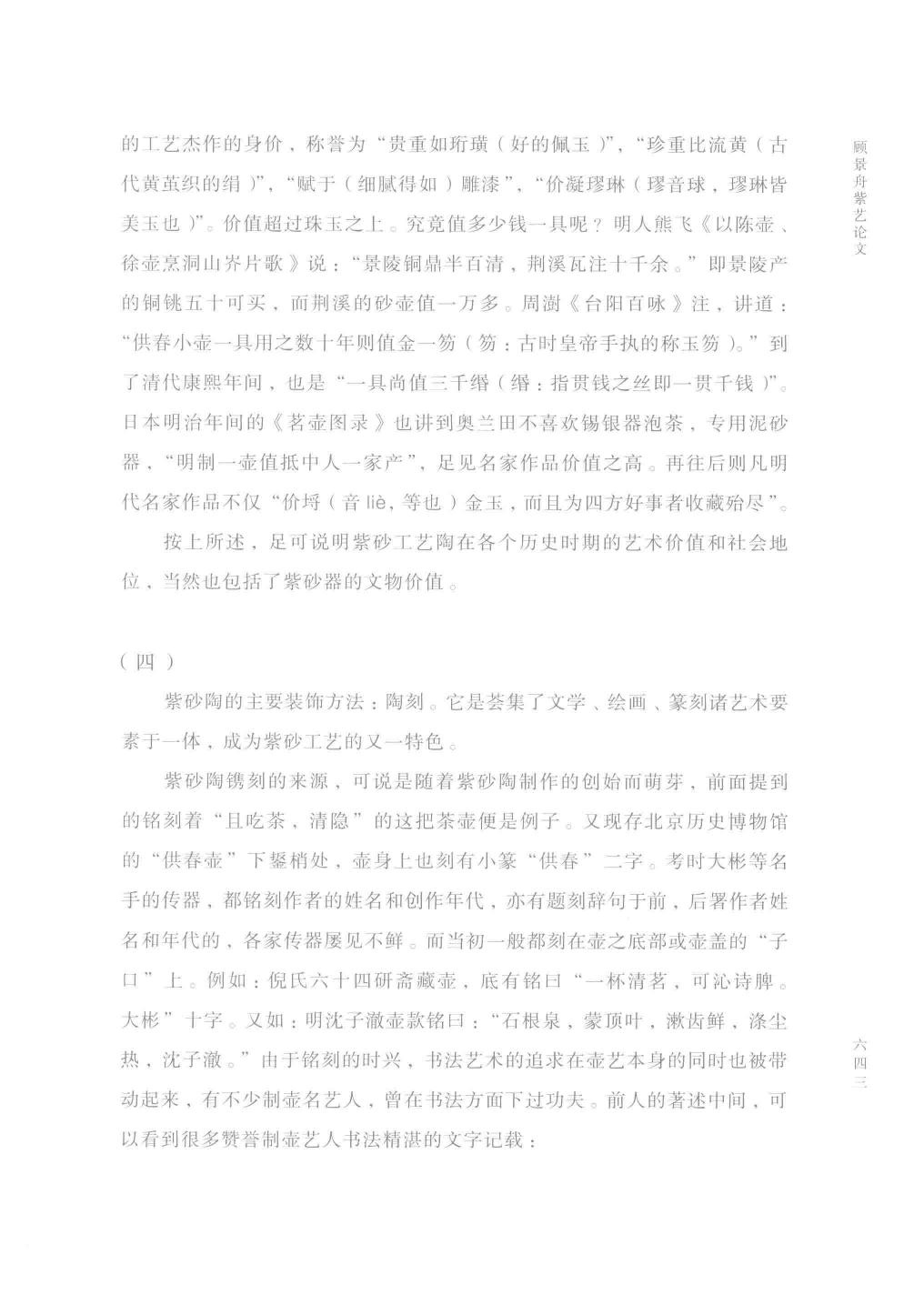
The value of these craft masterpieces was described as "precious as fine jade (good ornamental jade)," "treasured more than flowing yellow (ancient silk woven from yellow cocoons)," "endowed with (delicate as) Zhou Qian," and "worth more than precious lin (beautiful jade, where li and lin both refer to fine jade)" — their value exceeded that of pearls and jade. But exactly how much money was one piece worth? The Ming dynasty scholar Neng Fei wrote in *Burying Chen Hu and Xu Hu with Cave Mountain Fragments*: "Jingling copper vessels can be bought for fifty qing, while Jingxi earthenware teapots are worth more than ten thousand." This means that copper vessels produced in Jingling could be purchased for fifty, while Yixing clay teapots were valued at over ten thousand. Zhou Ji's annotations to *One Hundred Chants of Taiyang* state: "A small Gong Chun teapot, after being used for several decades, becomes worth one jin of gold (jin: the jade scepter held by ancient emperors)." By the Kangxi period of the Qing dynasty, "one piece was still worth three thousand guan (guan: refers to strings of cash, meaning one thousand coins)." Japan's Meiji-era *Teapot Catalog* also mentions that Okakura Tenshin disliked using tin or silver vessels for brewing tea, exclusively using clay teapots.
> "A Ming dynasty teapot is worth the entire property of a middle-class family"
This demonstrates the high value of famous artisans' works. In later periods, not only were Ming dynasty pieces and works by renowned masters "worth as much as gold and jade," but they were also "collected and exhausted by enthusiasts from all directions."
Based on the above, we can fully explain the artistic value and social status of Yixing zisha craft pottery throughout various historical periods, which naturally includes the cultural relic value of zisha wares.
## (IV)
The primary decorative method of zisha pottery is engraving. It integrates the artistic elements of literature, painting, and seal carving into one body, becoming another distinctive feature of zisha craftsmanship.
The origin of zisha pottery engraving can be said to have sprouted alongside the inception of zisha pottery production. The teapot mentioned earlier, inscribed with "且吃茶,清隱" (Just drink tea, Qingyin), is an example. Another example is the "Gong Chun teapot" currently housed in the Beijing History Museum — on the body of the teapot, beneath the handle, the two characters "供春" (Gong Chun) are also carved in small seal script. Examining the surviving works of master craftsmen like Shi Dabin and others, all bear inscriptions of the maker's name and date of creation. Some have inscribed poems or phrases on the front, followed by the maker's name and date on the back — such inherited works from various masters are commonly seen. Initially, these inscriptions were generally carved on the bottom of the teapot or on the "zi kou" (inner rim) of the lid. For example, the Ni family's Sixty-Four Inkstone Studio collection has an inscription on the bottom reading: "一杯清茶,可沁詩腺。大彬" (A cup of clear tea can moisten the poetic glands. Dabin) — ten characters in total. Another example is the inscription on a teapot by Ming dynasty craftsman Shen Ziche: "石根泉,蒙頂葉,滌齒鮮,涤塵熱,沈子澈" (Stone root spring, Mengding leaves, cleanse teeth fresh, wash away worldly heat, Shen Ziche). Due to the popularity of inscriptions, the pursuit of calligraphic art was stimulated alongside the teapot craft itself. Many renowned teapot artisans devoted considerable effort to calligraphy. In writings by predecessors, one can find numerous textual records praising the exquisite calligraphy of teapot craftsmen.
Chapter 10
附录
Appendix
Pages 526-651
View Chapter →
English Translation
The value of these craft masterpieces was described as "precious as fine jade (good ornamental jade)," "treasured more than flowing yellow (ancient silk woven from yellow cocoons)," "endowed with (delicate as) Zhou Qian," and "worth more than precious lin (beautiful jade, where li and lin both refer to fine jade)" — their value exceeded that of pearls and jade. But exactly how much money was one piece worth? The Ming dynasty scholar Neng Fei wrote in *Burying Chen Hu and Xu Hu with Cave Mountain Fragments*: "Jingling copper vessels can be bought for fifty qing, while Jingxi earthenware teapots are worth more than ten thousand." This means that copper vessels produced in Jingling could be purchased for fifty, while Yixing clay teapots were valued at over ten thousand. Zhou Ji's annotations to *One Hundred Chants of Taiyang* state: "A small Gong Chun teapot, after being used for several decades, becomes worth one jin of gold (jin: the jade scepter held by ancient emperors)." By the Kangxi period of the Qing dynasty, "one piece was still worth three thousand guan (guan: refers to strings of cash, meaning one thousand coins)." Japan's Meiji-era *Teapot Catalog* also mentions that Okakura Tenshin disliked using tin or silver vessels for brewing tea, exclusively using clay teapots.
> "A Ming dynasty teapot is worth the entire property of a middle-class family"
This demonstrates the high value of famous artisans' works. In later periods, not only were Ming dynasty pieces and works by renowned masters "worth as much as gold and jade," but they were also "collected and exhausted by enthusiasts from all directions."
Based on the above, we can fully explain the artistic value and social status of Yixing zisha craft pottery throughout various historical periods, which naturally includes the cultural relic value of zisha wares.
## (IV)
The primary decorative method of zisha pottery is engraving. It integrates the artistic elements of literature, painting, and seal carving into one body, becoming another distinctive feature of zisha craftsmanship.
The origin of zisha pottery engraving can be said to have sprouted alongside the inception of zisha pottery production. The teapot mentioned earlier, inscribed with "且吃茶,清隱" (Just drink tea, Qingyin), is an example. Another example is the "Gong Chun teapot" currently housed in the Beijing History Museum — on the body of the teapot, beneath the handle, the two characters "供春" (Gong Chun) are also carved in small seal script. Examining the surviving works of master craftsmen like Shi Dabin and others, all bear inscriptions of the maker's name and date of creation. Some have inscribed poems or phrases on the front, followed by the maker's name and date on the back — such inherited works from various masters are commonly seen. Initially, these inscriptions were generally carved on the bottom of the teapot or on the "zi kou" (inner rim) of the lid. For example, the Ni family's Sixty-Four Inkstone Studio collection has an inscription on the bottom reading: "一杯清茶,可沁詩腺。大彬" (A cup of clear tea can moisten the poetic glands. Dabin) — ten characters in total. Another example is the inscription on a teapot by Ming dynasty craftsman Shen Ziche: "石根泉,蒙頂葉,滌齒鮮,涤塵熱,沈子澈" (Stone root spring, Mengding leaves, cleanse teeth fresh, wash away worldly heat, Shen Ziche). Due to the popularity of inscriptions, the pursuit of calligraphic art was stimulated alongside the teapot craft itself. Many renowned teapot artisans devoted considerable effort to calligraphy. In writings by predecessors, one can find numerous textual records praising the exquisite calligraphy of teapot craftsmen.
章节导航 Chapter Navigation
Chapter 1
序文
Pages 6-6
Chapter 2
引言
Pages 28-31
Chapter 3
达变
Pages 32-133
Chapter 3
开宗立派
Pages 46-66
Chapter 3
传道授业
Pages 67-98
Chapter 3
大师淳友
Pages 99-120
Chapter 3
学艺谋生
Pages 121-133
Chapter 4
化神
Pages 134-141
Chapter 5
独妙
Pages 142-405
Chapter 5
匠心独运 不苟丝毫
Pages 142-179
Chapter 5
器利善事 物尽其用
Pages 180-199
Chapter 5
紫泥春华 研精究微
Pages 200-405
Chapter 6
驾简
Pages 406-427
Chapter 6
精雕细刻 文质合一
Pages 406-410
Chapter 6
师法自然 妙趣横生
Pages 411-415
Chapter 6
丝来线去 曲尽其妙
Pages 416-427
Chapter 7
明志
Pages 463-485
Chapter 7
高山仰止 淡泊明志
Pages 463-472
Chapter 7
啜墨看茶 气定神闲
Pages 473-478
Chapter 7
齿少心锐 怡志抒情
Pages 479-485
Chapter 8
存真
Pages 428-462
Chapter 8
规圆矩方 弃伪存真
Pages 428-436
Chapter 8
有物有则 钻尖仰高
Pages 437-462
Chapter 9
心营
Pages 506-525
Chapter 9
坚守传统 艺立潮头
Pages 506-513
Chapter 9
新型师承 桃李满园
Pages 514-525
Chapter 10
附录
Pages 526-651
Chapter 10
顾景舟紫艺论文
Pages 526-535
Chapter 10
技术课备课笔记
Pages 536-543
Chapter 10
顾景舟艺术年表
Pages 544-651
Chapter 11
参考文献
Pages 652-657
Chapter 12
鸣谢
Pages 658-659